
Ptyctodontida
The ptyctodontids ("folded-teeth") are placoderms of the orderPtyctodontida, containing the familyPtyctodontidae. With their big heads, big eyes, reduced armor and long bodies, the ptyctodontids bore a superficial resemblance to modern day chimaeras (Holocephali). Their armor was reduced to a pattern of small plates around the head and neck. Like the extinct and related acanthothoracids, and the living and unrelated holocephalians, most of the ptyctodontids are thought to have lived near the sea bottom and preyed on shellfish.
On account of their radically reduced armor, some paleontologists have suggested that the Ptyctodontida were not actually placoderms, but actual holocephalians, some primitive group of elasmobranch fish, or even were the ancestors of the holocephalians, including the chimaeras. Thorough anatomical examinations of whole fossil specimens reveal that the profound similarities between these two groups are actually very superficial. The major differences between them were that holocephalians have shagreen on their skin and ptyctodontids did not, that the armored plates and scales of holocephalians are made of dentine, and the armored plates and scales of ptyctodontids were made of bone, the anatomy of the craniums of holocephalians is more similar to sharks, and that of ptyctodontids were more similar to those of other placoderms, and, most importantly, the holocephalians have true teeth, while the ptyctodonts had beak-like tooth-plates.
The Ptyctodontida were the only known group of placoderms that were recognizably sexually dimorphic, in that the males had hook-like growths on their pelvic fins that were analogous to the clasping organs found in male sharks, and chimaeras. Paleontologists believe that the males of the ancestral placoderm had pelvic claspers, but the claspers were lost in the evolutionary development of each of the placoderm orders, save for the ptyctodontids (there are too few whole specimens of the primitive Stensioella heintzi to tell if the males of that species had claspers or not).
بسبب انخفاض مستوى دروعها، كان يُعتقد سابقًا أن البتيكتودونتيدات هي أكثر أنواع البلاكوديرمات بدائية. بل كان هناك اعتقاد سائد بأن البلاكوديرمات تتدرج في مستوى الدروع، من الأقل دروعًا والأكثر بدائية، إلى الأكثر تطورًا والأكثر دروعًا. خلال ثمانينيات وتسعينيات القرن الماضي، قورنت جماجم البتيكتودونتات بجماجم من رتب أخرى. وبناءً على هذه التحليلات، تم دحض فكرة التدرج في مستوى الدروع بين البلاكوديرمات. والآن، تُعتبر البتيكتودونتات المجموعة الشقيقة للأرثروديرا والفيلوليبيدا .
الأجناس
تُعرف الأجناس التالية في عائلة Ptyctodontidae: [ 2 ] [ 1 ] [ 3 ]
- جنس Austroptyctodus طويل، 1997
- جنس Borysthenoplax Plax، 2019 [ 4 ]
- جنس كامبيلودوس مايلز ويونغ، 1977
- جنس Chelyophorus Agassiz, 1844b [= Cheliophorus Stensiö, 1969b ] [ 1 ]
- جنس Ctenurella Ørvig، 1960
- جنس دينيسونودوس جونسون وإليوت، 1996
- جنس ديسموبوريلا أورفيغ، 1971
- جنس Eczematolepis S. A. Miller، 1892a [= Acantholepis Newberry، 1875a ؛ = Phlyctaenacanthus Eastman، 1898b ] [ 1 ]
- جنس غونيستيوس غروس، 1933د
- جنس Kimbryanodus Trinajstic & Long، 2009 [ 2 ]
- جنس ماتيربيسيس لونغ، ترينايستيك، يونغ وسيندين، 2008
- جنس Meeksiella Trinajstic، Long، Ivanov & Mark-Kurik، 2019 [ 5 ]
- جنس Palaeomylus Woodward، 1891a
- جنس Ptyctodopsis Denison، 1985
- جنس Ptyctodus Pander، 1858a [= Aulacosteus Eichwald، 1846c ؛ = رينودوس نيوبيري وورثين، 1866 أ ؛ = بارابتيكتودوس كارتر، 1942 ] [ 1 ]
- جنس رامفودوبسيس واتسون، 1934أ
- جنس Rhynchodus Newberry، 1873 [= Ramphodus Jaekel، 1903g ؛ = Rhamphodus Jaekel، 1906d ؛ = Rhamphodontus Jaekel، 1906 ؛ = Rhynchodontus Jaekel، 1919a ؛ = Rhynchosteus Jaekel، 1925d ؛ = Rhynchognathus Jaekel، 1929b ؛ = Ringinia Whitley، 1950 ] [ 1 ]
- جنس تولودوس مارك-كوريك، 1977 [ 6 ]
الجدول الزمني للأجناس
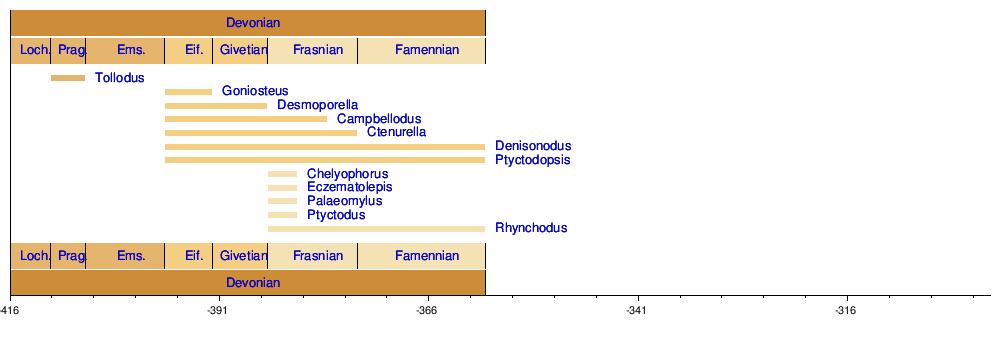
معرض
 شوكة زعنفة من نوع ptyctodont، Gamphacanthus ، تظهر أنماط الألوان؛ من العصر الديفوني الأوسط في ولاية ويسكونسن.
 صفائح أسنان من نوع بتيكتودوس فيروكس ، من العصر الديفوني الأوسط في ولاية ويسكونسن. لاحظ أسطح الطحن.
 صفيحة سنية تشبه المنقار لحيوان من نوع بتيكتودونت من العصر الديفوني الأوسط في ولاية ويسكونسن.
مراجع
- 1 2 3 4 5 6 دينيسون، روبرت (1978). دليل علم الحفريات القديمة، المجلد 2، Placodermi . نيويورك: دار غوستاف فيشر. ص 26 – 34. ISBN 9780895740274.
- 1 2 تريناستيك، كيت؛ لونغ، جون أ. (سبتمبر 2009). "جنس ونوع جديدان من البتيكتودونت (بلاكوديرمي) من تكوين غنيودنا الديفوني المتأخر، غرب أستراليا، وتحليل لتطور البتيكتودونت" . المجلة الجيولوجية . 146 (5): 743-760 . doi : 10.1017/S001675680900644X . ISSN 1469-5081 .
- ↑ سيبكوسكي الابن، جيه جيه (2002). "موسوعة أجناس الحيوانات البحرية الأحفورية" . نشرات علم الحفريات الأمريكي . 363 : 300 - عبر مكتبة التراث البيولوجي.
- ^ بلاكس، د. (2019). "جنس جديد من أسماك البلاكوديرم (PLACODERMI، PTYCTODONTIDA) من رواسب إمسيان العليا في بيلاروسيا" . المشروع الوحدوي الجمهوري "مركز الإنتاج الجيولوجي العالي" . 2 (51): 75– 83. ISSN 1680-2373 .
- ↑ ترينايستيك، كيت؛ لونغ، جون أ.؛ إيفانوف، ألكسندر أ.؛ مارك-كوريك، إلغا (2019). "جنس جديد من البتيكتودونت (بلاكوديرمي) من العصر الديفوني المتأخر في منطقة البلطيق" . مجلة علم الأحياء الإلكترونية . 22 (2). doi : 10.26879/890 . hdl : 1885/222039 .
- ^ دوبريت، فنسنت. فونج، تا هوا؛ ثانه، تونغ دزوي؛ فونج، نجوين دوك؛ جانفييه، فيليب؛ كليمان ، جايل (مايو 2011). "جمجمة Hagiangella goujeti Janvier، 2005، وهي من فصيلة الأكانثوثوراسيد عالية القمة (الفقاريات، Placodermi) من العصر الديفوني السفلي في شمال فيتنام" . مجلة علم الحفريات الفقارية . 31 (3): 531-538 . دوى : 10.1080 / 02724634.2011.558148 . ردمك 0272-4634 .
للمزيد من القراءة
- لونغ، جون أ. (1996): نشأة الأسماك: 500 مليون سنة من التطور . مطبعة جامعة جونز هوبكنز، بالتيمور. ISBN 0-8018-5438-5
- بتيكتودونتيدا
- الظهور الأول للعصر الديفوني المبكر
- حيوانات العصر الديفوني المتأخر
- انقراضات العصر الديفوني المتأخر
- طلبات بلاكوديرم
- رتب الفقاريات أحادية النوع