
مستوى التنعيم
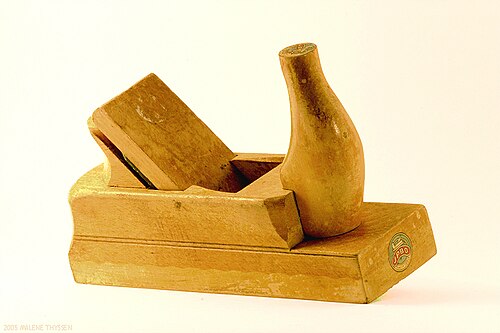
المسحاج أو المسحاج الأملس هو نوع من أنواع المسحاجات المستخدمة في النجارة . عادةً ما يكون المسحاج الأملس هو آخر مسحاج يُستخدم على سطح الخشب ، حيث يزيل رقائق الخشب الدقيقة جدًا ليترك سطحًا أملسًا. عند استخدامه بفعالية ، فإنه يُنتج بسرعة سطحًا نهائيًا يُضاهي أو يفوق السطح الناتج عن ورق الصنفرة . [ 1 ]
الوصف والتاريخ
يُعدّ المسحاج التنعيمي أقصر أنواع المسحاجات المكتبية. [ 2 ] وفقًا لنظام ترقيم ستانلي بيلي للمساحج ذات الهيكل المعدني، تُصنّف المسحاجات من رقم 1 إلى رقم 4 ضمن فئة المسحاجات التنعيمية، بأطوال تتراوح بين 140 مم (5.5 بوصة ) و 250 مم ( 10 بوصات ) . [ 3 ] يُعدّ المسحاج رقم 4، الذي يبلغ طوله 230 مم (9 بوصات ) ، الأكثر شيوعًا في الاستخدام. تاريخيًا، كانت المسحاجات الخشبية التنعيمية في الولايات المتحدة تتراوح أطوالها عادةً بين 180 مم ( 7 بوصات) و230 مم (9 بوصات ) ، بعرض شفرات يتراوح بين 38 مم ( 1.5 بوصة ) و 64 مم ( 2.5 بوصة ) . [ 4 ]
كما هو الحال مع أنواع المسحاج الأخرى، كانت أجسام مسحاج التنعيم حتى نهاية القرن التاسع عشر مصنوعة في الغالب من الخشب، وتحديدًا من خشب الزان ( Fagus sylvatica في أوروبا، وFagus grandifolia في أمريكا الشمالية). [ 4 ] وقد حلت المسحاجات ذات الأجسام الحديدية محل المسحاجات الخشبية إلى حد كبير ، وبدرجة أقل المسحاجات الانتقالية . وعلى الرغم من شيوع المسحاجات الحديدية الأثقل وزنًا، لا تزال المسحاجات الخشبية القديمة شائعة الاستخدام، بينما تتوفر مسحاجات التنعيم الخشبية الجديدة من عدد قليل من المصنّعين. [ 5 ]
نظرًا لصغر حجمها مقارنةً بأنواع المسحاج الأخرى، فإن مسحاج التنعيم أكثر قدرة على العمل على قطع العمل الصغيرة وحول العوائق. [ 4 ] منذ القرن الثامن عشر الميلادي، اتخذت مسحاجات التنعيم الخشبية في الغالب شكل "التابوت" - أعرض في المنتصف ومستدير قليلاً - مما يجعلها أكثر سهولة في المناورة. [ 2 ] [ 4 ] كما يُزعم أن تصميم التابوت يُظهر المزيد من ألياف الخشب النهائية، مما يُمكّن المسحاج من التكيف بشكل أفضل مع تغيرات الرطوبة. [ 6 ] : 139
The irons (blades) on smoothing planes are often slightly rounded at the corners to minimise the risk of gouging out tracks or marks in the workpiece, and on a metal plane the throat or mouth is usually set tight to reduce the risk of tearout.[7][1][4]
In Britain the name smoothing plane dates back to at least the 17th century.[8]
Use
A smoothing plane is typically used after the workpiece has been flattened and trued by the other bench planes, such as the jack, fore, and jointer planes. Smoothing planes can also be used to remove marks left by woodworking machinery.
When used effectively alongside other bench planes, the smoothing plane should only need a handful of passes removing shavings as fine as 0.002 inches (0.051 mm) or less.[1] The workpiece is then ready to be finished, or can be further refined with a card scraper or sandpaper.[6]:61[9]
The smoothing plane is usually held with both hands, and used in a similar manner to the other bench planes.[10]
Though designed for smoothing, a smoothing plane can be used as an 'all-round' bench tool and for rougher work depending on how it is set up.[2]
References
- 123Schwarz, Christopher (2009). Handplane Essentials (1st ed.). Cincinnati, Ohio, USA: F+W Media. pp. 23–24. ISBN 978-1-4403-0298-5. OCLC 326678537.
- 123Salaman, Raphael A. (1975). Dictionary of Tools Used in the Woodworking and Allied Trades, c. 1700-1970. Internet Archive. New York, USA: Scribner. p. 360. ISBN 978-0-684-14535-8.
- ↑"Stanely Bailey Planes Miscellaneous Data". primeshop.com. Retrieved 2020-10-13.
- 12345Sellens, Alvin (1978). Woodworking Planes: A Descriptive Register of Wooden Planes. Internet Archive. Augusta, Kansas, USA: Alvin Sellens. pp. 18–19.
- ↑"Another Great Maker of Wooden Handplanes". Popular Woodworking Magazine. 2015-07-03. Retrieved 2020-10-13.
- 12Schwarz, Christopher (2010). The Anarchist's Tool Chest. Fort Mitchell, Kentucky, USA: Lost Art Press LLC. pp. 61, 139. ISBN 978-0-578-08413-8. OCLC 875304703.
- ↑Pekovich, Michael (2018). The Why & How of Woodworking: A Simple Approach to Making Meaningful Work. Newtown, Connecticut, USA: The Taunton Press. p. 57. ISBN 978-1-64155-051-2. OCLC 1045464261.
- ↑"smoothing, n. (1b smoothing-plane)", OED Online, Oxford University Press, retrieved 2020-10-13
- ↑Wearing, Robert. (1988). The Essential Woodworker: Skills, Tools and Methods (2010 ed.). Fort Mitchell, Kentucky, USA: Lost Art Press LLC. p. 131. ISBN 978-0-578-06044-6. OCLC 711676532.
- ↑Hand Planes Reprint from Handwork In Wood by William Noyes
- Planes