
Spin fishing
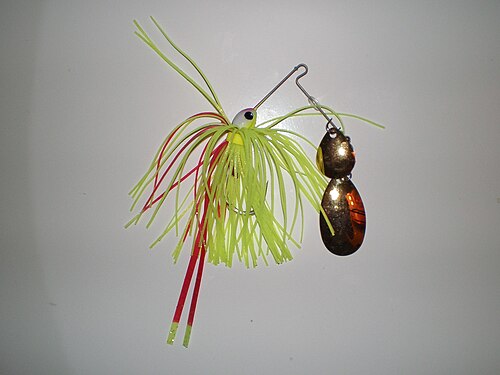
Spin fishing is an angling technique where a spinnerbait, a type of hybrid fishing lure with at least one freely rotating blade, is used to entice the fish to bite. When the line is reeled back, the spinnerbait blades will spin passively with the oncoming water flow, in turn stirring up a significant amount of turbulence and noise, which transmit through the water and provoke predatory fish to strike the lure out of their foraging as well as territorial instincts. Spin fishing is used in both freshwater and marine environments.[1]
Techniques
When fishing in a river the line should be cast upstream. Casting upstream and retrieving with the current results in the spinner/lure sinking faster.[2]
Bottom bouncing
Bottom bouncing is a spin fishing technique where the spinner is cast up river from the shore, and then allowed to bounce on the river bottom until it has moved downstream. The rod tip is held higher in the air than normal and the speed of retrieval is faster. This method is commonly used when float fishing from an inflatable dingy. The spinner is cast directly behind the boat until it settles on the bottom. After the spinner has settled it bounces on the bottom, naturally attracting fish of all species. This technique is commonly used for trout in large wide rivers where an inflatable boat can be used. All types of trout are caught with this method including brown trout, rainbow trout, bull trout, brook trout and cutthroat trout.[3]
Walking the dog
Walking the dog is a spin fishing technique that involves imparting a zigzag motion to a spinner or lure. This action is achieved by creating slack in the line before and after each jerk, allowing for a crisp and natural motion of the lure. The method begins with the rod tip held low over the water, around 1 to 1.5 feet above the surface. The angler can activate the lure either with wrist action or a whole-arm motion that pivots from the shoulder, with alternation between these two methods serving to reduce stress on individual joints.[4]
In this technique, the slack before and after each jerk allows the rod tip to move further than the lure's movement, creating a more natural and unpredictable motion. The angler delivers a non-stop series of rhythmic strokes that jerk the lure by snapping slack line, causing it to zigzag about six inches (15 cm) to alternating sides without pause.
من وجهة نظر السمكة، يبدو الطعم ككائن خائف يقوم بحركات غير ضرورية. هذه الحركة تجعل من الصعب على سمك القاروص وأنواع أخرى رؤية الطعم بوضوح، وهو ما يُعزى إليه جزئيًا نجاح هذه التقنية. يقضي الطعم وقته في التحرك ذهابًا وإيابًا دون تقدم يُذكر للأمام، ومع ذلك يبقى من الصعب التعرف عليه. [ 5 ]
الأنواع المستهدفة
يمكن صيد معظم أنواع الأسماك باستخدام الصيد بالخيط الدوار؛ إلا أن بعضها أكثر استجابةً لهذه التقنية من غيرها. ومن أنواع الأسماك الشائعة في المياه العذبة: سمك السلمون المرقط، وسمك السلمون ، وسمك الفرخ، وسمك الشوب، وسمك الدنيس ، وسمك الكراكي ، وسمك الولاي ، وسمك الكوربر الأزرق ، وسمك القاروص.
أنواع الدوارات
تُعدّ الطعوم الصناعية والدوارة بسيطة وفعّالة، إذ تهدف إلى محاكاة الأسماك المفترسة لصيد سمك الكراكي والزاندر . ويبقى سبب انجذاب هذه الأسماك المفترسة إليها لغزًا، إذ غالبًا ما لا تشبهها على الإطلاق. تُصنّف الطعوم الصناعية والدوارة والملاعق ضمن الفئات الكلاسيكية، بينما يجمع الطعم الدوار بين وظيفتي الطعم الدوار والطعم الصناعي. جميعها فعّالة بنفس القدر، خاصةً في فصلي الصيف والخريف، وتتوفر منها آلاف الأنواع المصنوعة من مواد متنوعة. وتعتمد فعاليتها على وزنها ولونها وحركتها وسرعة سحبها من قِبل الصياد.
ملحوظات
- ↑ "الصيد من أجل الاستدامة: دراسة حالة حول الصيد الترفيهي والسياحة وريادة الأعمال المستدامة" ، من البحث الجامعي إلى الشركات المنبثقة بقيادة الطلاب: حالة Biodata ، دار نشر إدوارد إلجار، 11 أكتوبر 2022، الصفحات 150-162 ، رقم ISBN 978-1-80088-115-0تم الاطلاع عليه بتاريخ 23 يوليو 2026
- ↑ مجلة فيلد آند ستريم . يونيو 2004.
- ↑ صيد الأسماك باستخدام الطعم الدوار
- ↑ كرين، إتش. ريتشارد، محرر. (1991-02-01). "ما الذي يجعل دوارة الصيد تدور؟" . معلم الفيزياء . 29 (2): 87-88 . doi : 10.1119/1.2343226 . ISSN 0031-921X .
- ↑ هواة Balıkçılık Malzemeleri
روابط خارجية
- "يسمونها صيد الأسماك باللف". مجلة Popular Mechanics ، مايو 1953، الصفحات 81-88، مقدمة أساسية عن الأساسيات.
- تقنيات وأساليب الصيد