
التغليف (الشبكات)
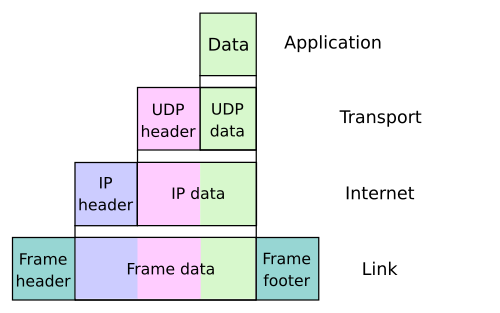
identifyالتغليف هو عملية ربط رؤوس أو تذييلات خاصة بكل طبقة بوحدة بيانات الخدمة (أي الحمولة ) لنقل المعلومات عبر شبكات الحاسوب. [ 2 ] [ 3 ] [ 4 ] أما فك التغليف فهو العملية العكسية لاستقبال المعلومات؛ حيث يتم فيه إزالة رأس أو تذييل مُدمج مسبقًا من وحدة بيانات البروتوكول (PDU) والتي أرسلتها طبقة الاتصالات الأساسية. [ 3 ] [ 5 ] [ 4 ]
يُتيح التغليف وفك التغليف تصميم بروتوكولات اتصال معيارية ، مما يسمح بفصل وظيفة كل طبقة اتصال منطقيًا، وتجريد بنية المعلومات المُتبادلة فوق طبقات الاتصال الأخرى. [ 2 ] [ 4 ] تُعدّ هاتان العمليتان من السمات الشائعة في نماذج شبكات الحاسوب ومجموعات البروتوكولات، كما هو الحال في نموذج OSI ومجموعة بروتوكولات الإنترنت . [ 3 ] مع ذلك، يُمكن أن تُستخدم عمليات التغليف/فك التغليف أيضًا كسمات خبيثة، كما هو الحال في بروتوكولات الأنفاق . [ 6 ]
تتولى الطبقة الفيزيائية مسؤولية النقل المادي للبيانات، بينما يسمح تغليف الروابط بإنشاء شبكات محلية ، ويوفر بروتوكول الإنترنت (IP) عناوين عالمية لأجهزة الكمبيوتر الفردية، ويختار بروتوكول التحكم بالنقل (TCP ) العملية أو التطبيق (أي منفذ TCP أو UDP ) الذي يحدد الخدمة مثل خادم الويب أو خادم TFTP . [ 7 ]
For example, in the IP suite, the contents of a web page are encapsulated with an HTTP header, then by a TCP header, an IP header, and, finally, by a frame header and trailer. The frame is forwarded to the destination node as a stream of bits, where it is decapsulated into the respective PDUs and interpreted at each layer by the receiving node.[8]
The result of encapsulation is that each lower-layer provides a service to the layer or layers above it, while at the same time each layer communicates with its corresponding layer on the receiving node. These are known as adjacent-layer interaction and same-layer interaction, respectively.[8]
In discussions of encapsulation, the more abstract layer is often called the upper-layer protocol while the more specific layer is called the lower-layer protocol. Sometimes, however, the terms upper-layer protocols and lower-layer protocols are used to describe the layers above and below IP.[7]
See also
References
- ↑Forouzan, Behrouz A. (2010). TCP/IP protocol suite (4th ed.). Boston: McGraw-Hill Higher Educations. p. 23. ISBN 978-0073376042.
- 12Eric Conrad; Seth Misenar; Joshua Feldman (2012). "Domain 2: Telecommunications and Network Security". CISSP Study Guide (2nd ed.). Elsevier. pp. 63–142. ISBN 978-1-59749-961-3.
- 123Odom, Wendell (2013). Cisco CCENT/ CCNA ICND1 100-101 Official Cert Guide. Pearson Education. ISBN 978-1-58714-385-4.
- 123Conrad E, Misenar S, Feldman J (2023). CISSP Study Guide (4th ed.). Elsevier. ISBN 978-0443187353.
- ↑Salva-Garcia, Alcaraz-Calero, Wang, Qi, Bernabe, Skarmeta (2018). "5G NB-IoT: efficient network traffic filtering for multitenant IoT cellular networks". Security and Communication Networks. 2018: 1–21. doi:10.1155/2018/9291506.
- ↑Raman, D., Sutter, B. D., Coppens, B., Volckaert, S., Bosschere, K. D., Danhieux, P., & Buggenhout, E. V. (2012, November). DNS tunneling for network penetration. In International Conference on Information Security and Cryptology (pp. 65-77). Springer, Berlin, Heidelberg.
- 1 2 "كيف يعمل التغليف ضمن نموذج TCP/IP" . learn-networking.com . 27-01-2008. مؤرشف من الأصل في 07-08-2012 . تم الاطلاع عليه في 22-11-2013 .
- 1 2 أودوم، ويندل (2013). دليل شهادة سيسكو CCENT/CCNA ICND1 100-101 الرسمي . بيرسون للتعليم. ص. الفصل 1. ISBN 978-1-58714-385-4.
روابط خارجية
- تقنية شبكات الحاسوب
- بروتوكولات الشبكة
- نقل البيانات
- الحزم (تكنولوجيا المعلومات)