
Wake-sleep algorithm
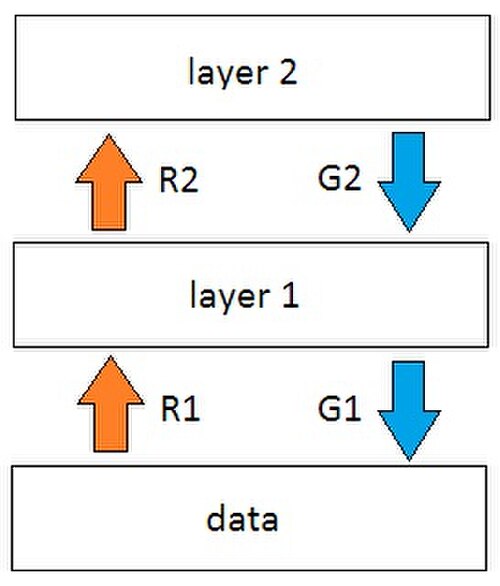
The wake-sleep algorithm[1] is an unsupervised learning algorithm for deep generative models, especially Helmholtz Machines.[2] The algorithm is similar to the expectation-maximization algorithm,[3] and optimizes the model likelihood for observed data.[4] The name of the algorithm derives from its use of two learning phases, the “wake” phase and the “sleep” phase, which are performed alternately.[1] It can be conceived as a model for learning in the brain,[5] but is also being applied for machine learning.[6]
Description
The goal of the wake-sleep algorithm is to find a hierarchical representation of observed data.[7] In a graphical representation of the algorithm, data is applied to the algorithm at the bottom, while higher layers form gradually more abstract representations. Between each pair of layers are two sets of weights: Recognition weights, which define how representations are inferred from data, and generative weights, which define how these representations relate to data.[8]
Training
Training consists of two phases – the “wake” phase and the “sleep” phase. It has been proven that this learning algorithm is convergent.[3]
The "wake" phase
Neurons are fired by recognition connections (from what would be input to what would be output). Generative connections (leading from outputs to inputs) are then modified to increase probability that they would recreate the correct activity in the layer below – closer to actual data from sensory input.[1]
The "sleep" phase
The process is reversed in the “sleep” phase – neurons are fired by generative connections while recognition connections are being modified to increase probability that they would recreate the correct activity in the layer above – further to actual data from sensory input.[1]
Extensions
نظرًا لمحدودية مرونة شبكة التعرف، فقد لا تتمكن من تقريب التوزيع الاحتمالي اللاحق للمتغيرات الكامنة بدقة. [ 6 ] ولتحسين تقريب التوزيع الاحتمالي اللاحق، يمكن استخدام أسلوب أخذ العينات المهمة ، مع اعتبار شبكة التعرف بمثابة التوزيع المقترح. كما يُحسّن هذا التقريب المُحسّن للتوزيع الاحتمالي اللاحق الأداء العام للنموذج. [ 6 ]
انظر أيضاً
- آلة بولتزمان المقيدة ، وهي نوع من الشبكات العصبية التي يتم تدريبها باستخدام خوارزمية مشابهة من الناحية المفاهيمية.
- آلة هيلمهولتز ، نموذج شبكة عصبية تم تدريبه بواسطة خوارزمية اليقظة والنوم.
مراجع
- 1 2 3 4 هينتون، جيفري إي .؛ دايان، بيتر ؛ فراي، بريندان جيه .؛ نيل، رادفورد (26-05-1995). "خوارزمية اليقظة والنوم للشبكات العصبية غير الخاضعة للإشراف". مجلة ساينس . 268 (5214): 1158-1161 . رمز Bibcode : 1995Sci...268.1158H . doi : 10.1126/science.7761831 . PMID 7761831. S2CID 871473 .
- ↑ دايان، بيتر . "آلات هيلمهولتز والتعلم أثناء اليقظة والنوم" (ملف PDF) . تم الاطلاع عليه بتاريخ 1 نوفمبر 2015 .
- 1 2 إيكيدا، شيرو؛ أماري، شون-إيتشي؛ ناكاهارا، هيرويوكي (1998). "تقارب خوارزمية اليقظة والنوم" . التطورات في أنظمة معالجة المعلومات العصبية . 11. مطبعة معهد ماساتشوستس للتكنولوجيا.
- ↑ فراي، بريندان جيه؛ هينتون، جيفري إي؛ دايان، بيتر (1996-05-01). "هل تُنتج خوارزمية اليقظة والنوم مُقدِّرات كثافة جيدة؟" (ملف PDF) . التطورات في أنظمة معالجة المعلومات العصبية.
- ^ كاتاياما، كاتسوكي؛ أندو، ماساتاكا؛ هوريجوتشي ، تسويوشي (2004/04/01). “نماذج مناطق MT و MST باستخدام خوارزمية الاستيقاظ والنوم”. الشبكات العصبية . 17 (3): 339-351 . دوى : 10.1016/j.neunet.2003.07.004 . بميد 15037352 .
- 1 2 3 بورنشاين، يورغ؛ بينجيو، يوشوا (2014-06-10). "إعادة ترجيح دورة اليقظة والنوم". arXiv : 1406.2751 [ cs.LG ].
- ↑ ماي، حامد رضا (25 يناير 2007). "خوارزمية اليقظة والنوم للتعلم التمثيلي" . جامعة مونتريال . تم الاطلاع عليه بتاريخ 1 نوفمبر 2011 .
- ↑ نيل، رادفورد م.؛ دايان، بيتر (24-11-1996). "تحليل العوامل باستخدام قواعد دلتا للتعلم أثناء اليقظة والنوم" (ملف PDF) . جامعة تورنتو . تاريخ الاسترجاع: 1-11-2015 .
- خوارزميات التعلم الآلي