
التنوع الكلي
في مجال الاتصالات اللاسلكية، يُعدّ التنوع الكلي [ 1 ] [ 2 ] نوعًا من أنظمة تنوع الفضاء التي تستخدم عدة هوائيات استقبال أو إرسال لنقل الإشارة نفسها. وتكون المسافة بين أجهزة الإرسال أطول بكثير من الطول الموجي ، على عكس التنوع الجزئي حيث تكون المسافة في حدود الطول الموجي أو أقصر منه.
في الشبكات الخلوية أو الشبكات المحلية اللاسلكية ، يشير التنوع الكلي إلى أن الهوائيات عادةً ما تكون موجودة في مواقع محطات أساسية أو نقاط وصول مختلفة . يُعدّ التنوع الكلي للمستقبلات شكلاً من أشكال دمج الهوائيات ، ويتطلب بنية تحتية تُحوّل الإشارات من الهوائيات أو المستقبلات المحلية إلى مستقبل أو مُفكِّك مركزي. أما التنوع الكلي للمرسلات فقد يكون شكلاً من أشكال البث المتزامن ، حيث تُرسَل الإشارة نفسها من عدة عُقد. إذا أُرسِلت الإشارات عبر القناة الفيزيائية نفسها (مثل تردد القناة وتسلسل الانتشار)، يُقال إن أجهزة الإرسال تُشكِّل شبكة أحادية التردد - وهو مصطلح يُستخدم بشكل خاص في مجال البث.
يهدف هذا النظام إلى مكافحة التلاشي وزيادة قوة وجودة الإشارة المستقبلة في المواقع المكشوفة بين المحطات الأساسية أو نقاط الوصول. كما يُسهّل التنوع الكلي خدمات البث المتعدد الفعّالة ، حيث يمكن استخدام قناة التردد نفسها لجميع أجهزة الإرسال التي تُرسل المعلومات نفسها. وقد يعتمد نظام التنوع على التنوع الكلي لجهاز الإرسال (الوصلة الهابطة) و/أو التنوع الكلي لجهاز الاستقبال (الوصلة الصاعدة).
أمثلة
- عملية تسليم سلسة عبر شبكة CDMA :
- تُعد الشبكات أحادية التردد (SFN) القائمة على تقنية OFDM ومعادلة المجال الترددي (FDE) شكلاً من أشكال تنوع الإرسال الكلي المستخدم في شبكات البث مثل DVB-T و DAB
- شبكات التردد الأحادي الديناميكية (DSFN)، حيث يقوم نظام الجدولة بتكييف تشكيلات شبكة التردد الأحادي ديناميكيًا مع ظروف حركة المرور و/أو ظروف جهاز الاستقبال
- 802.16e عملية تسليم التنوع الكلي (MDHO)
- شبكة 3GPP طويلة المدى (LTE) متعددة البث أحادية التردد (MBSFN)، مما يجعل من الممكن إرسال نفس البيانات بكفاءة إلى العديد من الهواتف المحمولة في الخلايا المجاورة.
- Cooperative diversity, for example 3GPP long term evolution (LTE) coordinated multipoint transmission/reception (CoMP), making it possible to increase the data rate to a mobile situated in the overlap of several base station transmission ranges.
Forms
The baseline form of macrodiversity is called single-user macrodiversity. In this form, single user which may have multiple antennas, communicates with several base stations. Therefore, depending on the spatial degree of freedom (DoF) of the system, user may transmit or receive multiple independent data streams to/from base stations in the same time and frequency resource.
- Single-user macrodiversity
- Uplink macrodiversity
- Downlink macrodiversity
In next more advanced form of macrodiversity, multiple distributed users communicate with multiple distributed base stations in the same time and frequency resource. This form of configuration has been shown to utilize available spatial DoF optimally and thus increasing the cellular system capacity and user capacity considerably.
Mathematical description
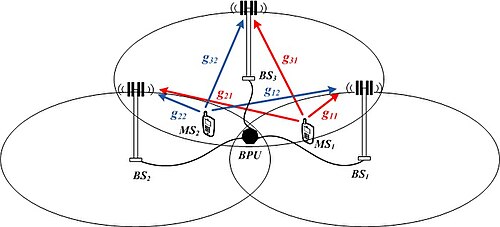
The macrodiversity multi-user MIMO uplink communication system considered here consists of distributed single antenna users and distributed single antenna base stations (BS). Following the well established narrow band flat fading MIMO system model, input-output relationship can be given as


where and are the receive and transmit vectors, respectively, and and are the macrodiversity channel matrix and the spatially uncorrelated AWGN noise vector, respectively. The power spectral density of AWGN noise is assumed to be . The th element of , represents the fading coefficient (see Fading) of the th constituent link which in this particular case, is the link between th user and the th base station. In macrodiversity scenario,


- ,
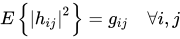
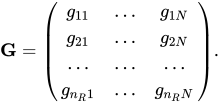
where is called the average link gain giving average link SNR of . The macrodiversity power profile matrix[2] can thus be defined as


The original input-output relationship may be rewritten in terms of the macrodiversity power profile and so-called normalized channel matrix, , as

- .
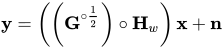
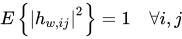
where is the element-wise square root of , and the operator, , represents Hadamard multiplication (see Hadamard product). The th element of , ، يحقق الشرط المحدد بواسطة


- .
لقد ثبت وجود علاقة وظيفية بين المصفوفة الدائمة لملف تعريف قوة التنوع الكلي،وأداء أنظمة التنوع الكلي متعددة المستخدمين في ظروف التلاشي. [ 2 ] على الرغم من أنه يبدو كما لو أن التنوع الكلي يظهر فقط في شكل القدرة، إلا أن الأنظمة التي تعتمد على التنوع الكلي عادة ما يكون لديها أنواع أخرى من قيود قدرة الإرسال (على سبيل المثال، كل عنصر من عناصر(يمتلك قدرة متوسطة محدودة) ومجموعات مختلفة من أجهزة الإرسال/الاستقبال المنسقة عند التواصل مع مستخدمين مختلفين. [ 4 ] تجدر الإشارة إلى أنه يمكن بسهولة توسيع علاقة الإدخال والإخراج المذكورة أعلاه لتشمل الحالة التي يحتوي فيها كل جهاز إرسال و/أو استقبال على هوائيات متعددة.

انظر أيضاً
مراجع
- ↑ D. Gesbert, S. Hanly, H. Huang, S. Shamai, O. Simeone, W. Yu, Multi-cell MIMO cooperative networks: A new look at interference IEEE Journal on Selected Areas in Communications, vol. 28, no. 9, pp. 1380–1408, Dec. 2010.
- 1 2 3 4 5 D. A. Basnayaka, PJ Smith and PA Martin, تحليل أداء أنظمة MIMO ذات التنوع الكلي مع مستقبلات MMSE و ZF في تلاشي رايلي المسطح، معاملات IEEE للاتصالات اللاسلكية، المجلد 12، العدد 5، الصفحات 2240-2251، مايو 2013.
- ↑ MK Karakayali, GJ Foschini, and RA Valenzuela, Network coordinate for spectrally efficient communications in the cellular systems IEEE Wireless Communication Magazine, vol. 13, no. 4, pp. 56–61, Aug. 2006.
- 1 2 E. Björnson و E. Jorswieck، التخصيص الأمثل للموارد في أنظمة الخلايا المتعددة المنسقة ، أسس واتجاهات في الاتصالات ونظرية المعلومات، المجلد 9، العدد 2-3، الصفحات 113-381، 2013.
- الهوائيات
- إدارة موارد الراديو