
Pfund telescope
The Pfund telescope, originated by A.H. Pfund, provides an alternative method for achieving a fixed telescope focal point in space regardless of where the telescope line of sight is pointed.
Pfund's configuration uses a two-axis flat feed mirror that reflects starlight into a fixed paraboloidal mirror, usually with a horizontal optical axis.
The paraboloid focuses through a central hole in the feed flat to a convenient location some distance behind the flat. No spider vanes or Newtonian secondary fold mirrors are required in this configuration. This eliminates vane diffraction and blockage, as well as secondary mirror scattering and absorption, thus improving image brightness and contrast.
Design considerations
The feed flat is mounted on a two-axis azimuth/elevation mount. The azimuth and elevation drive servos must be continuously controlled as objects move across the sky, using vector addition to calculate the mirror motion in real time.
- One vector () is stationary and points from the center of the feed flat to the center of the fixed paraboloid mirror.
- The other vector () points from the center of the feed flat to the object to be tracked, which of course moves across the sky in time.


The surface normal of the feed flat mirror is the 3D bisector of vectors and , normalized to unity length. If are the instantaneous unit vector components of the mirror's surface normal, then the mirror elevation angle , and the mirror azimuth angle is .
![{\displaystyle [N_{k},N_{l},N_{m}]}](https://wikimedia.org/api/rest_v1/media/math/render/svg/0f979033c3fec08d2a90dd66910d01390e58fe93)

![{\displaystyle \arcsin[N_{k}/\cos(\theta _{\mathrm {el} })]}](https://wikimedia.org/api/rest_v1/media/math/render/svg/50a2bf61ecf1f1942acd2d3a134935ad96141ca3)
The field of a Pfund telescope rotates at a nonuniform rate during tracking, precluding it from long-exposure astrophotography, unless a derotation control matrix and optics are used to compensate field rotation.
The hole in the front face of a Pfund tracking flat should only be large enough to pass the desired field of view with minimum vignetting (blocking of part of the light from the paraboloid) to minimize central obstruction. The hole through the flat must be conically shaped, opening outward toward the back of the flat with at least a 45° cone, to prevent vignetting of the image by the back of the steering flat at high mirror tilt angles.[a]
يجب صقل السطح العاكس الأمامي لمرآة بفوند المسطحة بدقة متناهية، بحيث يكون مستويًا تمامًا وناعمًا وخاليًا من أي عيوب. من الأفضل أن يكون السطح مستويًا بدقة تصل إلى حوالي 25 نانومتر من حيث الخطأ بين القمة والقاع. [ ب ] يجب أن يقع السطح الأمامي بدقة في مستوى محور دوران الارتفاع لتقليل فتحة المرآة المسطحة المطلوبة . وهذا يستلزم استخدام أثقال موازنة تمتد للأمام من خلية المرآة لموازنة الحمل على محرك مؤازر الارتفاع.
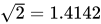
يكون قطر سطح بفوند المسطح أكبر عمومًا من قطر القطع المكافئ البؤري؛ ويُعدّ حجمه موازنةً تصميميةً بين تغطية مجال الرؤية المضاءة بالكامل وتكلفة السطح المسطح ووزنه. إذا كان الهدف من بفوند هو توفير تغطية مجال رؤية مضاءة بالكامل بزاوية مسطحة 90 درجة، فيجب ألا يقل قطر السطح المسطح عن 100 درجة.مضروبة في قطر القطع المكافئ.
إن فتحة التوقف هي حافة القطع المكافئ للتركيز، وبالتالي يجب أن يكون سطح التغذية أكبر قليلاً من القطر المحوري المطلوب لزيادة الإضاءة إلى أقصى حد على المجال المطلوب.
استخدم تلسكوب البحث عن المستعرات العظمى في مرصد ماكدونالد تكوين بفوند، وكان قطر سطح التغذية المسطح 24 بوصة ، بينما كانت مرآة التركيز عبارة عن قطع مكافئ 18 بوصة f/4.5.
التركيبات
جامعة كاليفورنيا في بيركلي: مقياس التداخل المكاني بالأشعة تحت الحمراء
من أمثلة تلسكوبات بفوند مصفوفة مقياس التداخل المكاني بالأشعة تحت الحمراء في جامعة كاليفورنيا في بيركلي . بالإضافة إلى موقع المصفوفة الإلكتروني، [ 1 ] تم وصف الجهاز من قبل تاونز (1999)، [ 2 ] ومانلي (1999). [ 3 ]
مرصد ماكدونالد: تلسكوب البحث عن المستعرات العظمى
يعتمد كل من تلسكوب جورج ب. رين للبحث عن المستعرات العظمى في مرصد ماكدونالد وتلسكوب رين-ماركاريو الجديد المخصص لذوي الاحتياجات الخاصة في مركز زوار مرصد ماكدونالد (والذي سيبدأ تشغيله في أوائل عام 2007) على تصميم بفوند. [ ج ]
تدور وحدة التوجيه المسطحة مقاس 24 بوصة ومجموعة فتحة الرؤية في اتجاه السمت نحو أي من المرآتين. لكل نصف كرة موقع صورة ثابت خاص به. يتوافق تلسكوب الوصول للكراسي المتحركة تمامًا مع متطلبات قانون الأمريكيين ذوي الإعاقة .
تلسكوب محلي الصنع من صنع شركة Fundingsland
يبدو أن جون أو. فوندينغسلاند لم يكن على دراية بتصميم تلسكوب بفوند، وقام بشكل مستقل بتطوير نفس التكوين البصري. في عام 1999، نشر وصفًا لنموذجه الأولي ذي الفتحة 4 بوصات في مجلة فلكية للهواة . [ 4 ]
انظر أيضاً
الحواشي
- ↑A cylindrical hole would quickly block light passing through the flat from the primary mirror as the steering flat tilt angle increases.
- ↑Departures from flatness, from figure error or deflection, or both, rapidly introduce unacceptable astigmatism in the image.
- ↑The Wheelchair Access Telescope is unique in that it will employ two 18″f/8 mirrors arranged on a north–south line and facing each other, with the steering flat halfway between. The north 18″ mirror covers the northern half-hemisphere of the sky, and the south 18″ mirror covers the south sky, thus providing full sky coverage, which is not possible with a single-mirror Pfund.
References
- ↑"Infrared Spatial Interferometer Array". Berkeley, CA: University of California. Archived from the original on 2019-04-29. Retrieved 2006-03-14.
- ↑Townes, Charles H. (1999). How the Laser Happened (pbk ed.). Oxford University Press. pp. 184–185. ISBN 0-19-515376-6.
- ↑Manly, Peter L. (1999). Unusual Telescopes (pbk ed.). Cambridge University Press. pp. 136–137. ISBN 0-521-48393-X.
- ↑Fundingsland, John O. (August 1992). "Easy viewing with a fixed telescope". Sky and Telescope. pp. 212–215.
- Telescope types