
IBM System p
The IBM System p is a high-end line of RISC (Power)/UNIX-based servers. It was the successor of the RS/6000 line, and predecessor of the IBM Power Systems server series.
History
The previous RS/6000 line was originally a line of workstations and servers. The first System p server line was named the eServer pSeries in 2000 as part of the e-Server branding initiative.
In 2004, with the advent of the POWER5 processor, the server family was rebranded the eServer p5.[1]
In 2005, following IBM's move to streamline its server and storage brands worldwide, and incorporating the "System" brand with the Systems Agenda, the family was again renamed to System p5. The System p5 now encompassed the IBM OpenPower product line.
In 2007, after the introduction of the POWER6 processor models, the last rename under the System p brand dropped the p (numbered) designation.
In April 2008, IBM announced a rebranding of the System p and its unification with the mid-range System i platform. The resulting product line was called IBM Power Systems.
Hardware and software
Processors
Whereas the previous RS/6000 line used a mix of early POWER and PowerPC processors, when pSeries came along, this had evolved into RS64-III and POWER3 across the board—POWER3 for its excellent floating-point performance and RS64 for its scalability, throughput, and integer performance.
IBM developed the POWER4 processor to replace both POWER3 and the RS64 line in 2001. After that, the differences between throughput and number crunching-optimized systems no longer existed. Since then, System p machines evolved to use the POWER5 but also the PowerPC 970 for the low-end and blade systems.
The last System p systems used the POWER6 processor, such as the POWER6-based System p 570 and the JS22 blade. In addition, during the SuperComputing 2007 (SC07) conference in Reno, IBM introduced a new POWER6-based System p 575 with 32 POWER6 cores at 4.7 GHz and up to 256 GB of RAM with water cooling.
Features
All IBM System p5 and IBM eServer p5 machines support DLPAR (Dynamic Logical Partitioning) with Virtual I/O and Micro-partitioning.
System p generally uses the AIX operating system and, more recently, 64-bit versions of the Linux operating system.
Models
BladeCenter
- IBM BladeCenter JS12 (POWER6)
- IBM BladeCenter JS22 (POWER6)
- IBM BladeCenter JS23 (POWER6)
- IBM BladeCenter JS43 (POWER6)
Main line
eServer pSeries
- IBM eServer pSeries 610 (7028-6C1 & 6E1)
- IBM eServer pSeries 615 (7029-6C3, 7029-6E3) (1~2-core POWER4+ CPU)[2]
- IBM eServer pSeries 620 (7025-F80, 6F0 & 6F1) (1~3 2-core RS64-IV CPUs)[3]
- IBM eServer pSeries 630 (7028-6C4, 7028-6E4) (1 1-core POWER4 CPU or 1~2 2-core POWER4 CPUs)[4]
- IBM eServer pSeries 640 (7026-B80) 1-4 POWER3-II CPUs
- IBM eServer pSeries 650 (7038-6M2) 2-8 POWER4 CPUs
- IBM eServer pSeries 655 (7039-651) 4-8 POWER4 CPUs
- IBM eServer pSeries 660 (7026-H80, 6H0, 6H1, M80 & 6M1)
- IBM eServer pSeries 670 (7040-671) 4-16 POWER4 CPUs
- IBM eServer pSeries 680 (7017 range)
- IBM eServer pSeries 690 (7040-681) 8-32 POWER4 CPUs
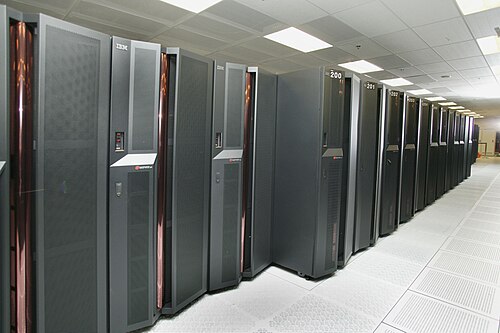
The IBM p690 was, at the time of its release in late 2001, the flagship of IBM's high-end Unix servers during the POWER4 era of processors. It was built to run IBM AIX Unix, although it is possible to run a version of Linux minus some POWER4-specific features.
It could support up to 32 (1.5, 1.7 or 1.9 GHz) POWER4+ processors and 1 TB of RAM, which weighs well over 1000 kg. It was used in a supercomputer at Forschungszentrum Jülich in 2004, and was discontinued in late 2005.[5]
eServer p5
Released in 2004.[6]
- IBM eServer p5 510 Express (9111-510) (1~2-core 1.5 GHz POWER5 CPU)[7][8]
- IBM eServer p5 510 (9111-510) (1~2-core 1.65 GHz POWER5 CPU)[9][8]
- IBM eServer p5 520 Express (9111-520) (1~2-core 1.5 GHz POWER5 CPU)[10][11]
- IBM eServer p5 520 (9111-520) (2-core 1.65 GHz POWER5 CPU)[12][11]
- IBM eServer p5 550 Express (9113-550) (1~2 1~2-core 1.5 GHz POWER5 CPUs)[13][14]
- IBM eServer p5 550 (9113-550) (1~2 2-core 1.65 GHz POWER5 CPUs)[15][14]
- IBM eServer p5 570 Express (9117-570) (1~8 2-core 1.5 GHz POWER5 CPUs)[16][17]
- IBM eServer p5 570 (9117-570) (1~8 2-core 1.65 GHz or 1.9 GHz POWER5 CPUs)[18][17]
- IBM eServer p5 590 (9119-590) (1~4 8-core 1.65 GHz POWER5 MCMs)[19][20]
- IBM eServer p5 595 (9119-595) (2, 4, 6 or 8 8-core 1.65 GHz or 1.9 GHz POWER5 MCMs)[21][20]
System p5
- IBM System p5 185 (7037-A50) (1~2-core PowerPC 970 CPU)[22]
- IBM System p5 505 (9115-505) (1~2-core POWER5 or POWER5+ CPU)[23][24]
- IBM System p5 505Q (9115-505) (4-core POWER5+ CPU)[25][24]
- IBM System p5 510 (9110-51A) (1~2 1~2-core POWER5 or POWER5+ CPUs)[26][27]
- IBM System p5 510Q (9110-51A) (1~2 4-core POWER5+ CPUs)[28][27]
- IBM System p5 520 (9131-52A) (1~2-core POWER5+ CPU)[29][30]
- IBM System p5 520Q (9131-52A) (4-core POWER5+ CPU)[31][30]
- IBM System p5 550 (9133-55A) (1~2 2-core POWER5+ CPUs)[32][33]
- IBM System p5 550Q (9133-55A) (1~2 4-core POWER5+ CPUs)[34][33]
- IBM System p5 560Q (9116-561) (1, 2 or 4 4-core POWER5+ CPUs)[35][36]
- IBM System p5 570 (9117-570) (1~8 2-core POWER5+ CPUs)[37][38]
- IBM System p5 575 (9118-575) (8 1~2-core POWER5+ CPUs)[39]
- IBM System p5 590 (9119-590) (1~2 16-core POWER5 or POWER5+ processor books)[40][41]
- IBM System p5 595 (9119-595) (1~4 16-core POWER5 or POWER5+ processor books)[42][41]
System p
- IBM System p 520 Express (1, 2 or 4-core POWER6 CPU)[43]
- IBM System p 550 Express (1~4 2-core POWER6 CPUs) [ 44 ]
- نظام IBM p 560 Express (POWER6) [ 45 ]
- نظام IBM ص 570 (POWER6) [ 46 ] [ 47 ] [ 48 ]
- نظام IBM ص 575 (POWER6) [ 49 ]
- نظام IBM ص 595 (9119-FHA) (1~8 كتب معالج POWER6 ثماني النواة) [ 50 ] [ 51 ]
تم تغيير اسم النظام p إلى أنظمة الطاقة في عام 2008.
أوبن باور
كان OpenPower اسمًا لمجموعة من الخوادم ضمن سلسلة System p من IBM . تميزت هذه الخوادم بمعالجات POWER5 من IBM ، وتعمل فقط بإصدارات 64 بت من نظام Linux . ولا يدعم نظام AIX ، وهو إصدار من نظام UNIX الخاص بشركة IBM ، خوادم OpenPower لعدم حصولها على ترخيص لاستخدام هذا النظام .
كان هناك نموذجان متاحان، مع مجموعة متنوعة من التكوينات.
قبل عام 2005، كانت OpenPower تنتمي إلى خط إنتاج eServer ولكن تم دمجها في النهاية في مجموعة منتجات أنظمة الطاقة من IBM .
- IBM eServer OpenPower 710 (9123-710) (1~2-core POWER5 CPU) [ 52 ]
- IBM eServer OpenPower 720 (9124-720) 1-4 معالجات POWER5
محطة الطاقة الذكية
مركز الشفرات
- IBM BladeCenter JS20 (PowerPC 970)
- IBM BladeCenter JS21 (PowerPC 970)
انظر أيضاً
مراجع
- ↑ ستوكس، جون (14 يوليو 2004). "آي بي إم تطلق سلسلة خوادم p5 القائمة على معالج POWER5" . آرس تكنيكا . تاريخ الاسترجاع: 11 ديسمبر 2020 .
- ↑ "نظرة عامة فنية ومقدمة عن طرازي pSeries 615 6C3 و6E3" (ملف PDF) . منشورات IBM Redbooks . IBM. 18 ديسمبر 2003. مؤرشف من النسخة الأصلية (PDF) بتاريخ 18 يوليو 2004. تم الاطلاع عليه بتاريخ 23 أغسطس 2021 .
- ↑ "نظرة عامة فنية ومقدمة عن خادم IBM eServer pSeries 620 طراز 6F1" (ملف PDF) . منشورات IBM Redbooks . IBM. 2002-04-02. مؤرشف من النسخة الأصلية (PDF) بتاريخ 2005-11-25 . تم الاطلاع عليه بتاريخ 2021-08-24 .
- ↑ "نظرة عامة فنية ومقدمة عن طرازي pSeries 630 6C4 و6E4" (ملف PDF) . منشورات IBM Redbooks . IBM. 11 نوفمبر 2002. مؤرشف من النسخة الأصلية (PDF) بتاريخ 3 أغسطس 2016. تم الاطلاع عليه بتاريخ 23 أغسطس 2021 .
- ↑ "pSeries 690" . شركة IBM . 8 نوفمبر 2005. مؤرشف من الأصل في 13 يناير 2006. تم الاطلاع عليه في 10 فبراير 2014 .
- ↑ "حقائق وميزات IBM @eserver p5 وpSeries" (ملف PDF) . IBM . 15 أكتوبر 2004. مؤرشف من الأصل (ملف PDF) في 15 يناير 2011.
- ↑ "ملخص مواصفات IBM eServer p5 510 Express" . IBM . مؤرشف من الأصل بتاريخ 20 أبريل 2005. تم الاطلاع عليه بتاريخ 10 يونيو 2021 .
- 1 2 "نظرة عامة فنية ومقدمة عن IBM eServer p5 510" (ملف PDF) . منشورات IBM Redbooks . IBM. 24 أبريل 2006. مؤرشف (ملف PDF) من الأصل بتاريخ 9 أكتوبر 2022. تم الاطلاع عليه بتاريخ 10 يونيو 2021 .
- ↑ "ملخص مواصفات IBM eServer p5 510" . IBM . مؤرشف من الأصل بتاريخ 13 مارس 2005. تم الاطلاع عليه بتاريخ 10 يونيو 2021 .
- ↑ "ملخص مواصفات IBM eServer p5 520 Express" . IBM . مؤرشف من الأصل بتاريخ 2004-12-06 . تم الاطلاع عليه بتاريخ 2021-06-10 .
- ١ ٢ "نظرة عامة فنية ومقدمة عن IBM eServer p5 520" (ملف PDF) . منشورات IBM Redbooks . IBM. ٨ أغسطس ٢٠٠٦. مؤرشف من النسخة الأصلية (PDF) بتاريخ ٢٩ سبتمبر ٢٠٠٦. تم الاطلاع عليه بتاريخ ١٣ أغسطس ٢٠٢١ .
- ↑ "ملخص مواصفات IBM eServer p5 520" . IBM . مؤرشف من الأصل بتاريخ 26-09-2004 . تم الاطلاع عليه بتاريخ 10-06-2021 .
- ↑ "ملخص مواصفات IBM eServer p5 550 Express" . IBM . مؤرشف من الأصل بتاريخ 2004-12-06 . تم الاطلاع عليه بتاريخ 2021-06-10 .
- ١ ٢ "نظرة عامة فنية ومقدمة عن IBM eServer p5 550" (ملف PDF) . منشورات IBM Redbooks . IBM. ٢٩ نوفمبر ٢٠٠٥. مؤرشف من النسخة الأصلية (PDF) بتاريخ ١٦ فبراير ٢٠٠٦. تم الاطلاع عليه بتاريخ ١٤ أغسطس ٢٠٢١ .
- ↑"IBM eServer p5 550 specification summary". IBM. Archived from the original on 2004-12-11. Retrieved 2021-06-10.
- ↑"IBM eServer p5 570 Express specification summary". IBM. Archived from the original on 2004-08-16. Retrieved 2021-06-10.
- 12"IBM eServer p5 570 Technical Overview and Introduction"(PDF). IBM Redbooks. IBM. 2005-05-13. Archived from the original(PDF) on 2005-12-22. Retrieved 2021-08-14.
- ↑"IBM eServer p5 570 specification summary". IBM. Archived from the original on 2004-08-04. Retrieved 2021-06-10.
- ↑"IBM eServer p5 590 specification summary". IBM. Archived from the original on 2004-12-07. Retrieved 2021-06-10.
- 12"IBM eServer p5 590 and 595 Technical Overview and Introduction"(PDF). IBM Redbooks. IBM. 2005-08-26. Archived from the original(PDF) on 2006-01-07. Retrieved 2021-08-14.
- ↑"IBM eServer p5 595 specification summary". IBM. Archived from the original on 2004-12-07. Retrieved 2021-06-10.
- ↑"IBM System p5 185 Technical Overview and Introduction"(PDF). IBM Redbooks. IBM. 2006-04-20. Archived(PDF) from the original on 2022-10-09. Retrieved 2021-06-10.
- ↑"IBM System p5 505 Express specification summary". IBM. Archived from the original on 2008-02-17. Retrieved 2021-06-10.
- 12"IBM System p5 505 and 505Q Technical Overview and Introduction"(PDF). IBM Redbooks. IBM. 2006-12-13. Archived(PDF) from the original on 2022-10-09. Retrieved 2021-06-10.
- ↑"IBM System p5 505Q Express specification summary". IBM. Archived from the original on 2008-10-20. Retrieved 2021-06-10.
- ↑"IBM System p5 510 Express specification summary". IBM. Archived from the original on 2008-03-20. Retrieved 2021-06-10.
- 12"IBM System p5 510 and 510Q Technical Overview and Introduction"(PDF). IBM Redbooks. IBM. 2006-09-23. Archived(PDF) from the original on 2022-10-09. Retrieved 2021-06-10.
- ↑"IBM System p5 510Q Express specification summary". IBM. Archived from the original on 2008-03-18. Retrieved 2021-06-10.
- ↑"IBM System p5 520 Express specification summary". IBM. Archived from the original on 2008-04-18. Retrieved 2021-06-10.
- 12"IBM System p5 520 and 520Q Technical Overview and Introduction"(PDF). IBM Redbooks. IBM. 2006-06-18. p. 6. Archived(PDF) from the original on 2022-10-09. Retrieved 2021-06-04.
- ↑"IBM System p5 520Q Express specification summary". IBM. Archived from the original on 2008-08-30. Retrieved 2021-06-10.
- ↑"IBM System p5 550 Express specification summary". IBM. Archived from the original on 2008-04-30. Retrieved 2021-06-10.
- 12"IBM System p5 550 and 550Q Technical Overview and Introduction"(PDF). IBM Redbooks. IBM. 2006-11-02. p. 6. Archived(PDF) from the original on 2006-07-21. Retrieved 2021-06-10.
- ↑"IBM System p5 550Q Express specification summary". IBM. Archived from the original on 2008-05-17. Retrieved 2021-06-10.
- ↑"IBM System p5 560Q Express specification summary". IBM. Archived from the original on 2008-07-05. Retrieved 2021-06-10.
- ↑"IBM System p5 560Q Technical Overview and Introduction"(PDF). IBM Redbooks. IBM. 2007-04-20. Archived(PDF) from the original on 2006-07-01. Retrieved 2021-06-10.
- ↑"IBM System p5 570 specification summary". IBM. Archived from the original on 2008-05-06. Retrieved 2021-06-10.
- ↑"IBM System p5 570 Technical Overview and Introduction"(PDF). IBM Redbooks. IBM. 2007-06-05. Retrieved 2021-06-10.
- ↑"IBM System p5 575 specification summary". IBM. Archived from the original on 2008-05-01. Retrieved 2021-06-10.
- ↑"IBM System p5 590 specification summary". IBM. Archived from the original on 2007-05-22. Retrieved 2021-06-10.
- 12"IBM System p5 590 and 595 Technical Overview and Introduction"(PDF). IBM Redbooks. IBM. 2010-01-15. Retrieved 2021-06-10.
- ↑"IBM System p5 595 specification summary". IBM. Archived from the original on 2008-01-28. Retrieved 2021-06-10.
- ↑"IBM System p 520 Express specification summary". IBM. Archived from the original on 2008-03-20. Retrieved 2021-06-10.
- ↑"IBM System p 550 Express specification summary". IBM. Archived from the original on 2008-03-24. Retrieved 2021-06-10.
- ↑"IBM Power 560 Express server specifications". IBM. Archived from the original on 2008-12-17. Retrieved 2021-06-10.
- ↑"IBM System p 570". IBM. Archived from the original on 2008-02-05. Retrieved 2021-06-10.
- ↑"IBM System p 570 Express specification summary". IBM.
- ↑"IBM Power 570 specification summary". IBM. Archived from the original on 2008-04-16. Retrieved 2021-06-10.
- ↑"IBM Power 575 supercomputing node". IBM. Archived from the original on 2009-02-03. Retrieved 2021-06-10.
- ↑"IBM Power 595 specification summary". IBM. Archived from the original on 2009-02-03. Retrieved 2021-06-10.
- ↑"IBM Power 595 Technical Overview and Introduction"(PDF). IBM Redbooks. IBM. 2008-08-14. Archived(PDF) from the original on 2022-10-09. Retrieved 2021-06-10.
- ↑"IBM eServer OpenPower 710 Technical Overview and Introduction"(PDF). IBM Redbooks. IBM. 2005-06-01. Archived(PDF) from the original on 2022-10-09. Retrieved 2021-06-10.
External links
- IBM server computers
- Computer-related introductions in 2000