
Turnover number
In chemistry, the term "turnover number" has two distinct meanings.
In enzymology, the turnover number (kcat) is defined as the limiting number of chemical conversions of substrate molecules per second that a single active site will execute for a given enzyme concentration [ET] for enzymes with two or more active sites.[1] For enzymes with a single active site, kcat is referred to as the catalytic constant.[2] It can be calculated from the limiting reaction rate Vmax and catalyst site concentration e0 as follows:
(See Michaelis–Menten kinetics).

In other chemical fields, such as organometalliccatalysis, turnover number (TON) has a different meaning: the number of moles of substrate that a mole of catalyst can convert before becoming inactivated:[3]
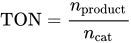
An ideal catalyst would have an infinite turnover number in this sense, because it would never be consumed. The term turnover frequency (TOF) is used to refer to the turnover per unit time, equivalent to the meaning of turnover number in enzymology.
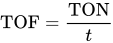
For most relevant industrial applications, the turnover frequency is in the range of 10−2 – 102 s−1 (103 – 107 s−1 for enzymes).[4] The enzyme catalase has the largest turnover frequency, with values up to 4×10⁷ s−1 having been reported.[5]
Turnover number of diffusion-limited enzymes
Acetylcholinesterase is a serine hydrolase with a reported catalytic constant greater than 104 s−1. This implies that this enzyme reacts with acetylcholine at close to the diffusion-limited rate.[6]
يُعدّ إنزيم الأنهيدراز الكربوني من أسرع الإنزيمات، وعادةً ما يكون معدل نشاطه محدودًا بمعدل انتشار ركائزه . تتراوح الثوابت التحفيزية النموذجية للأشكال المختلفة لهذا الإنزيم بين 10⁴ ثانية⁻¹ و10⁶ ثانية⁻¹ . [ 7 ]
انظر أيضاً
مراجع
- ↑ روسكوسكي، روبرت (2015). "حركية ميكايليس-مينتين". وحدة مرجعية في العلوم الطبية الحيوية . doi : 10.1016/b978-0-12-801238-3.05143-6 . ISBN 978-0-12-801238-3.
- ↑ كورنيش-باودن، أثيل (2012). أساسيات حركية الإنزيمات ( الطبعة الرابعة). وايلي-بلاك ويل، فاينهايم. ص 33. ISBN 978-3-527-33074-4.
- ↑ بليغارد، توماس؛ بولوك، ر. موريس؛ كامبل، تشارلز ت.؛ تشين، جينغوانغ ج.؛ غيتس، بروس س.؛ غورت، ريموند ج.؛ جونز، كريستوفر و.؛ جونز، ويليام د.؛ كيتشن، جون ر.؛ سكوت، سوزانا ل. (1 أبريل 2016). "نحو وضع معايير في علم التحفيز: أفضل الممارسات والتحديات والفرص" . مجلة ACS Catalysis . 6 (4): 2590-2602 . doi : 10.1021/acscatal.6b00183 . OSTI 1243133 .
- ↑ هاجن، ينس (2005). "مقدمة". التحفيز الصناعي . ص 1-14 . doi : 10.1002/3527607684.ch1 . ISBN 978-3-527-31144-6.
- ↑ سميجكال، غاري ب.؛ كاكومانو، سريكانث (2019-07-03). "الإنزيمات ومعدلات دورانها" . مراجعة الخبراء في علم البروتينات . 16 (7): 543-544 . doi : 10.1080/14789450.2019.1630275 . PMID 31220960 .
- ↑ بازيليانسكي، مايكل؛ روبي، إيلين؛ كيرش، جاك ف. (14 يناير 1986). "المكون المحدود بالانتشار الجزئي للتفاعلات المحفزة بواسطة أستيل كولين إستراز". الكيمياء الحيوية . 25 (1): 125-130 . doi : 10.1021/bi00349a019 . PMID 3954986 .
- ↑ ليندسكوج، سفين (يناير 1997). "بنية وآلية عمل الأنهيدراز الكربوني". علم الأدوية والعلاجات . 74 (1): 1-20 . doi : 10.1016/s0163-7258(96)00198-2 . PMID 9336012 .
- حركية الإنزيم
- وحدات النشاط التحفيزي
- موقع ساينس ستوبز