
Visual cryptography
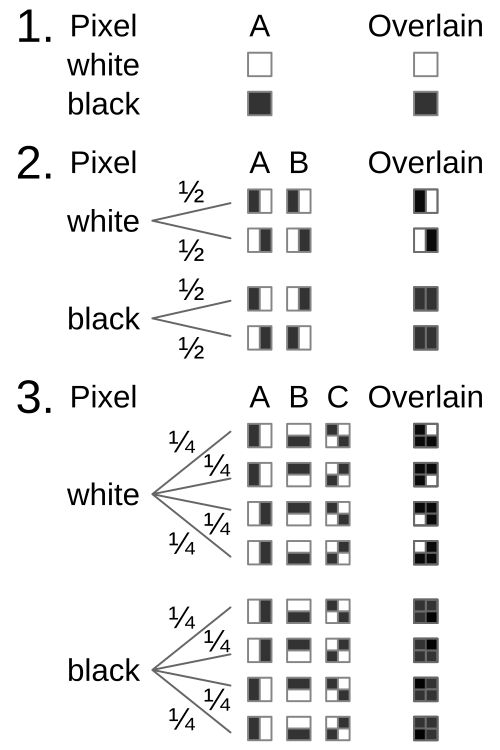
Visual cryptography is a cryptographic technique which allows visual information (pictures, text, etc.) to be encrypted in such a way that the decrypted information appears as a visual image.
One of the best-known techniques has been credited to Moni Naor and Adi Shamir, who developed it in 1994.[1] They demonstrated a visual secret sharing scheme, where a binary image was broken up into n shares so that only someone with all n shares could decrypt the image, while any n − 1 shares revealed no information about the original image. Each share was printed on a separate transparency, and decryption was performed by overlaying the shares. When all n shares were overlaid, the original image would appear. There are several generalizations of the basic scheme including k-out-of-n visual cryptography,[2][3] and using opaque sheets but illuminating them by multiple sets of identical illumination patterns under the recording of only one single-pixel detector, which exposed the image.[4]
Using a similar idea, transparencies can be used to implement a one-time pad encryption, where one transparency is a shared random pad, and another transparency acts as the ciphertext. Normally, there is an expansion of space requirement in visual cryptography. But if one of the two shares is structured recursively, the efficiency of visual cryptography can be increased to 100%.[5]
Some antecedents of visual cryptography are in patents from the 1960s.[6][7] Other antecedents are in the work on perception and secure communication.[8][9]
Visual cryptography can be used to protect biometric templates in which decryption does not require any complex computations.[10]
Example
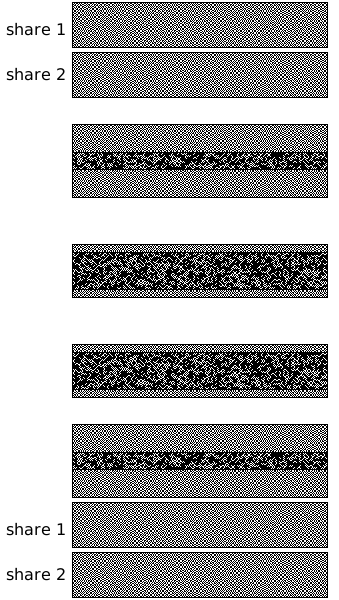
في هذا المثال، تم تقسيم الصورة الثنائية إلى صورتين فرعيتين. تحتوي كل صورة فرعية على زوج من البكسلات لكل بكسل في الصورة الأصلية. يتم تظليل أزواج البكسلات هذه باللون الأسود أو الأبيض وفقًا للقاعدة التالية: إذا كان بكسل الصورة الأصلية أسود، فيجب أن تكون أزواج البكسلات في الصورتين الفرعيتين متكاملة؛ يتم تظليل أحدهما عشوائيًا باللون الأسود (■□)، والآخر باللون الأبيض (□■). عند تداخل هذين الزوجين المتكاملين، سيظهران باللون الرمادي الداكن. من ناحية أخرى، إذا كان بكسل الصورة الأصلية أبيض، فيجب أن تتطابق أزواج البكسلات في الصورتين الفرعيتين: إما أن يكون كلاهما أسود (■□) أو كلاهما أبيض (□■). عند تداخل هذين الزوجين المتطابقين، سيظهران باللون الرمادي الفاتح.
لذا، عند دمج الصورتين المكونتين، تظهر الصورة الأصلية. مع ذلك، بدون الصورة المكونة الأخرى، لا تكشف الصورة المكونة أي معلومات عن الصورة الأصلية؛ فهي لا يمكن تمييزها عن نمط عشوائي من أزواج ■□ / □■. علاوة على ذلك، إذا كانت لديك صورة مكونة واحدة، يمكنك استخدام قواعد التظليل المذكورة أعلاه لإنتاج صورة مكونة مزيفة تتحد معها لإنتاج أي صورة على الإطلاق.
(2، ن ) حالة مشاركة التشفير المرئي

يُعدّ تبادل سرّ مع عددٍ عشوائيّ من الأشخاص، n ، بحيث يتطلّب فكّ شفرة السرّ اثنين منهم على الأقلّ، أحد أشكال مخطط تبادل الأسرار المرئية الذي قدّمه موني ناور وآدي شامير عام 1994. في هذا المخطط، لدينا صورة سرّية مُشفّرة في n من الأجزاء المطبوعة على شرائح شفافة. تبدو الأجزاء عشوائية ولا تحتوي على أيّ معلومات قابلة للفكّ حول الصورة السرّية الأصلية، ولكن إذا وُضع أيّ جزأين منها فوق بعضهما البعض، تصبح الصورة السرّية قابلة للفكّ بالعين المجردة.
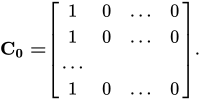
يتم ترميز كل بكسل من الصورة السرية إلى عدة بكسلات فرعية في كل صورة مشتركة باستخدام مصفوفة لتحديد لون البكسلات. في حالة (2، ن )، يتم ترميز البكسل الأبيض في الصورة السرية باستخدام مصفوفة من المجموعة التالية، حيث يمثل كل صف نمط البكسل الفرعي لأحد المكونات:
{جميع تباديل أعمدة} :
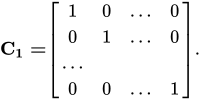
بينما يتم ترميز البكسل الأسود في الصورة السرية باستخدام مصفوفة من المجموعة التالية:
{جميع تباديل أعمدة} :
على سبيل المثال، في حالة المشاركة (2,2) (حيث يُقسّم السر إلى جزأين، ويُشترط استخدام كلا الجزأين لفك تشفير السر)، نستخدم مصفوفات متكاملة لمشاركة بكسل أسود، ومصفوفات متطابقة لمشاركة بكسل أبيض. عند تكديس الجزأين، تصبح جميع البكسلات الفرعية المرتبطة بالبكسل الأسود سوداء، بينما تبقى 50% من البكسلات الفرعية المرتبطة بالبكسل الأبيض بيضاء.
خداع مخطط مشاركة الأسرار المرئية (2، ن )
Horng et al. proposed a method that allows n − 1 colluding parties to cheat an honest party in visual cryptography. They take advantage of knowing the underlying distribution of the pixels in the shares to create new shares that combine with existing shares to form a new secret message of the cheaters choosing.[11]
We know that 2 shares are enough to decode the secret image using the human visual system. But examining two shares also gives some information about the 3rd share. For instance, colluding participants may examine their shares to determine when they both have black pixels and use that information to determine that another participant will also have a black pixel in that location. Knowing where black pixels exist in another party's share allows them to create a new share that will combine with the predicted share to form a new secret message. In this way a set of colluding parties that have enough shares to access the secret code can cheat other honest parties.
Visual steganography
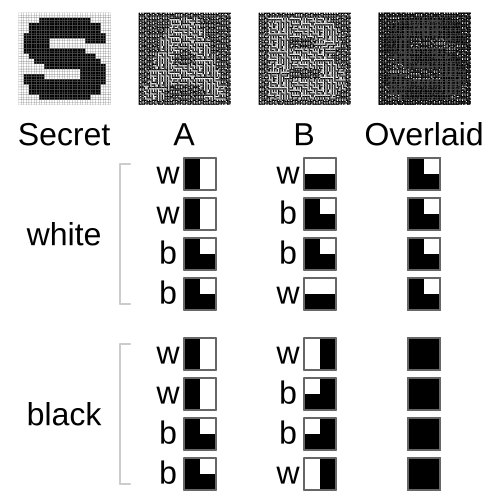
2×2 subpixels can also encode a binary image in each component image. For example, each white pixel of each component image could be represented by two black subpixels, while each black pixel represented by three black subpixels.
When overlaid, each white pixel of the secret image is represented by three black subpixels, while each black pixel is represented by all four subpixels black. Each corresponding pixel in the component images is randomly rotated to avoid orientation leaking information about the secret image.[12]
In popular culture
- In "Do Not Forsake Me Oh My Darling", a 1967 episode of TV series The Prisoner, the protagonist uses a visual cryptography overlay of multiple transparencies to reveal a secret message – the location of a scientist friend who had gone into hiding.
See also
References
- ↑Naor, Moni; Shamir, Adi (1995). "Visual cryptography". Advances in Cryptology – EUROCRYPT'94. Lecture Notes in Computer Science. Vol. 950. pp. 1–12. doi:10.1007/BFb0053419. ISBN 978-3-540-60176-0.
- ↑Verheul, Eric R.; Van Tilborg, Henk C. A. (1997). "Constructions and Properties of k out of n Visual Secret Sharing Schemes". Designs, Codes and Cryptography. 11 (2): 179–196. doi:10.1023/A:1008280705142. S2CID 479227.
- ↑ أتينيزي، جوزيبي؛ بلوندو، كارلو؛ سانتيس، ألفريدو دي؛ ستينسون، دوغلاس ر. (2001). "قدرات موسعة للتشفير المرئي". علوم الحاسوب النظرية . 250 ( 1-2 ): 143-161 . doi : 10.1016/S0304-3975(99)00127-9 .
- ↑ جياو، شومينغ؛ فينغ، جون؛ غاو، يانغ؛ لي، تينغ؛ يوان، شياو كونغ (2020). "التشفير المرئي في التصوير أحادي البكسل". أوبتكس إكسبرس . 28 (5): 7301-7313 . arXiv : 1911.05033 . Bibcode : 2020OExpr..28.7301J . doi : 10.1364/OE.383240 . PMID: 32225961. S2CID : 207863416 .
- ↑ غناناغوروباران، ميناكشي؛ كاك، سوبهاش (2002). "الإخفاء المتكرر للأسرار في التشفير المرئي". كريبتولوجيا . 26 : 68-76 . doi : 10.1080/0161-110291890768 . S2CID 7995141 .
- ↑ كوك، ريتشارد سي. (1960) عملية التشفير والمنتج المشفر ، براءة اختراع الولايات المتحدة 4,682,954.
- ↑ كارلسون، كارل أو. (1961) طريقة ترميز وفك ترميز المعلومات ، براءة اختراع الولايات المتحدة 3,279,095.
- ↑ كافري، أ.؛ كيرين، إ. (1987). "تشفير الصور والأشكال بواسطة شبكات عشوائية". رسائل البصريات . 12 (6): 377-379 . Bibcode : 1987OptL...12..377K . doi : 10.1364/OL.12.000377 . PMID 19741737 .
- ↑ أرازي، ب.؛ دينشتاين، إ.؛ كافري، أ. (1989). "الحدس والإدراك والاتصال الآمن". معاملات IEEE في الأنظمة والإنسان وعلم التحكم الآلي . 19 (5): 1016-1020 . doi : 10.1109/21.44016 .
- ↑ عسكري، نازانين؛ مولوني، سيسيليا؛ هيز، هوارد م. (نوفمبر 2011). تطبيق التشفير المرئي على المصادقة البيومترية . مؤتمر NECEC 2011. تاريخ الاسترجاع: 12 فبراير 2015 .
- ↑ هورنغ، غووبوا؛ تشين، تزونغير؛ تساي، دو-شياو (2006). "الغش في التشفير المرئي". التصاميم، والرموز، والتشفير . 38 (2): 219-236 . doi : 10.1007/s10623-005-6342-0 . S2CID 2109660 .
- ↑ م. برامانيك، كالبانا شارما، تحليل التشفير المرئي، ومخططات إخفاء المعلومات، ونهجها الهجين لأمن الصور ، علوم الحاسوب، 2014
روابط خارجية
- تطبيق جافا ورسوم توضيحية للتشفير المرئي
- تطبيق بايثون للتشفير المرئي
- التشفير المرئي على آلات التشفير وعلم التشفير
- صفحة دوغ ستينسون للتشفير المرئي
- ليو، فينغ؛ يان، وي تشي (2014) التشفير المرئي لمعالجة الصور والأمن: النظرية والأساليب والتطبيقات، سبرينغر
- حمودي، كريم؛ ملكيمي، محمود (2018). "مشاركات شخصية في التشفير المرئي" . مجلة التصوير . 4 (11): 126. doi : 10.3390/jimaging4110126 .
- علم التشفير