
Doily
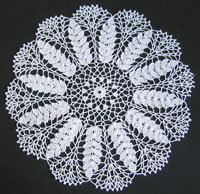


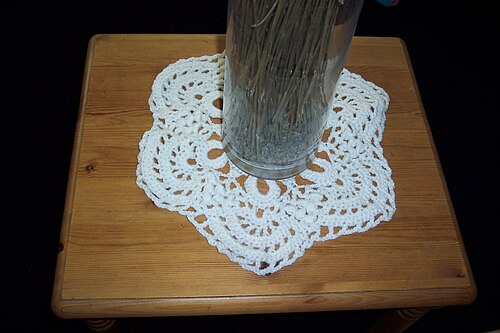


A doily (also doiley, doilie, doyly, or doyley) is an ornamental mat, typically made of paper or fabric, and variously used for protecting surfaces or binding flowers, in food service presentation, or as a clothing ornamentation, as well as a head covering for Christian women. It is characterized by openwork, which allows the surface of the underlying object to show through.
Doilies can be constructed in a variety of techniques, and the doily motif can also be represented in atypical non-textile formats.
Etymology
Doiley was a 17th-century Londondraper,[1] who made popular "a woolen stuff, 'at once cheap and genteel', introduced for summer wear in the latter part of the 17th c."[2][3] At the time, it was used as an adjective, as in "doily stuffs" or "doily suit". Later, usage shifted to refer to "a small ornamental napkin used at dessert", known as a "doily-napkin".[2]
Usage
Headcovering
The doily is worn as a headcovering for Jewish women as an alternative to the traditional tichel (headscarf).[4]
The doily is used as a headcovering by many Christian women who wear them in obedience to 1 Corinthians 11:1–13, especially by Conservative Anabaptist Christian women, including certain Conservative Mennonite fellowships such as the Biblical Mennonite Alliance.[5]
Furniture protection
In addition to their decorative function doilies have the practical role of protecting fine-wood furniture from the scratches caused by crockery or decorative objects such as nativity scenes, or from spilled tea when used on tea trays or with cups and saucers. When used to protect the backs and arms of chairs, they are serving as antimacassars.
Flower arrangement
Doilies are traditionally used to bind the stems in posies (formal flower arrangements called tussie-mussies in the Victorian Era).[6]
Food service and etiquette
تُعدّ المفارش الدانتيلية عنصراً أساسياً في عادة غسل الأصابع ، التي كانت شائعة في حفلات العشاء الرسمية متعددة الأطباق . يفصل المفرش الكتاني (وليس الورقي) طبق الحلوى عن وعاء غسل الأصابع. تقتضي العادة إزالة كل من المفرش ووعاء غسل الأصابع ووضعهما في أعلى يسار مكان الجلوس قبل غمس أطراف الأصابع في الماء لفترة وجيزة وتجفيفها على المفرش. ويُعتبر عدم تحريكهما معاً خطأً في آداب المائدة.
تم تصميم مفارش الورق التي تستخدم لمرة واحدة كبديل أرخص ولكنه محترم لمفارش الكتان المصنوعة بالكروشيه، وتستخدم عادة لتزيين الأطباق، وتوضع تحت الطعام للزينة.
ردود فعل عنيفة على عدم احترام الحرفيات الماهرات في صناعة المفارش.
رداً على استخفاف أحد المتاحف بعمل وقيمة المنسوجات النسائية، دافعت الباحثة إيلينا كاناجي-لوكس عن براعة وقيمة ومهارة صانعات المفارش. [ 7 ] وقد احتفى فنانون معاصرون بأعمال وزخارف المفارش الثقافية، بما في ذلك الأعمال الفنية العامة [ 8 ] والمعارض. ويجد هواة جمع قطع المفارش الفنية النسيجية مجموعة واسعة من الأساليب والتقنيات المتاحة. [ 9 ]
التقنيات
تُحاك هذه المفارش بالكروشيه أو التاتينغ أو الحياكة من خيوط القطن أو الكتان . وقد نشرت شركات تصنيع الخيوط العديد من أنماط حياكة المفارش بالكروشيه أو الحياكة في النصف الأول من القرن العشرين، وغالبًا ما لم يُذكر اسم المصممين. ويمكن أن تكون التصاميم دائرية أو بيضاوية، تبدأ من المركز وتتجه نحو الخارج، على غرار نظام الإحداثيات القطبية . ويمكن صنع المفارش، بالإضافة إلى غيرها من الأدوات المنزلية، عن طريق حياكة صفوف على نمط شبكي باستخدام تقنية تُسمى الكروشيه الشبكي ، وهي تقنية مشابهة للنقاط على نظام الإحداثيات الديكارتية .
يواصل المصممون المعاصرون ابتكار أنماط لهواة الحرف اليدوية الحديثة. ورغم أن ذلك قد يتعارض إلى حد ما مع الاستخدام الأصلي، إلا أن بعض المفارش المطرزة تتضمن تطريزًا أو تتميز بتصاميم بارزة (بتلات الورد، أو الفشار، أو الكشكشة) بدلاً من أن تكون مسطحة.

انظر أيضاً
مراجع
- ↑ "دويلي" . قاموس ميريام-ويبستر الإلكتروني. 2009.
- 1 2 "Doily, adj. and n." Oxford University Press.
- ↑ هاربر، دوغلاس. "مفرش" . قاموس أصل الكلمات على الإنترنت .
- ↑Goldman, Ari L. (2 October 2007). Being Jewish: The Spiritual and Cultural Practice of Judaism Today. Simon and Schuster. p. 219. ISBN 978-1-4165-3602-4.
- ↑Stevick, Richard A. (15 June 2014). Growing Up Amish: The Rumspringa Years. JHU Press. p. 319. ISBN 978-1-4214-1371-6.
- ↑Felbinger, Elaine (May–June 2005). "Tussie Mussies". SUBROSA: The Huntington Rose and Perennial Gardens Newsletter (42). huntingtonbotanical.org/. Retrieved 26 January 2014.
- ↑Kanagy-Loux, Elena (2024-04-25). "My Grandma's Doilies Are Not a Joke". Hyperallergic. Retrieved 2024-05-23.
- ↑"A Continuous Thread". MTA. Retrieved 2024-05-23.
- ↑"The Push-Pull of Doilies: Revered, Reviled, and Reconceived". PieceWork. Retrieved 2024-05-23.
- Crochet
- Linens
- Serving and dining
- Embroidery
- Lace
- Domestic implements