
Exposure hierarchy
In exposure therapy, an exposure hierarchy is developed to help clients confront their feared objects and situations in a manner that is systematic and controlled for the purpose of systematic desensitization. Exposure hierarchies are included in the treatment of a wide range of anxiety disorders.
An exposure hierarchy itself is a list of objects and situations that an individual fears or avoids that are graded or rank-ordered in their ability to elicit anxiety. The least anxiety-provoking situations are ordered at the bottom of the hierarchy while the most anxiety-provoking situations are at the top. Exposure hierarchies typically consist of 10-15 items and will guide the client’s exposure practices.[1] An abbreviated example of an exposure hierarchy is pictured in Image 1.
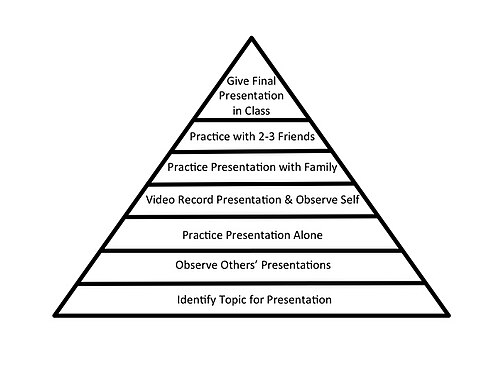
When exposure to an item at the bottom of the hierarchy leads to moderately reduced distress or increased tolerance, a client progresses up the hierarchy to more and more difficult exposures. An exposure hierarchy can also be used as an assessment tool of the client's progress and their increasing ability to habituate to fearful situations further up in their hierarchy.[2]
Design
When designing an exposure hierarchy, therapists first conduct a thorough assessment of their client's fear with particular attention to the (a) feared object or situation, (b) feared consequences of confronting the object, (c) fear-related avoidance or safety behaviors, and (d) triggers and contexts of the fear.[3] The assessment often focuses on one source of anxiety (e.g. social anxiety) that the client and therapist prioritize as the main target of intervention, often because it is the most distressing or causes the most impairment. Table 1, adapted from Dobson & Dobson (2009),[4] displays a wide range possible items to include in an exposure hierarchy based on the client's diagnosis.[4]
| Table 1: Possible Targets in Exposure Hierarchy |
|---|
| Social "gaffes" or mistakes in Social Anxiety Disorder |
| Presentations or being center of attention in Public Speaking Fears |
| Physiological sensations (e.g. dizziness) in Panic Disorder |
| Feared memories or images in Posttraumatic Stress Disorder |
| The feared situations (e.g. encounters with snakes) in Specific Phobias |
| Being in situations where escape is difficult (e.g. crowds) in Agoraphobia |
| Ruminations and worries in Generalized Anxiety Disorder |
Second, the therapist and client work collaboratively to develop an individually tailored list of feared situations that center on the identified target area (e.g. social anxiety). A list often includes several different situations that cause fear to varying degrees. For example, a fear hierarchy for a client with public speaking fears could include various situations that might trigger fears of embarrassment or judgment like: identifying a topic for a presentation, watching others give a presentation, practicing the presentation alone, practicing the presentation in front of a small and familiar audience, and giving the final presentation in front of a large audience. Though it is not uncommon for those with public speaking fears to have fears of other social situations (e.g. eating in public, making mistakes) if the situation is not feared or avoided by the client, it would not be included in his or her individualized fear hierarchy.
Third, after a list of several feared or avoided situations is generated, the therapist guides the client to rank-order the level of distress elicited by each of the situations. The client uses the Subjective Units of Distress Scale (SUDS)[5] to rate the situation on a scale of 0 (no fear) to 100 (most severe distress ever experienced). Returning to our example of a client with public speaking fears, she may rate the task of choosing a presentation topic as 20 SUDS while speaking in front of a large audience as 95 SUDS. The items are then ordered on the hierarchy from lowest to highest SUDS ratings (see Image 1).
Finally, after the hierarchy is developed, the client completes exposures from the bottom of the hierarchy to the top.
Efficacious hierarchy designs
Content
In general, the most effective hierarchies are ones in which the items are specific to the client and that most closely resembles their experience of fear in the real world, particularly ones that elicit the same cognitions and physiological reactions.[6] In some cases, other individuals should be involved in the exposure to mimic the experience of fear more closely (e.g. a client with social anxiety giving a presentation to her group of peers).
Gradual exposure
لا تُشير الدراسات التجريبية الحالية إلى ما إذا كان تعريض العملاء تدريجيًا باستخدام تسلسل هرمي مُرتب للتعرض أكثر فعالية من الانتقال السريع عبر هذا التسلسل أو البدء الفوري بالعلاج من أعلى الهرم. [ 6 ] [ 7 ] ومع ذلك، يميل العملاء إلى تفضيل النهج التدريجي. [ 8 ] في الواقع، تُشير تجربة كبار معالجي التعرض إلى أن العملاء أكثر ميلًا للانخراط في جلسات التعرض وأقل ميلًا للتوقف عن العلاج قبل الأوان إذا كان التسلسل الهرمي تدريجيًا. [ 6 ] [ 9 ]
شدة
ينبغي أن يتضمن التسلسل الهرمي للتعرض عناصر تغطي النطاق الكامل لتصنيفات مقياس اضطرابات القلق الاجتماعي (SUDS) لضمان تضمين أسوأ المخاوف ومواجهتها أثناء العلاج. [ 6 ] قد لا تُعلّم ممارسات التعرض منخفضة الشدة العملاءَ كيفية التغلب على مخاوفهم أو تحملها في مواقف أخرى، وقد يستمرون في الاعتقاد بأن بعض المخاوف (الأكثر حدة) مبررة ويجب الاستمرار في تجنبها. [ 6 ] مع ذلك، فإن إحداث قدر كبير من الإثارة أو الرعب بدلاً من الإثارة المعتدلة أثناء التعرض لا يؤدي إلى تحسن الأعراض، وقد يتسبب في التوقف عن العلاج. [ 10 ]
المدة والتكرار
يمكن تصنيف عناصر التسلسل الهرمي للخوف ليس فقط من حيث المحتوى (مثل اختيار موضوع العرض التقديمي مقابل تقديمه)، بل أيضًا من حيث مدة التعرض (مثل التعرض لمدة 5 دقائق مقابل التعرض لمدة 30 دقيقة). يُنصح عمومًا بأن يستمر العملاء في التعرض لفترة كافية لتحفيز استجابتهم المعتادة للخوف، ويُعد تعديل المدة إحدى الاستراتيجيات لتوليد قلق معتدل بدلًا من إثارة قلق شديد أو منخفض جدًا.
لم تُثبت الأبحاث بشكل قاطع ما إذا كان التعرض المكثف (أي التعرضات المتقاربة زمنيًا) أكثر فعالية من التعرضات المتباعدة (أي التعرضات ذات الفترات الزمنية الأطول). للاطلاع على مراجعة، انظر أبراموفيتز وآخرون (2012) [ 6 ] وفورستنبوش وآخرون (2014). [ 1 ]
سياق
As summarized by Vorstenbosch et al. (2014),[1] the generalizability and durability of gains made in exposure therapy is highly dependent on the context of the exposure practices. As such, certain conditions may optimize the effectiveness of exposure hierarchies. This includes conducting exposures across contexts that are: (a) varied and different in nature,[11] (b) do not include safety cues (e.g. therapist, medication),[12] and likely to elicit fear that is problematic or impairing.[11]
References
- 123Vorstenbosch, Valerie; Newman, Leorra; Antony, Martin M. (2014). "Exposure Techniques". In Hofmann, Stefan (ed.). The Wiley Handbook of Cognitive Behavioral Therapy (First ed.). John Wiley & Sons, Ltd. doi:10.1002/9781118528563.wbcbt03. ISBN 9781118528563.
- ↑Katerelos, Marina; Hawley, Lance L.; Antony, Martin M.; McCabe, Randi E. (2008). "The Exposure Hierarchy as a Measure of Progress and Efficacy in the Treatment of Social Anxiety Disorder". Behavior Modification. 32 (4): 504–518. doi:10.1177/0145445507309302. ISSN 0145-4455. PMID 18525064. S2CID 25966631.
- ↑Moscovitch, David; Antony, Martin; Swinson, Richard (2009). "Exposure-based treatment for anxiety disorders: Theory and process". In Antony, M. M.; Stein, M. B. (eds.). Oxford handbook of anxiety and related disorders. New York, NY: Oxford University Press. pp. 461–475.
- 12Dobson, Deborah June Gora; Dobson, Keith S. (2009). Evidence-Based Practice of Cognitive-Behavioral Therapy (1 ed.). New York, NY: The Guilford Press. ISBN 9781606230206.
- ↑Penney, Alexander; Teatero, Missy (2015). "Subjective Units of Distress Scale". In Milosevic, Irena; McCabe, Randi (eds.). Phobias: The Psychology of Irrational Fear. Greenwood. ISBN 9781610695756.
- 123456Abramowitz, Jonathan S.; Deacon, Brett J.; Whiteside, Stephen P. H. (2011). Exposure Therapy for Anxiety: Principles and Practice. Guilford Press. ISBN 9781609180171.
- ↑ جيلدر، إم جي؛ بانكروفت، جيه إتش جيه؛ جاث، دي إتش؛ جونستون، دي دبليو؛ ماثيوز، إيه إم؛ شو، بي إم (1973). "العوامل المحددة وغير المحددة في العلاج السلوكي". المجلة البريطانية للطب النفسي . 123 (575): 445-462 . doi : 10.1192/bjp.123.4.445 . ISSN 0007-1250 . PMID 4748863. S2CID 43440014 .
- ↑ هودجسون، ر.؛ راشمان، س.؛ ماركس، إم. إم. (1972-01-01). "علاج الوسواس القهري المزمن: متابعة ونتائج إضافية". بحوث وعلاج السلوك . 10 (2): 181-189 . doi : 10.1016/S0005-7967(72)80012-3 . PMID 5030262 .
- ↑ بيك، جوديث س. (18 أغسطس 2011). العلاج السلوكي المعرفي، الطبعة الثانية: الأساسيات وما بعدها . مطبعة جيلفورد. ISBN 9781609185060.
- ↑ فوا، إدنا ب.؛ بلاو، جوديث س.؛ براوت، موريس؛ لاتيمر، بول (1977). "هل يُعدّ الرعب عنصرًا ضروريًا في الفيضان (الانفجار الداخلي)؟". بحوث وعلاج السلوك . 15 (5): 397-402 . doi : 10.1016/0005-7967(77)90043-2 . PMID 612340 .
- 1 2 بوتون، مارك إي (2002). "السياق والغموض والتعلم العكسي: مصادر الانتكاس بعد الانطفاء السلوكي". الطب النفسي البيولوجي . 52 (10): 976-986 . doi : 10.1016/s0006-3223( 02 )01546-9 . PMID 12437938. S2CID 12887666 .
- ↑ باورز، مارك ب.؛ سميتس، جاسبر أ. ج.؛ ليرو، تيريزا م.؛ أوتو، مايكل و. (2006). "وجهات نظر البحث الانتقالي حول تعظيم فعالية العلاج بالتعرض" . في ريتشارد، ديفيد س. س.؛ لاوترباخ، دين (محرران). دليل العلاجات بالتعرض . دار النشر الأكاديمية. ISBN 9780080467818.
للمزيد من القراءة
- أبراموفيتز، جوناثان س.؛ ديكون، بريت ج.؛ وايتسايد، ستيفن ب.هـ. (2011). العلاج بالتعرض للقلق: المبادئ والممارسة. مطبعة جيلفورد. ISBN 9781609180171.
- فورستنبوش، فاليري؛ نيومان، ليورا؛ أنتوني، مارتن م. (2014). "تقنيات التعرض". في هوفمان، ستيفان. دليل وايلي للعلاج السلوكي المعرفي (الطبعة الأولى). جون وايلي وأولاده المحدودة. doi:10.1002/9781118528563.wbcbt03. ISBN 9781118528563.
- العلاج السلوكي المعرفي