
In ovo

In ovo is Latin for in the egg. In medical usage it refers to the growth of live virus in chicken egg embryos for vaccine development for human use, as well as an effective method for vaccination of poultry against various Avian influenza and coronaviruses. During the incubation period, the virus replicates in the cells that make up the chorioallantoic membrane.[2][3]
Advantages
In human vaccine development, the main advantage is rapid propagation, and high yield, of viruses for vaccine production. This method is most commonly used for growth of influenza virus, both attenuated vaccine and inactivated vaccine forms. It is recommended by the World Health Organization in managing influenza pandemics because it is high-yield and cost effective. [3]
In poultry, In ovo vaccination improves hatchability and efficient protection against Avian influenza (AI), Newcastle disease (ND) and Coronaviruses (Av-CoV). Seroconversion rates of chickens vaccinated as embryos ranged from 27% to 100% with ND vaccination and 85% to 100% for AI vaccination. The birds are protected before delivery to a commercial operation such as a farm, thus preventing the spread of Avian viruses.[4][5]
In Ovo Vaccination
In ovo vaccination is carried out by machines. These machines perform a number of actions to ensure good vaccination of the chick inside the egg. Benefits of in ovo vaccination include avoidance of bird stress, controlled hygienic conditions, and earlier immunity with less interference from maternal antibodies. [6]
This practice has been used in the broiler chicken industry, but recent adoption of in-ovo sexing technology in the layer industry has also made it possible for layer hens.
Feeding
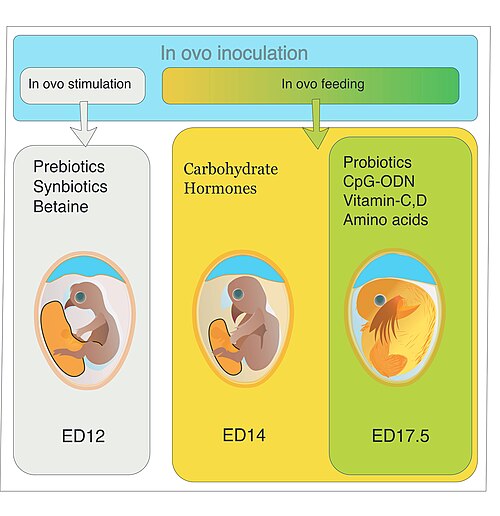
In ovo feeding is a considered as a potential tool to provide nutrient to embryo as well as to modulate performance and gut health of pre and post hatched chicks.[1] Based on the purpose the in ovo injection could be considered as in ovo stimulation or in ovo feeding.[1]
انظر أيضاً
مراجع
- 1 2 3 4 داس، رازيب؛ ميشرا، برافين؛ جها، راجيش (11-11-2021). "التغذية داخل البيضة كأداة لتحسين أداء وصحة أمعاء الدواجن: مراجعة" . مجلة فرونتيرز في العلوم البيطرية . 8 754246. doi : 10.3389/fvets.2021.754246 . ISSN 2297-1769 . PMC 8632539. PMID 34859087 .
- ↑ ريكس، سي. أ.، أفاكيان، أ.، برايان، ت.، جيلدرسليف، ر.، حداد، إ.، إيليتش، ر.، وآخرون . (1999). "تقنية التطعيم داخل البيضة". التقدم في الطب البيطري . 41 : 495-515 . doi : 10.1016/S0065-3519(99)80037-8 . PMID 9890038 .
- ١ ٢ هيكلينج ج، ديهوندت إي (ديسمبر ٢٠٠٦). "مراجعة لتقنيات إنتاج لقاحات فيروس الإنفلونزا، ومدى ملاءمتها للاستخدام في البلدان النامية للتأهب لوباء الإنفلونزا" (ملف PDF) . مبادرة منظمة الصحة العالمية لأبحاث اللقاحات . الصفحات ١-٣٤ . مؤرشف من النسخة الأصلية (ملف PDF) بتاريخ ٨ أكتوبر ٢٠١٠.
- ↑ كاي واي، سونغ إتش، يي جيه، شاو إتش، بادمانابهان آر، ساتون تي سي، بيريز دي آر (يناير 2011). "تحسين نسبة الفقس وتوفير حماية فعالة بعد التطعيم داخل البيضة بفيروسات إنفلونزا الطيور H7N2 وH9N2 الحية المضعفة" . مجلة علم الفيروسات . 8 : 31. doi : 10.1186/1743-422X- 8-31 . PMC 3032716. PMID 21255403 .
- ↑ ستون هـ، ميتشل ب، بروغ م (1997). "تطعيم أجنة الدجاج داخل البيضة بلقاحات مستحلب الزيت التجريبية لمرض نيوكاسل وإنفلونزا الطيور". أمراض الطيور . 41 (4): 856-863 . doi : 10.2307/1592339 . JSTOR 1592339. PMID 9454919 .
- ↑ "التطعيم داخل البيضة: فوائد للمفرخات الصغيرة" . موقع الدواجن .
- تلقيح