
الأكوان المتوازية في الخيال
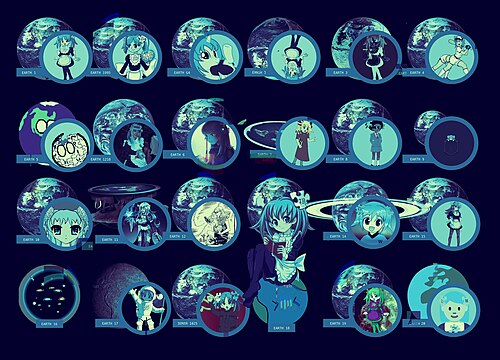
الكون الموازي ، المعروف أيضاً بالكون البديل أو العالم البديل أو البُعد البديل ، هو أداة سردية في الأدب الخيالي تستخدم فكرة وجود كون افتراضي متعايش مع كون آخر، وذلك عادةً لتمكين احتمالات سردية بديلة. ويُطلق على مجموع جميع الأكوان الموازية المحتملة التي تُشكّل الواقع اسم "الكون المتعدد ".
يخدم هذا الجهاز عدة أغراض سردية. من بينها، تم استخدام الأكوان المتوازية للسماح بقصص ذات عناصر من شأنها أن تنتهك قوانين الطبيعة عادةً ، ولتمكين الشخصيات من مقابلة والتفاعل مع نسخ بديلة من أنفسهم أو من الآخرين من كونهم الأصلي، مما يتيح مزيدًا من تطور الشخصية ، [ 1 ] وليكون بمثابة نقطة انطلاق للخيال التأملي ، وخاصة التاريخ البديل .

تاريخ
أمثلة مبكرة
تُعدّ قصة موراي لينستر القصيرة " جانباً في الزمن" ، التي نُشرت عام 1934 ، من أوائل الأمثلة على الأكوان المتوازية في أدب الخيال العلمي. ورغم أن قصة لينستر لم تكن أول مثال على الأكوان المتوازية، إلا أنها تُنسب إليها الفضل في نشر هذا المفهوم. [ 2 ] [ 3 ] [ 4 ]
انتشر استخدام الأكوان المتوازية كأداة في قصص الأبطال الخارقين مع نشر العدد 123 من سلسلة " ذا فلاش " ، بعنوان " فلاش العالمين "، في عام 1961. في هذا العدد، يلتقي فلاش الأرض -1 وفلاش الأرض-2 ، باري ألين وجاي جاريك ، مما يرسخ مفهوم الكون المتعدد في عالم دي سي كوميكس . [ 1 ]
أمثلة حديثة
The multiverse has seen much usage in popular media in the late 2010s and early 2020s, particularly in superhero films, such as the Marvel Cinematic Universe (MCU) and the animated Spider-Verse franchise, as well as the 2022 film Everything Everywhere All at Once.[5][3] Some filmmakers and critics, including MCU director Joe Russo, have expressed concern that film studios may be embracing multiverse-centric plotlines to capitalize on characters and intellectual property with pre-existing popularity, ultimately to the detriment of originality and creativity in filmmaking.[3][6][7]
Associated genres
Isekai
Isekai is a subgenre of Japanese fantasy light novels, manga, anime, and video games revolving around a normal person being transported to or trapped in a parallel universe. Often, this universe already exists in the protagonist's world as a fictional universe, but it may also be unbeknownst to them.[8]
Fan fiction
In fan fiction, parallel universes are commonly used as a setting for a story that departs from the canon of the fictional universe that the fan work is based on. Such works are usually referred to as "alternate universe" works, often abbreviated to "AU".[9] Common motivations for writing such stories are to either explore alternative narrative possibilities not depicted in the original media, or to "fix" plot points which were disliked by the fandom.[10]
See also
References
- 12Clark, Jonathan Russell (16 January 2024). "The End of the Multiverse". Esquire. Retrieved 26 March 2025.
- ↑"NOVA | Parallel Worlds, Parallel Lives | Science Fiction and Fact (non-Flash)". www.pbs.org. Retrieved 26 March 2025.
- 123Burt, Stephanie (31 October 2022). "Is the Multiverse Where Originality Goes to Die?". www.newyorker.com.
- ↑Wolfe, Gary (4 July 2007). "Surfing the multiverse". Nature. 448 (7149): 25–26. doi:10.1038/448025a. ISSN 1476-4687.
- ↑'Dockterman, Eliana (27 April 2022). "A Guide to All the Major Cinematic Multiverses". Time.
- ↑Weiss, Josh (24 February 2022). "'Avengers: Endgame' co-director Joe Russo warns multiverse could be too much of a good thing". Syfy.
- ↑Kain, Erik (14 November 2023). "The Madness Of The Multiverse: How Infinite Universes Are Killing The Superhero Genre". Forbes.
- ↑Dennison, Kara (17 January 2018). "Hacking the Isekai: Make Your Parallel World Work for You". Crunchyroll. Archived from the original on 20 March 2018. Retrieved 20 March 2018.
- ↑Finn, Kavita Mudan; McCall, Jessica (2016). "Exit, pursued by a fan: Shakespeare, Fandom, and the Lure of the Alternate Universe". Critical Survey. 28 (2): 27–38. ISSN 0011-1570.
- ↑Koning, A. J. (25 June 2015). "Chapter 3 A Quest For Family". THE FAMOUS AND THEIR FOLLOWERS FANFICTION AS AN ALTERNATIVE FORM OF LITERARY CRITICISM(PDF) (BA). Utrecht University.
External links
 Media related to Multiverse (science fiction) at Wikimedia Commons
- Fiction about parallel universes
- Science fiction themes
- Science fiction genres
- Setting
- Multiverse