
Rotational partition function
In chemistry, the rotational partition function relates the rotational degrees of freedom to the rotational part of the energy.
Definition
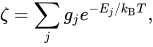
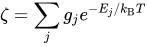
The total canonical partition function of a system of identical, indistinguishable, noninteracting atoms or molecules can be divided into the atomic or molecular partition functions :[1] with: where is the degeneracy of the jth quantum level of an individual particle, is the Boltzmann constant, and is the absolute temperature of system. For molecules, under the assumption that total energy levels can be partitioned into its contributions from different degrees of freedom (weakly coupled degrees of freedom)[2] and the number of degenerate states are given as products of the single contributions where "trans", "ns", "rot", "vib" and "e" denotes translational, nuclear spin, rotational and vibrational contributions as well as electron excitation, the molecular partition functions can be written as a product itself







Linear molecules
Rotational energies are quantized. For a diatomic molecule like CO or HCl, or a linear polyatomic molecule like OCS in its ground vibrational state, the allowed rotational energies in the rigid rotor approximation are J is the quantum number for total rotational angular momentum and takes all integer values starting at zero, i.e., , is the rotational constant, and is the moment of inertia. Here we are using B in energy units. If it is expressed in frequency units, replace B by hB in all the expression that follow, where h is the Planck constant. If B is given in units of , then replace B by hcB where c is the speed of light in vacuum.




For each value of J, we have rotational degeneracy, = (2J+1), so the rotational partition function is therefore

For all but the lightest molecules or the very lowest temperatures we have . This suggests we can approximate the sum by replacing the sum over J by an integral of J treated as a continuous variable.


This approximation is known as the high temperature limit. It is also called the classical approximation as this is the result for the canonical partition function for a classical rigid rod.
باستخدام صيغة أويلر-ماكلورين، يمكن إيجاد تقدير محسّن [ 3 ]

بالنسبة لجزيء أول أكسيد الكربون عندالمساهمة (بدون وحدة)لتبين أن نطاقها.


يمكن الآن حساب متوسط الطاقة الدورانية الحرارية لكل جزيء عن طريق اشتقاقفيما يتعلق بدرجة الحرارةفي تقريب حد درجة الحرارة العالية، تكون الطاقة الدورانية الحرارية المتوسطة لدوار صلب خطي هي.

تأثيرات التناظر الكمي
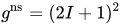
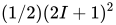
بالنسبة لجزيء ثنائي الذرة ذي مركز تناظر، مثلأو(أيالمجموعة النقطية )، دوران الجزيء بواسطةسيؤدي الدوران بزاوية π/π حول محور عمودي على محور الجزيء ويمر بمركز كتلته إلى تبادل أزواج من الذرات المتكافئة. تنص نظرية الإحصاء الدوراني في ميكانيكا الكم على أن الدالة الموجية الجزيئية الكلية إما متناظرة أو غير متناظرة بالنسبة لهذا الدوران، وذلك اعتمادًا على ما إذا كان عدد أزواج النوى الفرميونية المتبادلة زوجيًا أم فرديًا. ستكون الدالة الموجية الإلكترونية والاهتزازية المعطاة إما متناظرة أو غير متناظرة بالنسبة لهذا الدوران. ستشهد الدالة الموجية الدورانية ذات العدد الكمي J تغيرًا في الإشارة.يمكن تصنيف حالات اللف المغزلي النووي إلى حالات متناظرة أو غير متناظرة بالنسبة للتباديل النووية الناتجة عن الدوران. في حالة جزيء ثنائي الذرة متناظر ذي عدد كمي لللف المغزلي النووي I لكل نواة، يوجددوال الدوران المتناظرة وهي دوال مضادة للتناظر لعدد إجمالي من الدوال النووية. Nuclei with an even nuclear mass number are bosons and have integer nuclear spin quantum number, I. Nuclei with odd mass number are fermions and had half integer I. For the case of H2, rotation exchanges a single pair of fermions and so the overall wavefunction must be antisymmetric under the half rotation. The vibration-electronic function is symmetric and so the rotation-vibration-electronic will be even or odd depending upon whether J is an even or odd integer. Since the total wavefunction must be odd, the even J levels can only use the antisymmetric functions (only one for I = 1/2) while the odd J levels can use the symmetric functions ( three for I = 1/2). For D2, I = 1 and thus there are six symmetric functions, which go with the even J levels to produce an overall symmetric wavefunction, and three antisymmetric functions that must go with odd J rotational levels to produce an overall even function. The number of nuclear spin functions that are compatible with a given rotation-vibration-electronic state is called the nuclear spin statistical weight of the level, often represented as . Averaging over both even and odd J levels, the mean statistical weight is , which is one half the value of expected ignoring the quantum statistical restrictions. In the high temperature limit, it is traditional to correct for the missing nuclear spin states by dividing the rotational partition function by a factor with known as the rotational symmetry number which is 2 for linear molecules with a center of symmetry and 1 for linear molecules without.








Nonlinear molecules
A rigid, nonlinear molecule has rotational energy levels determined by three rotational constants, conventionally written and , which can often be determined by rotational spectroscopy. In terms of these constants, the rotational partition function can be written in the high temperature limit as [4] with again known as the rotational symmetry number [5] which in general equals the number ways a molecule can be rotated to overlap itself in an indistinguishable way, i.e. that at most interchanges identical atoms. Like in the case of the diatomic treated explicitly above, this factor corrects for the fact that only a fraction of the nuclear spin functions can be used for any given molecular level to construct wavefunctions that overall obey the required exchange symmetries. Another convenient expression for the rotational partition function for symmetric and asymmetric tops is provided by Gordy and Cook: where the prefactor comes from عندما يتم التعبير عن A و B و C بوحدات ميغاهرتز. [ 6 ]


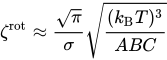
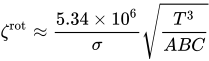
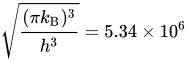
التعبيرات لـيعمل مع الدوارات العلوية غير المتماثلة والمتماثلة والكروية.
مراجع
- ↑ دونالد أ. ماكواري، الميكانيكا الإحصائية ، هاربر آند رو، 1973
- ↑ دونالد أ. ماكواري، المرجع نفسه
- ↑ جي. هيرزبرغ، أطياف الأشعة تحت الحمراء وأطياف رامان ، فان نوستراند رينهولد، 1945، المعادلة (V,21)
- ↑ ج. هيرزبرغ، المرجع نفسه ، المعادلة (V,29)
- ↑ ج. هيرزبرغ، المرجع نفسه ؛ انظر الجدول 140 للاطلاع على قيم مجموعات النقاط الجزيئية الشائعة
- ↑ كوك، روبرت ل.؛ جوردي، والتر (1970). أطياف الجزيئات الميكروية ( الطبعة الثانية). دار إنترساينس للنشر. الصفحات 56-57 . ISBN 0-471-08681-9.
انظر أيضاً
- معادلات الفيزياء
- دوال التقسيم