
Sears–Haack body
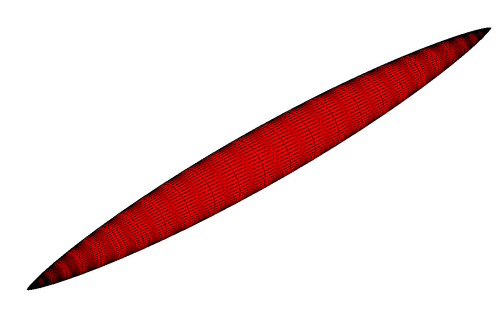
The Sears–Haack body is the shape with the lowest theoretical wave drag in supersonic flow, for a slender solid body of revolution with a given body length and volume. The mathematical derivation assumes small-disturbance (linearized) supersonic flow, which is governed by the Prandtl–Glauert equation. The derivation and shape were published independently by two separate researchers: Wolfgang Haack in 1941 and later by William Sears in 1947.[1][2][3]
The Kármán–Moore theory indicates that the wave drag scales as the square of the second derivative of the area distribution, (see full expression below), so for low wave drag it is necessary that be smooth. Thus, the Sears–Haack body is pointed at each end and grows smoothly to a maximum and then decreases smoothly toward the second point.
![{\displaystyle D_{\text{wave}}\sim \left[S''\left(x\right)\right]^{2}}](https://wikimedia.org/api/rest_v1/media/math/render/svg/b61ee53342700adb764d6d7dec346fb1f486c00e)

Useful formulas
Because these formulas assume a slender body, they assume L >> 2Rmax (i.e. a large fineness ratiof = L/2Rmax), but no specific upper limit on Rmax (or lower limit on fineness) is specified.
![{\displaystyle {\begin{aligned}R_{\text{max}}&={\frac {4}{\pi }}{\sqrt {\frac {V}{3L}}}\\V&={\frac {3\pi ^{2}}{16}}R_{\text{max}}^{2}L\\L&={\frac {16V}{3\pi ^{2}R_{\text{max}}^{2}}}\\f&:={\frac {L}{2R_{\text{max}}}}={\frac {\pi }{8}}{\sqrt {\frac {3L^{3}}{V}}}&&={\frac {8V}{3\pi ^{2}R_{\text{max}}^{3}}}\\S_{\text{max}}&={\frac {16V}{3\pi L}}&&=\pi R_{\text{max}}^{2}\\S(x)&={\frac {128V}{3\pi L}}{\bigl (}x(1-x){\bigr )}^{3/2}&&=8\pi R_{\text{max}}^{2}{\bigl (}x(1-x){\bigr )}^{3/2}\\r(x)&={\frac {8}{\pi }}{\sqrt {\frac {2V}{3L}}}{\bigl (}x(1-x){\bigr )}^{3/4}&&=2{\sqrt {2}}R_{\text{max}}{\bigl (}x(1-x){\bigr )}^{3/4}\\r'(x)&={\frac {3R_{\text{max}}(1-2x)}{{\sqrt {2}}{\sqrt[{4}]{x(1-x)}}}},&&S'(x)=12\pi R_{\text{max}}^{2}(1-2x){\sqrt {x(1-x)}}\\r''(x)&=-{\frac {3R_{\text{max}}{\bigl (}1+4x(1-x){\bigr )}}{4{\sqrt {2}}{\bigl (}x(1-x){\bigr )}^{5/4}}},&&S''(x)=-{\frac {6\pi R_{\text{max}}^{2}(8(1-x)x-1)}{\sqrt {x(1-x)}}}\\\end{aligned}}}](https://wikimedia.org/api/rest_v1/media/math/render/svg/2eb9428881e9e76f9a38072e473549bea6b54b73)
where:
- x is the ratio of the distance from the nose to the whole body length (this is always between 0 and 1),
- is the local radius,
- is the local slope,
- is the local cross-sectional area,
- is the radius at its maximum (occurs at x = 0.5, center of the shape),
- is the maximum cross-sectional area when x = 0.5 and = ,
- V is the volume,
- L is the length,
- f is the fineness ratio.


From Kármán–Moore theory, it follows that:

aIternatively:

These formulae may be combined to get the following:

where:
- is the wave drag force,
- is the drag coefficient (normaled by the dynamic pressure and frontal area),
- ρ is the density of the fluid,
- U is the velocity,
- ρb is the average density of the body,
- a is the magnitude of the acceleration due to the wave drag force.


Since the kinetic energyE of the body depends solely on its volume, density, and velocity, this can also be presented as:

Derivation
وفقًا لنظرية كارمان-مور ، تُعطى قوة سحب الموجة بالعلاقة التالية

أينهي مساحة المقطع العرضي للجسم العمودية على محور الجسم؛ هنايمثل الطليعة والحافة الخلفية هي ، على الرغم من أن نظرية كارمان-مور لا تميز بين هاتين النهايتين لأن معامل السحب مستقل عن اتجاه الحركة في النظرية الخطية. بدلاً من، يمكننا تعريف الدالةوقم بتوسيعها في سلسلة


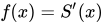

أينتبدأ السلسلة منبسبب الحالةلدينا




لاحظ أن حجم الجسم يعتمد فقط على المعامل.

لحساب قوة السحب، سنقوم أولاً بإعادة كتابة صيغة قوة السحب، وذلك بالتكامل بالتجزئة مرة واحدة.

في أييرمز إلى القيمة الرئيسية لكوشي . الآن يمكننا استبدال التوسع بـوقم بتكامل التعبير باستخدام المتطابقتين التاليتين



والنتيجة النهائية، المعبر عنها بدلالة معامل السحب C d ، تُعطى ببساطة بواسطة [ 4 ]

منذيعتمد فقط على، القيمة الدنيا لـيتم الوصول إلى هذه المرحلة عندمال.


وبالتالي، فإن الإعدادل، نحصل
![{\displaystyle {\begin{aligned}S&={\frac {l^{3}A_{2}\sin ^{3}\theta }{3}}\\C_{d}&={\frac {128}{\pi }}\left({\frac {V}{l^{3}}}\right)^{2}={\frac {9\pi }{2}}\left({\frac {S_{\mathrm {max} }}{l^{2}}}\right)^{2}\\r(x)&={\frac {8}{\pi l^{2}}}{\sqrt {\frac {2V}{3}}}[x(lx)]^{\frac {3}{4}}={\frac {8}{\pi }}{\sqrt {\frac {2V}{3l}}}\left[{\frac {x}{l}}\left(1-{\frac {x}{l}}\right)\right]^{\frac {3}{4}}\\\end{aligned}}}](https://wikimedia.org/api/rest_v1/media/math/render/svg/c8f56407f6da27fac1b822f296e0b83ab0e25727)
أينيمثل نصف القطر كدالة لـ x ؛يُظهر الإصدار الصيغة حيث يكون x نسبيًا إلى l ، كما هو الحال في قسم الصيغ المفيدة أعلاه.

التعميم بواسطة آر تي جونز
إن اشتقاق شكل الجسم لسيرز-هاك صحيح فقط في حالة الجسم النحيف. وقد عُممت النظرية لتشمل الأشكال النحيفة غير المتناظرة محوريًا بواسطة روبرت ت. جونز في تقرير NACA رقم 1284. [ 5 ] في هذا التوسيع، المساحةيتم تعريفها على مخروط ماخ الذي تقع قمته في الموقعبدلاً من أن يكون علىالطائرة كما افترضها سيرز وهاك. ومن ثم، فإن نظرية جونز تجعلها قابلة للتطبيق على أشكال أكثر تعقيدًا مثل الطائرات الأسرع من الصوت بأكملها .


قاعدة المنطقة
يُعدّ مفهوم قاعدة ويتكومب للمساحة مفهومًا ذا صلة ظاهرية ، إذ تنصّ على أن مقاومة الموجة الناتجة عن الحجم في التدفق فوق الصوتي تعتمد أساسًا على توزيع مساحة المقطع العرضي الكلية، وللحصول على مقاومة موجة منخفضة، يجب أن يكون هذا التوزيع سلسًا. ومن المفاهيم الخاطئة الشائعة أن جسم سيرز-هاك يمتلك توزيع المساحة المثالي وفقًا لقاعدة المساحة، ولكن هذا غير صحيح. فمعادلة براندتل-غلاورت ، التي تُشكّل نقطة البداية في اشتقاق شكل جسم سيرز-هاك، لا تُطبّق في التدفق فوق الصوتي، حيث تُطبّق قاعدة المساحة .
انظر أيضاً
مراجع
- ^ هاك، دبليو (1941). Geschossformen kleinsten wellenwiderstandes. بيريشت دير ليلينثال جيزيلشافت، 136(1)، 14-28.
- ↑ سيرز، دبليو آر (1947). حول المقذوفات ذات الحد الأدنى من مقاومة الأمواج. مجلة الرياضيات التطبيقية الفصلية، 4(4)، 361-366.
- ↑ بالانيابان، كارتيك (2004). الأجسام ذات أقل مقاومة ضغط في التدفق فوق الصوتي - دراسة التأثيرات غير الخطية (ملف PDF) . المؤتمر والمعرض الثاني والعشرون للديناميكا الهوائية التطبيقية. أنتوني جيمسون . تاريخ الاسترجاع: 16 سبتمبر 2010 .
- ↑ لاندو، إل دي، وليفشيتز، إي إم (2013). ميكانيكا الموائع: لاندو وليفشيتز: دورة في الفيزياء النظرية، المجلد 6 (المجلد 6). إلسيفير. الصفحات 473-474.
- ↑ تقرير NACA رقم 1284، نظرية مقاومة جسم الجناح عند السرعات فوق الصوتية، بقلم روبرت تي. جونز، 8 يوليو 1953
روابط خارجية
- رصاصة بندقية هاك ذات مقاومة السحب الدنيا، مؤرشفة بتاريخ 27-09-2007 على موقع Wayback Machine ( الموقع معطل) – https://web.archive.org/web/20160306044740/http://www.lima-wiederladetechnik.de/englisch/haack_minimum_drag_bullet.htm
- Geschoßformen kleinsten Wellenwiderstandes بقلم دبليو هاك، Bericht 139 der Lilienthal-Gesellschaft (1941)
- حاسبة الجسم من سيرز-هاك
- الديناميكا الهوائية