Tangent vector

In mathematics, a tangent vector is a vector that is tangent to a curve or surface at a given point. Tangent vectors are described in the differential geometry of curves in the context of curves in Rn. More generally, tangent vectors are elements of a tangent space of a differentiable manifold. Tangent vectors can also be described in terms of germs. Formally, a tangent vector at the point x{\displaystyle x} is a linear derivation of the algebra defined by the set of germs at x{\displaystyle x}.

Motivation

Before proceeding to a general definition of the tangent vector, we discuss its use in calculus and its tensor properties.

Calculus

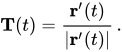
Let r(t){\displaystyle \mathbf {r} (t)} be a parametric smooth curve. The tangent vector is given by r(t){\displaystyle \mathbf {r} '(t)} provided it exists and provided r(t)0{\displaystyle \mathbf {r} '(t)\neq \mathbf {0} }, where we have used a prime instead of the usual dot to indicate differentiation with respect to parameter t.[1] The unit tangent vector is given by T(t)=r(t)|r(t)|.{\displaystyle \mathbf {T} (t)={\frac {\mathbf {r} '(t)}{|\mathbf {r} '(t)|}}\,.}

Example

Given the curve r(t)={(1+t2,e2t,cost)tR}{\displaystyle \mathbf {r} (t)=\left\{\left(1+t^{2},e^{2t},\cos {t}\right)\mid t\in \mathbb {R} \right\}} in R3{\displaystyle \mathbb {R} ^{3}}, the unit tangent vector at t=0{\displaystyle t=0} is given by T(0)=r(0)r(0)=(2t,2e2t,sint)4t2+4e4t+sin2t|t=0=(0,1,0).{\displaystyle \mathbf {T} (0)={\frac {\mathbf {r} '(0)}{\|\mathbf {r} '(0)\|}}=\left.{\frac {(2t,2e^{2t},-\sin {t})}{\sqrt {4t^{2}+4e^{4t}+\sin ^{2}{t}}}}\right|_{t=0}=(0,1,0)\,.} Where the components of the tangent vector are found by taking the derivative of each corresponding component of the curve with respect to t{\displaystyle t}.

Contravariance

If r(t){\displaystyle \mathbf {r} (t)} is given parametrically in the n-dimensional coordinate systemxi (here we have used superscripts as an index instead of the usual subscript) by r(t)=(x1(t),x2(t),,xn(t)){\displaystyle \mathbf {r} (t)=(x^{1}(t),x^{2}(t),\ldots ,x^{n}(t))} or r=xi=xi(t),atb,{\displaystyle \mathbf {r} =x^{i}=x^{i}(t),\quad a\leq t\leq b\,,} then the tangent vector field T=Ti{\displaystyle \mathbf {T} =T^{i}} is given by Ti=dxidt.{\displaystyle T^{i}={\frac {dx^{i}}{dt}}\,.} Under a change of coordinates ui=ui(x1,x2,,xn),1in{\displaystyle u^{i}=u^{i}(x^{1},x^{2},\ldots ,x^{n}),\quad 1\leq i\leq n} the tangent vector T¯=T¯i{\displaystyle {\bar {\mathbf {T} }}={\bar {T}}^{i}} in the ui-coordinate system is given by T¯i=duidt=uixsdxsdt=Tsuixs{\displaystyle {\bar {T}}^{i}={\frac {du^{i}}{dt}}={\frac {\partial u^{i}}{\partial x^{s}}}{\frac {dx^{s}}{dt}}=T^{s}{\frac {\partial u^{i}}{\partial x^{s}}}} where we have used the Einstein summation convention. Therefore, a tangent vector of a smooth curve will transform as a contravariant tensor of order one under a change of coordinates.[2]


Definition

Let f:RnR{\displaystyle f:\mathbb {R} ^{n}\to \mathbb {R} } be a differentiable function and let v{\displaystyle \mathbf {v} } be a vector in Rn{\displaystyle \mathbb {R} ^{n}}. We define the directional derivative in the v{\displaystyle \mathbf {v} } direction at a point xRn{\displaystyle \mathbf {x} \in \mathbb {R} ^{n}} by vf(x)=ddtf(x+tv)|t=0=i=1nvifxi(x).{\displaystyle \nabla _{\mathbf {v} }f(\mathbf {x} )=\left.{\frac {d}{dt}}f(\mathbf {x} +t\mathbf {v} )\right|_{t=0}=\sum _{i=1}^{n}v_{i}{\frac {\partial f}{\partial x_{i}}}(\mathbf {x} )\,.} The tangent vector at the point x{\displaystyle \mathbf {x} } may then be defined[3] as v(f(x))(v(f))(x).{\displaystyle \mathbf {v} (f(\mathbf {x} ))\equiv (\nabla _{\mathbf {v} }(f))(\mathbf {x} )\,.}

Properties

Let f,g:RnR{\displaystyle f,g:\mathbb {R} ^{n}\to \mathbb {R} } be differentiable functions, let v,w{\displaystyle \mathbf {v} ,\mathbf {w} } be tangent vectors in Rn{\displaystyle \mathbb {R} ^{n}} at xRn{\displaystyle \mathbf {x} \in \mathbb {R} ^{n}}, and let a,bR{\displaystyle a,b\in \mathbb {R} }. Then

  1. (av+bw)(f)=av(f)+bw(f){\displaystyle (a\mathbf {v} +b\mathbf {w} )(f)=a\mathbf {v} (f)+b\mathbf {w} (f)}
  2. v(af+bg)=av(f)+bv(g){\displaystyle \mathbf {v} (af+bg)=a\mathbf {v} (f)+b\mathbf {v} (g)}
  3. v(fg)=f(x)v(g)+g(x)v(f).{\displaystyle \mathbf {v} (fg)=f(\mathbf {x} )\mathbf {v} (g)+g(\mathbf {x} )\mathbf {v} (f)\,.}

Tangent vector on manifolds

Let M{\displaystyle M} be a differentiable manifold and let A(M){\displaystyle A(M)} be the algebra of real-valued differentiable functions on M{\displaystyle M}. Then the tangent vector to M{\displaystyle M} at a point x{\displaystyle x} in the manifold is given by the derivationDv:A(M)R{\displaystyle D_{v}:A(M)\rightarrow \mathbb {R} } which shall be linear i.e., for any f,gA(M){\displaystyle f,g\in A(M)} and a,bR{\displaystyle a,b\in \mathbb {R} } we have

Dv(af+bg)=aDv(f)+bDv(g).{\displaystyle D_{v}(af+bg)=aD_{v}(f)+bD_{v}(g)\,.}

Note that the derivation will by definition have the Leibniz property

Dv(fg)(x)=Dv(f)(x)g(x)+f(x)Dv(g)(x).{\displaystyle D_{v}(f\cdot g)(x)=D_{v}(f)(x)\cdot g(x)+f(x)\cdot D_{v}(g)(x)\,.}

See also

References

  1. J. Stewart (2001)
  2. D. Kay (1988)
  3. A. Gray (1993)

Bibliography

  • Gray, Alfred (1993), Modern Differential Geometry of Curves and Surfaces, Boca Raton: CRC Press.
  • Stewart, James (2001), Calculus: Concepts and Contexts, Australia: Thomson/Brooks/Cole.
  • Kay, David (1988), Schaums Outline of Theory and Problems of Tensor Calculus, New York: McGraw-Hill.