
Bagnold number
The Bagnold number (Ba) is the ratio of grain collision stresses to viscous fluid stresses in a granular flow with interstitial Newtonian fluid, first identified by Ralph Alger Bagnold.[1]
The Bagnold number is defined by
- ,[2]
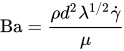
where is the particle density, is the grain diameter, is the shear rate and is the dynamic viscosity of the interstitial fluid. The parameter is known as the linear concentration, and is given by


- ,
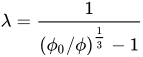
where is the solids fraction and is the maximum possible concentration (see random close packing).


In flows with small Bagnold numbers (Ba < 40), viscous fluid stresses dominate grain collision stresses, and the flow is said to be in the "macro-viscous" regime. Grain collision stresses dominate at large Bagnold number (Ba > 450), which is known as the "grain-inertia" regime. A transitional regime falls between these two values.
See also
References
- ↑Bagnold, R. A. (1954). "Experiments on a Gravity-Free Dispersion of Large Solid Spheres in a Newtonian Fluid under Shear". Proc. R. Soc. Lond. A. 225 (1160): 49–63. Bibcode:1954RSPSA.225...49B. doi:10.1098/rspa.1954.0186. S2CID 98030586.
- ↑Hunt, M. L.; Zenit, R.; Campbell, C. S.; Brennen, C.E. (2002). "Revisiting the 1954 suspension experiments of R. A. Bagnold". Journal of Fluid Mechanics. 452 (1): 1–24. Bibcode:2002JFM...452....1H. CiteSeerX 10.1.1.564.7792. doi:10.1017/S0022112001006577. S2CID 9416685.
External links
- Granular Material Flows at N.A.S.A
- Granularity of materials
- Bubbles (physics)
- Dimensionless numbers of fluid mechanics
- Number stubs