
Filled Julia set
The filled-in Julia set of a polynomial is the union of a Julia set and its interior, non-escaping set.


Formal definition
The filled-in Julia set of a polynomial is defined as the set of all points of the dynamical plane that have boundedorbit with respect to where:


- is the set of complex numbers
- is the -fold composition of with itself = iteration of function


Relation to the Fatou set
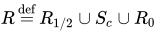
The filled-in Julia set is the (absolute) complement of the attractive basin of infinity.

The attractive basin of infinity is one of the components of the Fatou set.
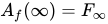
In other words, the filled-in Julia set is the complement of the unbounded Fatou component:

Relation between Julia, filled-in Julia set and attractive basin of infinity
The Julia set is the common boundary of the filled-in Julia set and the attractive basin of infinity where: denotes the attractive basin of infinity = exterior of filled-in Julia set = set of escaping points for



If the filled-in Julia set has no interior then the Julia set coincides with the filled-in Julia set. This happens when all the critical points of are pre-periodic. Such critical points are often called Misiurewicz points.
Spine
 Rabbit Julia set with spine
 Basilica Julia set with spine
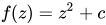
The most studied polynomials are probably those of the form, which are often denoted by , where is any complex number. In this case, the spine of the filled Julia set is defined as arc between -fixed point and , with such properties:


![{\displaystyle S_{c}=\left[-\beta ,\beta \right]}](https://wikimedia.org/api/rest_v1/media/math/render/svg/0dc28d767679ab7c75c23b245f5213dc2e38cb52)
- spine lies inside .[1] This makes sense when is connected and full[2]
- spine is invariant under 180 degree rotation,
- spine is a finite topological tree,
- Critical point always belongs to the spine.[3]
- -fixed point is a landing point of external ray of angle zero ,
- is landing point of external ray.


Algorithms for constructing the spine:
- detailed version is described by A. Douady[4]
- Simplified version of algorithm:
- connect and within by an arc,
- when has empty interior then arc is unique,
- otherwise take the shortest way that contains .[5]

Curve : divides dynamical plane into two components.

Images
 Filled Julia set for fc, c=1−φ=−0.618033988749…, where φ is the Golden ratio
 Filled Julia with no interior = Julia set. This example has c=i.
 Filled Julia set for c=−1+0.1*i. Here Julia set is the boundary of filled-in Julia set.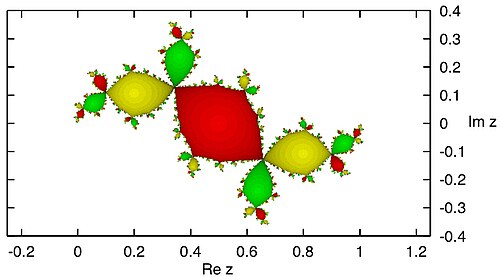
 Filled Julia set for c = −0.8 + 0.156i.
 Filled Julia set for c = 0.285 + 0.01i.
 Filled Julia set for c = −1.476.
Names
- airplane[6]
- Douady rabbit
- dragon
- basilica or San Marco fractal or San Marco dragon
- cauliflower
- dendrite
- Siegel disc
Notes
- ↑Douglas C. Ravenel: External angles in the Mandelbrot set: the work of Douady and Hubbard. University of RochesterArchived 2012-02-08 at the Wayback Machine
- ↑John Milnor : Pasting Together Julia Sets: A Worked Out Example of Mating. Experimental Mathematics Volume 13 (2004)
- ↑Saaed Zakeri: Biaccessiblility in quadratic Julia sets I: The locally-connected case
- ↑A. Douady, “Algorithms for computing angles in the Mandelbrot set,” in Chaotic Dynamics and Fractals, M. Barnsley and S. G. Demko, Eds., vol. 2 of Notes and Reports in Mathematics in Science and Engineering, pp. 155–168, Academic Press, Atlanta, Georgia, USA, 1986.
- ↑K M. Brucks, H Bruin : Topics from One-Dimensional Dynamics Series: London Mathematical Society Student Texts (No. 62) page 257
- ↑The Mandelbrot Set And Its Associated Julia Sets by Hermann Karcher
References
- Peitgen Heinz-Otto, Richter, P.H. : The beauty of fractals: Images of Complex Dynamical Systems. Springer-Verlag 1986. ISBN 978-0-387-15851-8.
- Bodil Branner : Holomorphic dynamical systems in the complex plane. Department of Mathematics Technical University of Denmark, MAT-Report no. 1996-42.
- Fractals
- Limit sets
- Complex dynamics