
Fortingall
Fortingall (Scottish Gaelic: Fartairchill) (lit. "Escarpment Church"—i.e. "church at the foot of an escarpment or steep slope") is a small village in Glen Lyon, Perthshire, Scotland.[1] Its nearest sizable neighbours are Aberfeldy and Kenmore.
Local legend claims that it was the birthplace of Pontius Pilate, although he was born well before the Roman conquest and became famous in the biblical account of Jesus's death 30 years before the Romans first reached this part of Scotland.[2] A number of other locations, including villages in Spain and Germany, make similar claims. It is also famous for the Fortingall Yew, the village's churchyard yew tree that could be over 5,000 years old, and thus one of the oldest living things in Europe.
Parish church

The parish church is on an early Christian site, dedicated to Coeddi, bishop of Iona (d. 712), probably founded about 700 AD from Iona itself as a daughter monastery. Though undocumented, crop-marks of surrounding ditched enclosures have been identified from the air, and the church's unusual dedication and fragments of several finely carved cross-slabs preserved in the church all point to an early origin as a major church site. Also preserved in an alcove in the church was an early hand-bell in Irish style (iron with bronze coating), dating from the 7th or 8th century, one of several to have survived in Highland Perthshire; the bell was stolen in 2017.[3] Several slabs with simple incised crosses (best paralleled at Iona and other west of Scotland sites) and a massive early font are to be seen in the churchyard. The attractive white-harled parish church (built 1901–02), notable for its fine woodwork, is open in summer. Its Arts and Crafts style was designed to harmonise with the rest of the village. A permanent display on the cross-slabs and the early church was recently installed in the building. Fortingall has one of the largest collections of early medieval sculpture in Scotland.
The yew tree
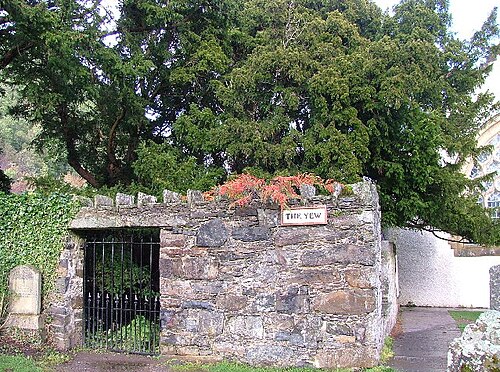
The Fortingall Yew is an ancient tree in its own walled enclosure within the village churchyard. Its age has been estimated between 2000 and 9000 years – with the higher estimate putting it in contention of the oldest living tree – perhaps even the oldest living thing – in Europe.[4] Place-name and archaeological evidence hint at an Iron Age cult centre at Fortingall, which may have had this tree as its focus. The site was Christianised during the Dark Ages, perhaps because it was already a sacred place.
Village planning
The attractive village, with its large hotel adjoining the churchyard, was built in 1890–1891 by shipowner and Unionist MP, Sir Donald Currie, who bought the Glenlyon Estate – including the village – in 1885. It was designed by the architect James M MacLaren and built by John McNaughton. The thatched cottages are notable examples of a planned village built in vernacular style (here combining both Lowland Scottish and English influences, notably from Devon) and are increasingly appreciated as one of the most important examples of 'arts and crafts' vernacular style in Scotland. Following roof fires in the 1970s and 1980s, several thatched roofs were converted to tiles and remain so today.[5] The Fortingall Hotel, which was restored to its original appearance in 2006–2007, is an important example of Scottish vernacular revival. It is based on the tower-houses and burgh architecture of the 16th and 17th centuries, but in a modern idiom which anticipates the buildings of Charles Rennie Mackintosh, whose work MacLaren influenced.
Glenlyon House, and its adjoining Farm and steading, west of the village, were also designed, or largely rebuilt, to MacLaren's designs.
Archaeology
تضم المنطقة المحيطة مباشرةً بفورتينغال واحدة من أغنى تجمعات المواقع الأثرية التي تعود إلى عصور ما قبل التاريخ في اسكتلندا، بما في ذلك كارن نام مارب، أي "رجم الموتى" باللغة الغيلية ، وهو تلٌّ أُعيد استخدامه من العصر البرونزي، ويُقال إنه استُخدم كمقبرة لضحايا الطاعون في القرن الرابع عشر، وموقعًا لاحتفال سامهاين في القرية . وتشمل المواقع الأخرى دائرة فورتينغال الحجرية، والأحجار القائمة بما فيها جسر ليون، ومجموعات حجرية على شكل أربعة أعمدة، وحصون دائرية (أسوار ضخمة لمنازل من العصر الحديدي)، والعديد من الأحجار المنقوشة بالكؤوس والحلقات (بما في ذلك حجرٌ تمّ استخراجه وحفظه في فناء الكنيسة)، وخندقٌ مائيٌّ محفوظٌ بشكلٍ ممتازٍ يعود إلى العصور الوسطى، والذي اعتقد علماء الآثار الأوائل أنه من أصل روماني نظرًا لشكلِه المنتظم.
تُعد أبرشية فورتينغال (المرتبطة الآن بغلينليون) واحدة من أكبر الأبرشيات في اسكتلندا، وتضم غلين ليون ، المشهورة بمناظرها الجبلية والعديد من المواقع الأثرية، وهي أطول وادٍ جبلي مغلق في البلاد.
معرض
 فندق فورتينغال
 الدوائر الحجرية
مراجع
- ↑ "بحيرة تاي ووادي دوشارت"، خريطة مسح الأراضي (طبعة B2 )، 2008، رقم ISBN 978-0-319-22979-8
- ↑ ديكي، دوغلاس (19 أبريل 2019). "لا يمكن تصديق أسطورة بيلاطس البنطي" . ديلي ريكورد . تم الاطلاع عليه في 2 أغسطس 2020 .
- ↑ «جرس يدوي سلتيكي، من القرن السابع، سُرق من كنيسة في بيرثشاير» . بي بي سي . ١٠ سبتمبر ٢٠١٧. تم الاطلاع عليه بتاريخ ٢٧ أكتوبر ٢٠١٩ .
- ↑ باكنهام، توماس. (2003). أشجار العالم الرائعة . وايدنفيلد ونيكلسون المصورة. ISBN 0-297-84349-4. OCLC 51965877 .
- ↑ سجلات بيرثشاير أدفرتايزر
للمزيد من القراءة
- فريزر، د. 1973 هايلاند بيرثشاير ، ستاندرد برس، مونتروز.
- صندوق بيرث وكينروس للتراث 2003 كنيسة وقرية فورتينغال ، بيرث.
- روبرتسون، نيو مكسيكو 1997 "الأحجار المنحوتة في فورتينغال" في هنري، د (محرر) الدودة، الجرثومة والشوكة: دراسات البيكتية وما يتصل بها مقدمة إلى إيزابيل هندرسون ، مطبعة بينكفوت، بالغافيس، أنغوس، 133-48.
- ستيوارت، ألكسندر "أبرشية المرتفعات أو تاريخ فورتينغال"، ماكلارين وشركاه، غلاسكو، 1928
- قرى في بيرث وكينروس
- التلال الأثرية في اسكتلندا
- بونتيوس بيلاطس