
Cercomonad
Cercomonads are small amoeboflagellates,[2] widespread in aqueous habitats and common in soils.[3]
Characteristics
The cells are generally around 10 μm in length, without any shell or covering. They produce filose pseudopods to capture bacteria, but do not use them for locomotion, which usually takes place by gliding along surfaces.
Most members have two flagella,[4] one directed forward and one trailing under the cell, inserted at right angles near its anterior. The nucleus is connected to the flagellar bases and accompanied by a characteristic paranuclear body.
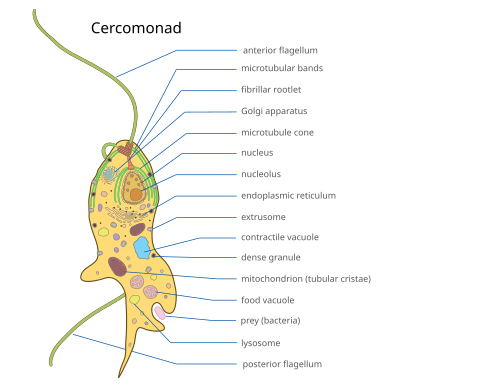
- Anterior flagellum
- Microtubular bands
- Fibrillar rootlet
- Golgi apparatus; modifies proteins and sends them out of the cell
- Microtubule cone
- Nucleus
- Nucleolus
- Endoplasmic reticulum, the transport network for molecules going to specific parts of the cell
- Extrusome
- Contractile vacuole, regulates the quantity of water inside a cell
- Dense granule
- Mitochondrion, creates ATP (energy) for the cell, tubular cristae
- Food vacuole
- Prey (bacteria)
- Lysosome, holds enzymes
- Posterior flagellum
Classification
Genetic studies place the cercomonads among the Cercozoa,[5] a diverse group of amoeboid and flagellate protozoans. They are divided into two families.
- The Heteromitidae tend to be relatively rigid, and produce only temporary pseudopods.
- The Cercomonadidae are more plastic, and when food supplies are plentiful may become amoeboid and even multinucleate.
The classification of genera and species continues to undergo revision. Some genera have been merged, like Cercomonas and Cercobodo. Others like Helkesimastix, Sainouron and Cholamonas have been moved to Helkesida,[6] while the rest of the family Heteromitidae has been moved to Glissomonadida.[7]
- CavernomonasVickerman 2009
- تعديل سيركوموناس دوجاردان 1841. كاربوف وآخرون. 2006 غير معدل. إكيلوند وآخرون. 2004 [ سيركوبودو كراسيلستشيك 1886 ; سيركوماستيكس ليمرمان 1913 ؛ ديماستيغاموبا بلوخمان 1894 ؛ ؟ موكدينياموناس سكوورتزوف 1960 ; ؟ تشانغيا سكوورتزوف 1960 غير الأحد 1924 ؛ ؟ ريبتوموناس كينت 1880 ؛ ديمورفا كليبس 1892 غير جروبر 1882 ]
- يوسيركوموناس كاربوف وآخرون. 2006
- فيلوموناس كافاليير-سميث وكاربوف 2012
- نيوسيركوموناس إكيلوند، دوغبجيرج وفريدسلوند 2004
مراجع
- ↑ سينا م. أدل؛ ديفيد باس؛ كريستوفر إي. لين؛ وآخرون . (1 يناير 2019). "مراجعات لتصنيف وتسمية وتنوع حقيقيات النوى" . مجلة علم الأحياء الدقيقة لحقيقيات النوى . 66 ( 1): 4-119 . doi : 10.1111/JEU.12691 . ISSN 1066-5234 . PMC 6492006. PMID 30257078. Wikidata Q57086550 .
- ↑ ألكسندر ب. ميلنيكوف؛ سيرغي أ. كاربوف (2004). "مراجعة لتنوع وتصنيف السيركومونادات" (ملف PDF) . علم الأوليات . 3 (4): 201-217 . ISSN 1680-0826 . Wikidata Q124459772 .
- ↑ كاربوف إس إيه، باس دي، ميلنيكوف إيه بي، كافاليير-سميث تي (يونيو 2006). "التصنيف الجزيئي لعائلة سيركوموناديداي وأنماط الكينيتيد لجنس سيركوموناس وإيوسيركوموناس الجديد (سيركوموناديدا، سيركوزوا)". بروتيست . 157 (2): 125-158 . doi : 10.1016/j.protis.2006.01.001 . PMID 16647880 .
- ↑ باس، د.؛ هاو، أ.؛ ميلنيكوف، أ.؛ فيكرمان، ك.؛ تشاو، إ.؛ إدواردز سمولبون، ج.؛ سنيل، ج.؛ كابرال الابن، ج.؛ كافاليير-سميث، ت. (2009). "التطور والتصنيف لـ Cercomonadida (الأوليات، Cercozoa): Cercomonas، Eocercomonas، Paracercomonas، و Cavernomonas gen. nov". Protist . 160 (4): 483–521 . doi : 10.1016/j.protis.2009.01.004 . PMID 19589724 .
- ↑ باس د، ريتشاردز ت.أ، ماثاي ل، مارش ف، كافاليير-سميث ت (2007). "أدلة الحمض النووي على الانتشار العالمي والتوطن المحتمل للأوليات" . بي إم سي إيفول. بيول . 7 : 162. doi : 10.1186/1471-2148-7-162 . PMC 2194784. PMID 17854485 .
- ↑ كافاليير-سميث، ت. (2018). "مملكة كروميستا وشعبها الثمانية: توليف جديد يركز على استهداف البروتين في البلاستيدات المحيطة، وتطور الهيكل الخلوي والبلاستيدات المحيطة، والاختلافات القديمة" . بروتوبلازما . 255 ( 1): 297-357 . doi : 10.1007/s00709-017-1147-3 . PMC 5756292. PMID 28875267 .
- ↑ هاو، أ. ت.؛ باس، د.؛ فيكرمان، ك.؛ تشاو، إ. إ.؛ كافاليير-سميث، ت. (2009). "التطور السلالي، والتصنيف، والتنوع الجيني المذهل لرتبة غليسوموناديدا الجديدة، وهي السوطيات الحيوانية المنزلقة السائدة في التربة (الأوليات: سيركوزوا)". بروتيست . 160 (2): 159-189 . doi : 10.1016/j.protis.2008.11.007 . PMID 19324594 .
- سيركوموناديدا
- سيركوزوا