Tensor–hom adjunction

In mathematics, the tensor-hom adjunction is the statement that the tensor productX{\displaystyle -\otimes X} and hom-functorHom(X,){\displaystyle \operatorname {Hom} (X,-)} form an adjoint pair:

Hom(YX,Z)Hom(Y,Hom(X,Z)).{\displaystyle \operatorname {Hom} (Y\otimes X,Z)\cong \operatorname {Hom} (Y,\operatorname {Hom} (X,Z)).}

This is made more precise below. The order of terms in the phrase "tensor-hom adjunction" reflects their relationship: tensor is the left adjoint, while hom is the right adjoint.

General statement for modules

Say R and S are (possibly noncommutative) rings, and consider the right module categories (an analogous statement holds for left modules):

C=ModSandD=ModR.{\displaystyle {\mathcal {C}}=\mathrm {Mod} _{S}\quad {\text{and}}\quad {\mathcal {D}}=\mathrm {Mod} _{R}.}

Fix an (R,S){\displaystyle (R,S)}-bimodule X{\displaystyle X} and define functors F:DC{\displaystyle F\colon {\mathcal {D}}\rightarrow {\mathcal {C}}} and G:CD{\displaystyle G\colon {\mathcal {C}}\rightarrow {\mathcal {D}}} as follows:

F(Y)=YRXfor YD{\displaystyle F(Y)=Y\otimes _{R}X\quad {\text{for }}Y\in {\mathcal {D}}}
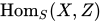
G(Z)=HomS(X,Z)for ZC{\displaystyle G(Z)=\operatorname {Hom} _{S}(X,Z)\quad {\text{for }}Z\in {\mathcal {C}}}

Then F{\displaystyle F} is left adjoint to G{\displaystyle G}. This means there is a natural isomorphism

HomS(YRX,Z)HomR(Y,HomS(X,Z)).{\displaystyle \operatorname {Hom} _{S}(Y\otimes _{R}X,Z)\cong \operatorname {Hom} _{R}(Y,\operatorname {Hom} _{S}(X,Z)).}

This is actually an isomorphism of abelian groups. More precisely, if Y{\displaystyle Y} is an (A,R){\displaystyle (A,R)}-bimodule and Z{\displaystyle Z} is a (B,S){\displaystyle (B,S)}-bimodule, then this is an isomorphism of (B,A){\displaystyle (B,A)}-bimodules. This is one of the motivating examples of the structure in a closed bicategory.[1]

Counit and unit

Like all adjunctions, the tensor-hom adjunction can be described by its counit and unit natural transformations. Using the notation from the previous section, the counit
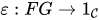
ε:FG1C{\displaystyle \varepsilon :FG\to 1_{\mathcal {C}}}

has components

εZ:HomS(X,Z)RXZ{\displaystyle \varepsilon _{Z}:\operatorname {Hom} _{S}(X,Z)\otimes _{R}X\to Z}

given by evaluation: For

ϕHomS(X,Z)andxX,{\displaystyle \phi \in \operatorname {Hom} _{S}(X,Z)\quad {\text{and}}\quad x\in X,}
ε(ϕx)=ϕ(x).{\displaystyle \varepsilon (\phi \otimes x)=\phi (x).}

The components of the unit

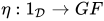
η:1DGF{\displaystyle \eta :1_{\mathcal {D}}\to GF}
ηY:YHomS(X,YRX){\displaystyle \eta _{Y}:Y\to \operatorname {Hom} _{S}(X,Y\otimes _{R}X)}

are defined as follows: For y{\displaystyle y} in Y{\displaystyle Y},

ηY(y)HomS(X,YRX){\displaystyle \eta _{Y}(y)\in \operatorname {Hom} _{S}(X,Y\otimes _{R}X)}

is a right S{\displaystyle S}-module homomorphism given by

ηY(y)(t)=ytfor tX.{\displaystyle \eta _{Y}(y)(t)=y\otimes t\quad {\text{for }}t\in X.}

The counit and unit equations can now be explicitly verified. For Y{\displaystyle Y} in D{\displaystyle {\mathcal {D}}},

εFYF(ηY):YRXHomS(X,YRX)RXYRX{\displaystyle \varepsilon _{FY}\circ F(\eta _{Y}):Y\otimes _{R}X\to \operatorname {Hom} _{S}(X,Y\otimes _{R}X)\otimes _{R}X\to Y\otimes _{R}X}

is given on simple tensors of YX{\displaystyle Y\otimes X} by

εFYF(ηY)(yx)=ηY(y)(x)=yx.{\displaystyle \varepsilon _{FY}\circ F(\eta _{Y})(y\otimes x)=\eta _{Y}(y)(x)=y\otimes x.}

Likewise,

G(εZ)ηGZ:HomS(X,Z)HomS(X,HomS(X,Z)RX)HomS(X,Z).{\displaystyle G(\varepsilon _{Z})\circ \eta _{GZ}:\operatorname {Hom} _{S}(X,Z)\to \operatorname {Hom} _{S}(X,\operatorname {Hom} _{S}(X,Z)\otimes _{R}X)\to \operatorname {Hom} _{S}(X,Z).}

For ϕ{\displaystyle \phi } in HomS(X,Z){\displaystyle \operatorname {Hom} _{S}(X,Z)},

G(εZ)ηGZ(ϕ){\displaystyle G(\varepsilon _{Z})\circ \eta _{GZ}(\phi )}

is a right S{\displaystyle S}-module homomorphism defined by

G(εZ)ηGZ(ϕ)(x)=εZ(ϕx)=ϕ(x){\displaystyle G(\varepsilon _{Z})\circ \eta _{GZ}(\phi )(x)=\varepsilon _{Z}(\phi \otimes x)=\phi (x)}

and therefore

G(εZ)ηGZ(ϕ)=ϕ.{\displaystyle G(\varepsilon _{Z})\circ \eta _{GZ}(\phi )=\phi .}

The Ext and Tor functors

The Hom functorhom(X,){\displaystyle \hom(X,-)} commutes with arbitrary limits, while the tensor product X{\displaystyle -\otimes X} functor commutes with arbitrary colimits that exist in their domain category. However, in general, hom(X,){\displaystyle \hom(X,-)} fails to commute with colimits, and X{\displaystyle -\otimes X} fails to commute with limits; this failure occurs even among finite limits or colimits. This failure to preserve short exact sequences motivates the definition of the Ext functor and the Tor functor.

In arithmetic

We can illustrate the tensor-hom adjunction in the category of functions of finite sets. Given a set N{\displaystyle N}, its Hom functor takes any set A{\displaystyle A} to the set of functions from N{\displaystyle N} to A{\displaystyle A}. The isomorphism class of this set of functions is the natural numberAN{\displaystyle A^{N}}. Similarly, the tensor product N{\displaystyle -\otimes N} takes a set A{\displaystyle A} to its cartesian product with N{\displaystyle N}وبالتالي فإن فئة التشاكل الخاصة بها هي العدد الطبيعيأشمال{\displaystyle AN}.

وهذا يسمح لنا بتفسير تماثل مجموعات التماثل

هوم(YX،Z)هوم(Y،هوم(X،Z)).{\displaystyle \operatorname {Hom} (Y\otimes X,Z)\cong \operatorname {Hom} (Y,\operatorname {Hom} (X,Z)).}

وهذا ما يميز بشكل عام اقتران الموتر-التجانس، باعتباره تصنيفًا للقانون الأساسي الملحوظ للأسس

ZYX=(ZX)Y.{\displaystyle Z^{YX}=(Z^{X})^{Y}.}

انظر أيضاً

مراجع

  1. ماي، جيه بي ؛ سيغوردسون، جيه. (2006). نظرية التماثل البارامتري . الجمعية الأمريكية للرياضيات، ص 253. ISBN  0-8218-3922-5.