
هولندا وأسلحة الدمار الشامل
على الرغم من أن هولندا لا تمتلك أسلحة دمار شامل من صنعها، إلا أنها تشارك في اتفاقيات تقاسم الأسلحة النووية التابعة لحلف الناتو ، وتُجري تدريبات لنقل الأسلحة النووية الأمريكية . وقد تم تخزين هذه الأسلحة لأول مرة في هولندا عام 1960. [ 1 ] [ 2 ]
تُعدّ هولندا أيضاً من بين الدول المنتجة للمكونات التي يمكن استخدامها في تصنيع عوامل فتاكة، وأسلحة كيميائية، وأنواع أخرى من أسلحة الدمار الشامل. وقد زودت عدة شركات هولندية الولايات المتحدة وإسرائيل وباكستان بمكونات لهذه الأسلحة .
صادقت هولندا على بروتوكول جنيف في 31 أكتوبر 1930. كما صادقت على اتفاقية الأسلحة البيولوجية في 10 أبريل 1972 واتفاقية الأسلحة الكيميائية في 30 يونيو 1995.
تقاسم الأسلحة النووية بين الولايات المتحدة وحلف شمال الأطلسي
صادقت هولندا على معاهدة عدم انتشار الأسلحة النووية في 2 مايو 1975.
في الماضي (من ستينيات القرن العشرين وحتى تسعينياته)، شاركت هولندا في نشر قذائف المدفعية النووية التابعة لحلف الناتو لمدافعها ذاتية الدفع ووحدات مدفعية الصواريخ. وقد تم تخزين هذه القذائف عيار 8 بوصات والرؤوس الحربية لصواريخ " أونست جون" ، ولاحقًا صواريخ "لانس" ، في مخازن الذخيرة الخاصة في مدينتي "ت هاردي" و "هافيلتربيرغ" . هذه الأسلحة لم تعد قيد الاستخدام.

حتى عام 2006، كانت طائرات البحرية الملكية الهولندية من طراز P-3 أوريون ، وسابقاتها من طراز P-2 نبتون ، المتمركزة في قاعدة فالكنبورغ الجوية البحرية السابقة في كاتويك وكوراساو في منطقة البحر الكاريبي ، مُجهزة بقنابل الأعماق النووية التابعة للبحرية الأمريكية لاستخدامها في الحرب المضادة للغواصات. كانت هذه الأسلحة في الأصل من طراز Mk 101 لولو ، بقوة 11 كيلوطن؛ وفي وقت لاحق، تم استبدالها بطراز Mk-57 (المعروف أيضًا باسم B-57 ).
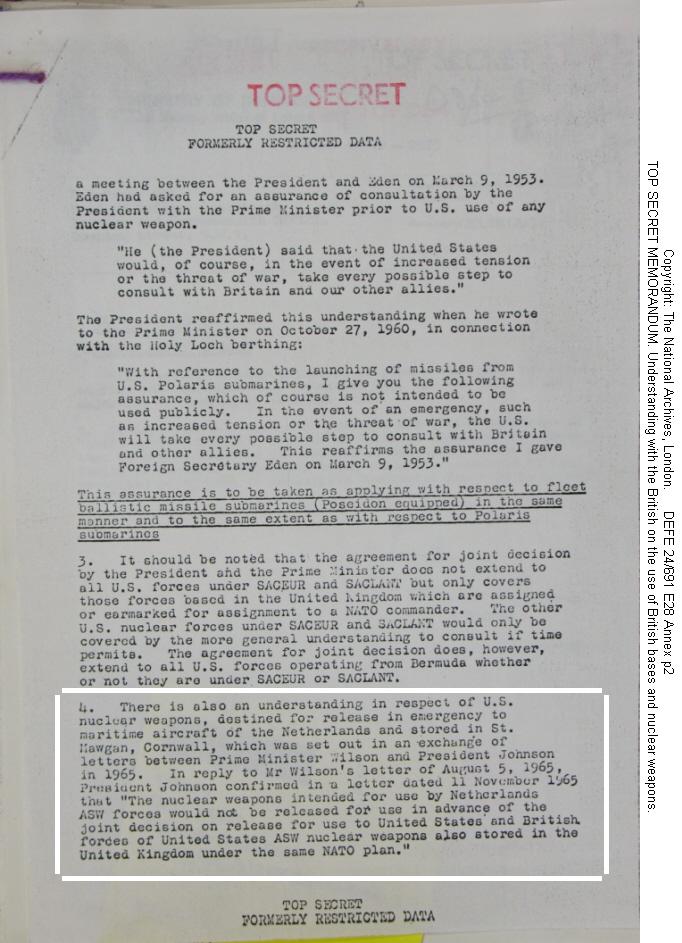
The NDBs were stored under U.S. Marine guard at RAF St. Mawgan, Cornwall, UK, which also held 60 similar weapons for the use of RAFShackleton and Nimrod aircraft. The storage arrangements were agreed in 1965 between the British Prime MinisterHarold Wilson and President Johnson in a secret memorandum now declassified in the UK archives.[3]
At present (2008), the USAF still provides 22 tactical B61 nuclear bombs for use by the Netherlands under the NATOnuclear weapons sharing agreement. These weapons are stored at Volkel Air Base and, in time of war, they may be delivered by Royal Netherlands Air and Space ForceF-35 warplanes.[4] (The Dutch government has never formally admitted or denied the presence of these weapons, but former prime ministers Dries van Agt and Ruud Lubbers both acknowledged their presence in 2013.[5][6])
The U.S. insists that its forces control the weapons and that no transfer of the nuclear bombs or control over them is intended "unless and until a decision were made to go to war, at which the [NPT] treaty would no longer be controlling", so there is no breach of the NPT.[7]
Dutch production of precursors to chemical weapons
Alongside companies from the United Kingdom, France, Germany, the United States, Belgium, Spain, India, and Brazil, Dutch companies provided Iraq with the chemicals used as precursors to produce chemical weapons for use against Iran in the Iran–Iraq War.
Suffering from chemical warfare during the Iran–Iraq War (1980–1988), 2000 Iranians submitted an indictment some years ago with a Tehran court against nine companies that had provided Saddam Hussein with such chemicals, and 455 American and European companies, two thirds being German, provided aid to Iraq during its war with Iran. The United Nations published a 12,000-page report about the conflict and named the companies involved.
Poison gas experiments
On 20 February 2008, it was revealed that the Netherlands had conducted chemical warfare experiments with nerve gas in the early 1950s. These experiments were conducted by the TNO organization on the request of the Defense Department. They consisted of the use of sarin, tabun, soman, and a modified French gas called Stof X (Substance X), which was more poisonous than sarin. The experiments were carried out on animals in the village of Harskamp and on the Vliehors bombing range, located on the island of Vlieland. After 1956, the only experiments were those conducted jointly with France and Belgium in the desert of Algeria, which utilized 6 kilograms of Stof X. The reason behind these experiments was the fear of an attack by the Soviet Union.[8]
See also
References
- ↑"US Nuclear Weapons in the Netherlands: A First Appraisal | National Security Archive". nsarchive.gwu.edu. 2021.
- ↑Onderco, Michal; Joosen, Rik (2022). "Nuclear Weapons in the Tweede Kamer: Analysis of Nuclear Motions in the Dutch House of Representatives in Times of Contestation". Global Studies Quarterly. 2 (3). doi:10.1093/isagsq/ksac028. hdl:1887/3513683.
- ↑The National Archives, London. DEFE 24/691 E28 p6.
- ↑Kristensen, Hans (February 2005). "U.S. Nuclear Weapons in Europe"(PDF).
- ↑"22 atoombommen in kluizen basis Volkel". RTL Nieuws. RTL Nederland. 10 June 2013. Archived from the original on 4 March 2016. Retrieved 26 December 2013.
- ↑"Een typisch geval van klassenjustitie (2)". RTL Nieuws. RTL Nederland. 4 December 2013. Archived from the original on 19 September 2016. Retrieved 26 December 2013.
- ↑Brian Donnelly, Foreign and Commonwealth Office. "The Nuclear Weapons Non-Proliferation Articles I, II and VI of the Treaty on the Non-Proliferation of Nuclear Weapons". Agency for the Prohibition of Nuclear Weapons in Latin America and the Caribbean. Archived from the original on 2009-01-05. Retrieved 2009-08-07.
- ↑NRC newspaper, 19 feb. 2008
Sources
- Norris, Robert S.; Andrew Burrows; Richard Fieldhouse (1994). Vol.5. British, French and Chinese Nuclear Weapons. Nuclear Weapons Databook. Oxford: Westview Press. ISBN 0-8133-1612-X.
- "UK-U.S. Memorandum of Understanding of Use of Nuclear Weapons". 1965. DEFE 24/691-E28.
{{cite journal}}: Cite journal requires|journal=(help), Contained in an exchange of letters between Prime Minister Harold Wilson and Pres Lyndon B.Johnson, declassified 2002, and now in the UK National Archives, London filed as DEFE 24/691-E28 - "To Dutch Navy weapons sharing and storage".
{{cite journal}}: Cite journal requires|journal=(help) - "Radiator" (Document). Southern Region CND. April 1984.
- Weapons of mass destruction by country
- Military history of the Netherlands
- Foreign relations of the Netherlands