
Bell pull
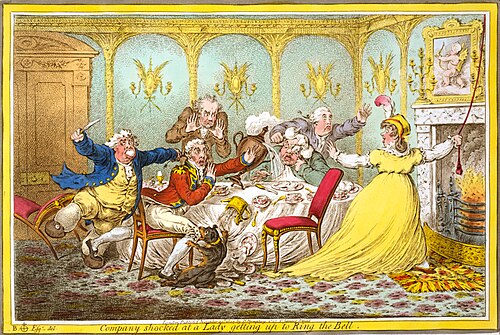
A bell pull is a woven textile, pull cord, handle, knob, or other object that connects with a bell or bell wire, and which rings a service bell when pulled. Bell pulls may be used to summon workers in homes of people who employ butlers, housemaids, nannies or other domestic workers,[1][2] and often have a tassel at the bottom.[3] The bell pull is one element of a complex interior mechanical network which, in Victorian times, typically involved a range of bell pulls in different rooms, connected to a central bank of labelled bells in a room where servants would wait to be summoned.[2]
Central bell panel
In the 19th century, some hotels also had such panels, with a bell for each room, as parts of centralized bell systems.[2]
Transport
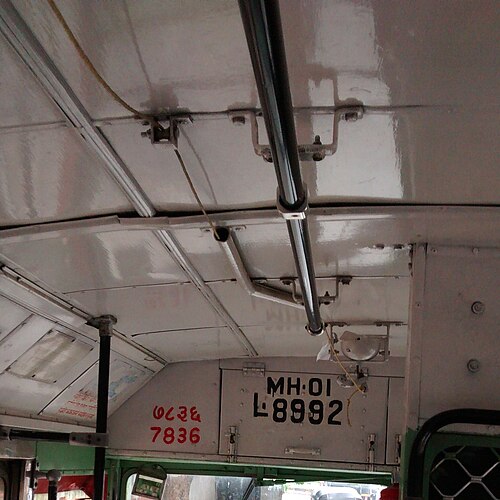

A bell pull is widely used in public transport buses and trams to signal the driver to halt at the next stop.[4]
See also
References
- ↑"Englishmen's Dining Rooms"(PDF). New York Times. 2 September 1894. Retrieved 28 October 2010.
- 123Larry Nash White; Emily Blankenship White (February 2004). Marietta. Arcadia Publishing. pp. 34–. ISBN 978-0-7385-3231-8. Retrieved 15 November 2011.
- ↑"New London Millinery". Poverty Bay Herald. 18 November 1911. Retrieved 28 October 2010.
- ↑Sultzberger, A. G. (12 May 2009). "Is This Your Stop? Pull the Cord, Like Old Times". The New York Times. New York. Retrieved 9 May 2015.
- Ropework