
قوة التلامس
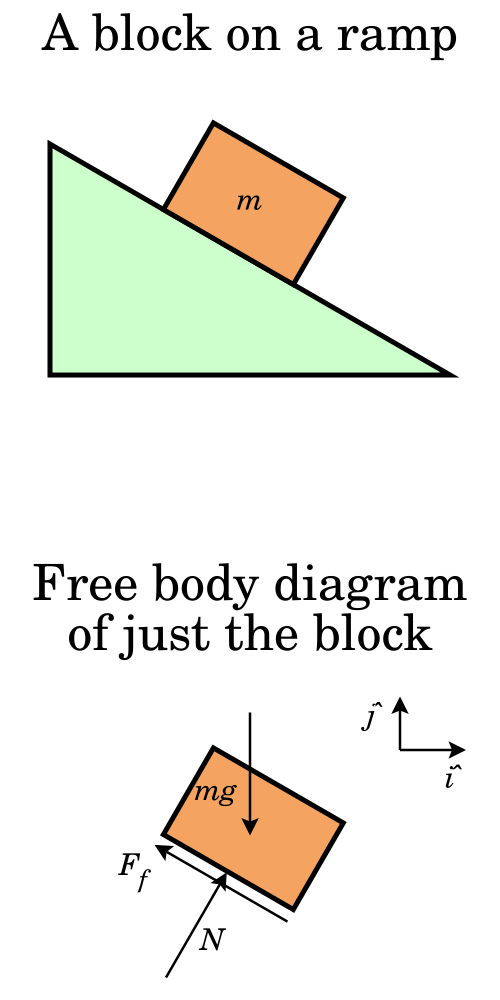
قوة التلامس هي أي قوة تنشأ نتيجة تلامس جسمين. [ 1 ] تُعدّ قوى التلامس شائعة جدًا، وهي المسؤولة عن معظم التفاعلات المرئية بين تجمعات المادة الكبيرة . يُعدّ دفع السيارة أو ركل الكرة مثالين يوميين على وجود قوى التلامس. في الحالة الأولى، تُطبّق القوة على السيارة باستمرار من قِبل الشخص، بينما في الحالة الثانية، تُطبّق القوة في دفعة قصيرة .
غالباً ما يتم تحليل قوى التلامس إلى مركبات متعامدة ، إحداها عمودية على السطح (الأسطح) المتلامسة وتسمى القوة العمودية ، والأخرى موازية للسطح (الأسطح) المتلامسة وتسمى قوة الاحتكاك . [ 1 ]
ليست كل القوى قوى تلامس؛ فمثلاً، وزن الجسم هو القوة المؤثرة بينه وبين الأرض، حتى وإن لم يكن هناك تلامس بينهما. أما قوى الجاذبية والقوى الكهربائية والقوى المغناطيسية فهي قوى جسدية ، ويمكن أن توجد دون حدوث تلامس.
أصل
The microscopic origin of contact forces is diverse. Normal force is directly a result of Pauli exclusion principle and not a true force per se: Everyday objects do not actually touch each other; rather, contact forces are the result of the interactions of the electrons at or near the surfaces of the objects.[1] The atoms in the two surfaces cannot penetrate one another without a large investment of energy because there is no low energy state for which the electron wavefunctions from the two surfaces overlap; thus no microscopic force is needed to prevent this penetration. On the more macroscopic level, such surfaces can be treated as a single object, and two bodies do not penetrate each other due to the stability of matter, which is again a consequence of Pauli exclusion principle, but also of the fundamental forces of nature: Cracks in the bodies do not widen due to electromagnetic forces that create the chemical bonds between the atoms; the atoms themselves do not disintegrate because of the electromagnetic forces between the electrons and the nuclei; and the nuclei do not disintegrate due to the nuclear forces.[2]
As for friction, it is a result of both microscopic adhesion and chemical bond formation due to the electromagnetic force, and of microscopic structures stressing into each other;[3] in the latter phenomena, in order to allow motion, the microscopic structures must either slide one above the other, or must acquire enough energy to break one another. Thus the force acting against motion is a combination of the normal force and of the force required to widen microscopic cracks within matter; the latter force is again due to electromagnetic interaction. Additionally, strain is created inside matter, and this strain is due to a combination of electromagnetic interactions (as electrons are attracted to nuclei and repelled from each other) and of Pauli exclusion principle, the latter working similarly to the case of normal force.
See also
References
- 123Plesha, Gray, and Costanzo (2010). Engineering Mechanics – Statics. McGraw-Hill. pp. 8-9.
{{cite book}}: CS1 maint: multiple names: authors list (link) - ↑Lieb, E. H. (1991). The stability of matter. In The Stability of Matter: From Atoms to Stars (pp. 483–499). Springer, Berlin, Heidelberg
- ↑ تشين، ز.، خاجه، أ.، مارتيني، أ.، وكيم، ش.هـ. (2019). الأصول الكيميائية والفيزيائية للاحتكاك على الأسطح ذات الخطوات الذرية. التقدم العلمي، 5(8)، eaaw0513.
- قوة