
Elegast
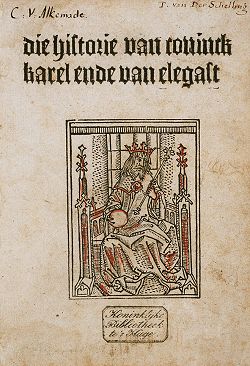
Elegast (elf spirit) is the hero and noble robber in the poem Karel ende Elegast, an early Middle Dutchepic poem that has been translated into English as Charlemagne and Elbegast. In the poem, he possibly represents the King of the Elves. He appears as a knight on a black horse, an outcast vassal of Charlemagne living in the forest. The original Dutch poem uses the name Elegast, while translated versions of the poem commonly use the name Elbegast in German and English, or Alegast in the Scandinavian ballad.
Karel ende Elegast

Karel ende Elegast was an original poem in Middle Dutch that scholars think was probably written at the end of the 12th century, otherwise in the 13th century and set in the region of Charlemagne's castle in Ingelheim. It is a Frankish romance of Charlemagne ("Karel") as an exemplary Christian king who was led on a strange quest to be a robber.[2]
Although the poem does not describe Elegast's background, he was an old friend of Charlemagne that had fallen into disgrace, and his banishment to the forest and his name connotes he was elven. Elegast could put people to sleep magically, could open locks without keys, and has a magic herb that when put in his mouth allows him to talk to animals. He lived in the forest, thief to the rich people and kind to poor people.
In summary, Charlemagne has a heavenly vision to go thieving in disguise, so meets with Elegast in the forest at night. Elegast does not recognize the king, as Charlemagne is in disguise as a thief. When Charlemagne suggests they steal from the king's castle, Elegast proves his loyalty to Charlemagne by refusing to steal from the king. Instead, Elegast takes Charlemagne to burgle the castle of Charlemagne's brother-in-law, Eggeric van Eggermonde. Once they break into the castle, Elegast overhears Eggeric scheming to kill Charlemagne to his wife, who is Charlemagne's sister. In this way Charlemagne learns of a traitor in his court. The next day, when Eggeric arrives in Charlemagne's court, Charlemagne has Eggeric searched and finds his weapons. Elegast duels with Eggeric and exposes him as a traitor. Eggeric is therefore killed, and his wife is given in marriage to Elegast. Elegast's reputation is also restored in the Charlemagne court.
Name
إن الأسماء Elegast و Alegast و Elbegast هي أشكال مختلفة من نفس الاسم الجرماني : الاسم الجرماني الشائع *albi-gastiz ، والذي يتكون من العناصر الموثقة جيدًا *albi- " إلف " و *gastiz "ضيف". [ 3 ]
يُذكر قزم واحد يُدعى إلبغاست في نصوص الإدا . ووفقًا للأساطير الألمانية السفلى، كان إلبغاست قزمًا قادرًا على سرقة البيض من تحت الطيور. [ 4 ] وفي الفولكلور والأساطير في شمال أوروبا، كان يُطلق على إلبغاست لقب ملك كل من الجان والأقزام . [ 5 ]
يقترح بعض الباحثين أن إليغاست هو شخصية ألبريش ، الذي يعني اسمه "ملك الجان". كان ألبريش ساحرًا في الملاحم الميروفنجية التي تعود إلى القرنين الخامس والثامن الميلاديين.
سياق
تتميز هذه القصيدة بفرادتها في الإشارة إلى صداقة شارلمان (الملك "المسيحي") مع شخصية قد ترمز إلى قزم أو جنيّ الغابة، بالإضافة إلى محاولة شارلمان السرقة مستغلًا الإلهام الإلهي. في هذه الصداقة، تمزج القصيدة بين أساطير الفرنجة عن شارلمان وبعض الأساطير الهولندية الجرمانية . كما تتميز القصيدة بكون شخصية إليغاست الهولندية بطلًا، إذ أن معظم قصائد تلك الفترة تتناول الفرنجة كأبطال. ربما يرمز إليغاست إلى أسطورة ما قبل المسيحية لدى الهولنديين عن قزم أو بطل شعبي قديم. في أساطير ما قبل المسيحية، كان السكن في الغابة مكانًا دينيًا ومقدسًا.
تاريخياً، قد تكون القصيدة الملحمية تتحدث عن انتفاضة حقيقية ضد شارلمان حدثت (حوالي عام 785؟)، حيث تم ذكر الحدث التالي في عام 1240 في كتاب Chronica Albrici Monachi Trium Fontium :
«حُبكت مؤامرة خطيرة ضد شارلمان على يد الأوستراسيين ، وكان هاردريكوس المحرّض الرئيسي عليها. وعند اكتشاف المؤامرة، قُطّع أوصال الكثيرين ونُفي آخرون. [...] وكما تروي إحدى الأغاني، فإنه من أجل كشف هذه المؤامرة، خرج شارلمان، بتحريض من ملاك، يسرق ليلاً.» [ 6 ]
وبحسب الأسطورة، فإن إنجلهيم (التي تعني "بيت الملاك") سميت على اسم الملاك الذي رآه شارلمان في الرؤيا.
التكيفات
التعديلات والترجمات:
- الهولندية: Karel ende Elegast (الحديثة: Karel en Elegast )
- الاسكندنافية: ملزمة أليجاست (أغنية أليجاست)
- الدنماركية الوسطى: Krønike بقلم كارل ماغنوس
- Norse: Karlamagnús saga
- English: Ingelheim: Charlemagne the Robber by Lewis Spencer.
- French epic: Chanson de Basin (a lost manuscript), Vie de Charlemagne
- German: Karlmeinet[7]
- West Frisian: Karel en Elegast (translation by Klaas Bruinsma, 1994).
See also
References
- ↑"Karel ende Elegast :[fragmenten][manuscript]". lib.ugent.be. Retrieved 2020-08-26.
- ↑Meijer 1971.
- ↑see e.g. Starostin, "Proto-Germanic: *gasti-z".
- ↑Grimm's Teutonic Mythology, 1888, Chapter 17.
- ↑H. A. Guerber, 1895.
- ↑de Ruiter, citing A.M. Duinhoven, Bijdragen tot reconstructie van de Karel ende Elegast. Dl. II. Groningen : Wolters-Noordhoff, 1981:26-27.
- ↑The list of adaptions supplied by de Ruiter.
- Ruiter, Jacqueline de, 'The Guises of Elegast: One story, Differing Genres', in: Carlos Alvar and Juan Perides (eds.), Actes du XVIe Congrès International de la Société Rencesvals, Granada 21-25 juillet 2003, Granada 2005 (prepublication, internet-archive 2007)
- Grimm, Jacob (1835). Deutsche Mythologie (German Mythology); From English released version Grimm's Teutonic Mythology (1888); Available online by Northvegr © 2004–2007, Chapter 17, page 2.
- Guerber, Helene A.Myths of Northern Lands, 1895. File retrieved 2/18/2007.
- Meijer, Reinder. Literature of the Low Countries: A Short History of Dutch Literature in the Netherlands and Belgium. New York: Twayne Publishers, Inc., 1971.
- Spence, Lewis. Ingelheim: Charlemagne the Robber - Retold in English version in Hero Tales and Legends of the Rhine, 1915.
- Germanic etymology database, by S. Starostin. (Proto-Germanic derivatives of: *gasti-z.) File retrieved 5/24/07.
External links
- Karel ende ElegastArchived 2007-02-04 at the Wayback Machine - Full text in Middle Dutch.
- Ingelheim: Charlemagne the Robber - narrative adaptation in English.
- Karel ende Elegast From the Collections at the Library of Congress
- Cultural depictions of Charlemagne
- Dutch folklore
- Epic poems
- European folklore
- Fictional elves
- Middle Dutch literature
- Dutch-language manuscripts
- Folklore of the Benelux