
الوهج (الرؤية)
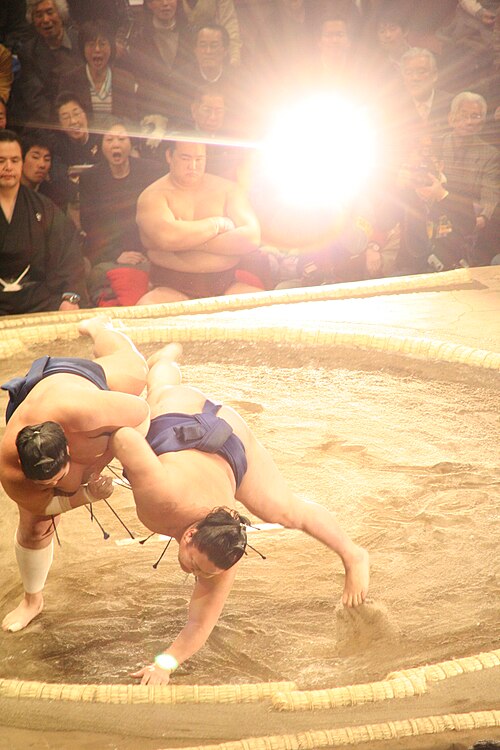
الوهج هو صعوبة الرؤية في وجود ضوء ساطع، كضوء الشمس المباشر أو المنعكس ، أو الضوء الاصطناعي كمصابيح السيارة الأمامية ليلاً. ولذلك، تُزود بعض السيارات بمرايا مزودة بخاصية مضادة للوهج تلقائياً، وفي المباني، تُستخدم الستائر أو الشرائح لحماية الركاب. وينتج الوهج عن اختلاف كبير في شدة الإضاءة بين الهدف (ما يُنظر إليه) ومصدر الوهج. وتؤثر عوامل مثل زاوية الرؤية بين الهدف ومصدر الوهج، وتكيف العين، تأثيراً كبيراً على تجربة الوهج.
الشعور بعدم الراحة والإعاقة
يمكن تقسيم الوهج عمومًا إلى نوعين: الوهج المزعج والوهج المُعيق. [ 1 ] الوهج المزعج هو إحساس نفسي ناتج عن سطوع عالٍ (أو تباين سطوع) ضمن مجال الرؤية، ولا يُعيق الرؤية بالضرورة. [ 2 ] في المباني، قد ينشأ الوهج المزعج من مصابيح إضاءة اصطناعية صغيرة (مثل مصابيح السقف) ذات سطوع أعلى بكثير من محيطها. عندما يشغل مصدر الضوء جزءًا كبيرًا من مجال الرؤية (مثل النوافذ المُضاءة بنور النهار)، يمكن ربط الانزعاج الناتج عن الوهج بتأثير التشبع. ولأن المُشاهدين لا ينظرون دائمًا مباشرةً إلى مصدر إضاءة ساطع، فإن الوهج المزعج يظهر عادةً عندما يُركز المُشاهد على مهمة بصرية (مثل شاشة الكمبيوتر) ويكون مصدر الضوء الساطع ضمن مجال رؤيته المحيطي. [ 3 ]
يُضعف وهج الإعاقة رؤية الأشياء دون أن يُسبب بالضرورة إزعاجًا. [ 4 ] قد يحدث هذا، على سبيل المثال، عند القيادة غربًا عند غروب الشمس. غالبًا ما ينتج وهج الإعاقة عن انعكاس الضوء داخل مقلة العين، مما يُقلل التباين بين المهمة ومصدر الوهج إلى درجة يصعب معها تمييز المهمة. عندما يكون الوهج شديدًا لدرجة إعاقة الرؤية تمامًا، يُطلق عليه أحيانًا اسم " الوهج المُبهر" . [ 5 ]
عوامل التخفيض

يمكن أن يقلل الوهج من الرؤية عن طريق:
- انخفاض سطوع بقية المشهد نتيجة انقباض حدقة العين
- انخفاض تباين بقية المشهد بسبب تشتت الضوء الساطع داخل العين .
- Reduction in contrast by scattering light in particles in the air, as when the headlights of a car illuminate the fog close to the vehicle, impeding vision at larger distance.
- Reduction in contrast between print and paper by reflection of the light source in the printed matter (veiling glare).
- Reduction in contrast by reflection of bright areas on the surface of a transparent medium as glass, plastic or water; for example when the sky is reflected in a lake, so that the bottom below or objects in the water cannot be seen (veiling glare).
- bloom surrounding objects in front of glare
Sunglasses are often worn to reduce glare; polarized sunglasses are designed to reduce glare caused by light reflected from non-metallic surfaces such as water, glossy printed matter or painted surfaces. An anti-reflective treatment on eyeglasses reduces the glare at night and glare from inside lights and computer screens that is caused by light bouncing off the lens. Some types of eyeglasses can reduce glare that occurs because of the imperfections on the surface of the eye.
Light field measurements can be taken to reduce glare with digital post-processing.
Measurement
Methods
Discomfort glare has often been studied using psychophysics experiments, where the common methods have been the luminance adjustment and category rating procedures.[6] Studies conducted by Petherbridge and Hopkinson[7] and Luckiesh and Guth.[8] were amongst the first to compared subjective assessments given by observers against physical measurements produced by a glare source.
Biases
A comprehensive review of the methods used to measure glare showed that there are biases associated with its measurement.[9] Luminance adjustments are sensitive to anchoring effects caused when the initial starting luminance viewed influences the final assessment of visual discomfort.[10] Glare is also subject to stimulus range bias effects.[11][12] This occurs when the luminance range influences the final evaluation of glare given by the observer. A larger range, often results in higher glare evaluations given.
Prediction models
Glare from artificial lights is typically measured with luminance meters. From daylit windows, cameras are used to convert the pixels into luminance. Both of which are able to determine the luminance of objects within small solid angles. The glare of a scene i.e. visual field of view, is then calculated from the luminance data of that scene.
The International Commission on Illumination (CIE) defines glare as:
"Visual conditions in which there is excessive contrast or an inappropriate distribution of light sources that disturbs the observer or limits the ability to distinguish details and objects".[13][14]
The CIE recommends the Unified glare rating (UGR) as a quantitative measure of glare.[15][16] Other glare calculation methods include CIBSE Glare Index, IES Glare Index and the Daylight Glare Index (DGI).[17]
Unified glare rating
The Unified Glare Rating (UGR) is a measure of the glare in a given environment, accounting only interior artificial lights, proposed by Sorensen in 1987 and adopted by the International Commission on Illumination (CIE). It is basically the logarithm of the glare of all visible lamps, divided by the background lumination :[18]

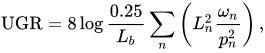
Where is the common logarithm (base 10), is the luminance of each light source numbered , is the solid angle of the light source seen from the observer and is the Guth Position Index, which depends on the distance from the line of sight of the viewer.


Daylight Glare Probability
The Daylight Glare Probability (DGP) is a measure glare from real daylight condition in side-lit room within the field of view from curtain position, not considering for artificial light. It considers illuminance and luminance from glare sources to estimate the level of dissatisfaction. DGP was proposed by Wienold and Christoffersen in 2006[19] and adopted as first ever day-lighting standard by the European Standard's EN 17037 (2018) Daylight in Buildings. The EN 17037 glare assessment helps designer to determine shading need, transmission of glazing if the DGP is higher than 0.4.[20] However, data from tropical climate countries suggests the DGP threshold is expected to be 0.24, significant lower than Wienold and Christoffersen's Copenhagen and Freiburg data.[21]

Where is the common logarithm (base 10), is the illuminance at eye level (lx), is the luminance of glare source (cd/), is the number of glare sources, is the solid angle of the glare sources seen from the observer and is the Guth Position Index, which depends on the distance from the line of sight of the viewer.


See also
References
- ↑Osterhaus, Werner (2005). "Discomfort glare assessment and prevention for daylight applications in office environments". Solar Energy. 79 (2): 140–158. Bibcode:2005SoEn...79..140O. doi:10.1016/j.solener.2004.11.011. Retrieved 2021-02-26.
- ↑"discomfort glare". Illuminating Engineering Society.
- ↑Kent, Michael; Fotios, Steve; Altomonte, Sergio (2019). "An Experimental Study on the Effect of Visual Tasks on Discomfort Due to Peripheral Glare". LEUKOS. 15 (1): 17–28. doi:10.1080/15502724.2018.1489282. hdl:2078.1/202093.
- ↑"CIE e-ILV: 17-330 disability glare". CIE. Archived from the original on 2013-05-11.
- ↑Schreuder, D. A. (1998). Road Lighting for Safety. London: Thomas Telford Publishing. p. 107. ISBN 0-7277-2616-1. Archived from the original on January 13, 2018. Retrieved September 25, 2009.
- ↑Fotios, Steve; Kent, Michael (2021). "Measuring Discomfort from Glare: Recommendations for Good Practice". LEUKOS. 17 (4): 338–358. doi:10.1080/15502724.2020.1803082. S2CID 225293753. Retrieved 2021-02-26.
- ↑Petherbridge, P; Hopkinson, RG (1950). "Discomfort Glare and the Lighting of Buildings". Transactions of the Illuminating Engineering Society. 15 (2): 39–79. doi:10.1177/147715355001500201. S2CID 112251972. Retrieved 2021-02-26.
- ↑Luckiesh, M; Guth, SK (1949). "Brightnesses in visual field at borderline between comfort and discomfort"(PDF). Illuminating Engineering. 44 (11): 650–670. PMID 24536275. Retrieved 2021-02-26.
- ↑Fotios, Steve; Kent, Michael (2021). "Measuring Discomfort from Glare: Recommendations for Good Practice". LEUKOS. 17 (4): 338–358. doi:10.1080/15502724.2020.1803082. S2CID 225293753. Retrieved 2021-02-26.
- ↑Kent, Michael; Fotios, Steve; Altomonte, Sergio (2017). "Discomfort glare evaluation: The influence of anchor bias in luminance adjustments". Lighting Research and Technology. 51: 131–146. doi:10.1177/1477153517734280. hdl:2078.1/192440. S2CID 28046530.
- ↑Kent, Michael; Fotios, Steve; Cheung, Toby (2019). "Stimulus range bias leads to different settings when using luminance adjustment to evaluate discomfort due to glare". Building and Environment. 153: 281–287. Bibcode:2019BuEnv.153..281K. doi:10.1016/j.buildenv.2018.12.061. S2CID 116723107.
- ↑Lulla, Ashok B.; Bennett, Corwin A. (1981). "Discomfort Glare: Range Effects". Journal of the Illuminating Engineering Society. 10 (2): 74–80. doi:10.1080/00994480.1980.10748591. Retrieved 2021-11-01.
- ↑Murray Ian (12 October 2007). "Glare (C7654)". OpticianOnline.net. Reed Business Information Limited. Archived from the original on February 25, 2014. Retrieved October 29, 2012.
- ↑"Glare". Centre for Window and Cladding Technologies. Archived from the original on August 12, 2012. Retrieved October 29, 2012.
- ↑CIE 117-1995 Discomfort Glare in Interior Lighting. CIE. 1995. ISBN 978-3-900734-70-1.
- ↑CIE 190:2010 Calculation and Presentation of Unified Glare Rating Tables for Indoor Lighting Luminaires. CIE. 2010. ISBN 9783901906879.
- ↑"Glare". LEARN, Low Energy Architecture Research Unit. Archived from the original on February 25, 2014. Retrieved October 29, 2012.
- ↑Peter R. Boyce, "Unified+glare+rating"&pg=PA177 Human Factors in LightingArchived 2018-01-13 at the Wayback Machine, 2nd edition, Taylor and Francis, London, 2003, p. 177
- ↑Wienold, Jan; Christoffersen, Jens (1 July 2006). "Evaluation methods and development of a new glare prediction model for daylight environments with the use of CCD cameras". Energy and Buildings. 38 (7): 743–757. doi:10.1016/j.enbuild.2006.03.017. ISSN 0378-7788.
- ↑European Committee for Standardization (December 2018). "Daylight in buildings". European Standard. EN 17037.
- ↑Chaloeytoy, Kittiwoot; Ichinose, Masayuki; Chien, Szu-Cheng (October 2020). "Determination of the Simplified Daylight Glare Probability (DGPs) Criteria for Daylit Office Spaces in Thailand". Buildings. 10 (10): 180. doi:10.3390/buildings10100180. ISSN 2075-5309.
- Vision