
Space Test Program
The Space Test Program (STP) is the primary provider of spaceflight for the United States Department of Defense (DoD) space science and technology community. STP is managed by a group within the Advanced Systems and Development Directorate, a directorate of the Space and Missile Systems Center of the United States Space Force. STP provides spaceflight via the International Space Station (ISS), piggybacks, secondary payloads and dedicated launch services.
STP has actually been in existence for 50 years as of 2019, and has been responsible for several thousand launches. For example, the initial experiments that led to the modern Global Positioning System (GPS) satellite constellation were STP-launched projects. Its predecessor was SATAR.
Past activities
Missions
| Launch designation[1] | Satellite designation | Date/time, UTC | Launch site | Rocket | Orbit | Function | Status | Patch | Remarks |
|---|---|---|---|---|---|---|---|---|---|
| STP-1[2] | ASTRO, NEXTSat-CSC, STPSat 1, CFESat, MidSTAR 1 & FalconSat 3 | 9 March 2007 | CCSFS, SLC-41 | Atlas V 401 | Low Earth | Various | Entered service, status unknown | ||
| STP-2[3] | DSX, Formosat 7A-7F, GPIM, OTB-1, NPSat 1, Oculus-ASR, Prox-1, LightSail 2, ARMADILLO, FalconSat-7, E-TBEx A,B, PSat 2, BRICSat 2, Prometheus 2.6, Prometheus Mass Model, TEPEC 1,2, CP 9 (LEO), StangSat | 25 June 2019 | KSC, LC-39A | Falcon Heavy | Low Earth | Various | Entered service, status unknown | ||
| STP-3[4] | STPSat-6, LDPE-1 & Ascent | 7 December 2021 | CCSFS, SLC-41 | Atlas V 551 | Geosynchronous | Various | Entered service, status unknown | ||
| STP-5[5] | SIRI-3 & PUMA | 2026 | CCSFS, SLC-41 | Vulcan Centaur | Low Earth | Various | Planned |
2001
During August 2001, STP conducted two successful activities using the Space Shuttle and ISS. STS-105 delivered and successfully deployed the Materials International Space Station Experiment (MISSE) externally on the ISS. MISSE was a passive materials exposure experiment, was the first external experiment on ISS. In addition, STS-105 retrieved and returned MACE II (Middeck Active Control Experiment II) from the ISS. MACE II was the first internal experiment on ISS and was operated for nearly a year.[6]
On 30 September 2001, STP and NASA launched the Kodiak Star mission on an Athena Ilaunch vehicle. This was the first orbital launch out of Kodiak Island, Alaska. In addition to NASA's Starshine III spacecraft, this mission included three small DoD spacecraft which tested a variety of new space technologies.[7]
STP and the Air Force Research Laboratory's (AFRL) Space Vehicles Directorate developed a secondary payload adapter ring for the Evolved Expendable Launch Vehicle (EELV), which can host up to six 180 kg (400 lb)microsatellites. STP also worked closely with NASA and the United States Navy on the Geosynchronous Imaging Fourier Transform Spectrometer / Indian Ocean Meteorology and Oceanography Imager project.
In December 2001, STS-108 hosted the Shuttle Ionospheric Modification with Pulsed Localized Exhaust (SIMPLEX) experiment. SIMPLEX observed ionospheric disturbances created by the Space Shuttle engine burns via ground radar sites and supported plume technology, plume signature, and space weather modeling.
2002
SIMPLEX flew again on STS-110 in April 2002. STP also worked to obtain a 1-year radio frequency license extension for the Picosat experiment launched on the Kodiak Star mission, in September 2001.
2003
On 6 January 2003, STP and the Naval Research Laboratory (NRL) launched the Coriolis satellite, a risk-reduction effort for NPOESS, aboard a Titan II launch vehicle.[8]
2007
On 9 March 2007, six satellites were launched into low Earth Orbit (LEO) on a shared Atlas V launch vehicle on the STP-1 mission.[9] The satellites were:
- Orbital Express: ASTRO and NextSat, (DARPA)
- MidSTAR-1, (United States Naval Academy)
- FalconSat3, (United States Air Force Academy)
- STPSat 1, USAF's Space Test Program
- CFESat, (Los Alamos National Laboratory)
The satellites shared the launcher through use of an Evolved Expendable Launch Vehicle Secondary Payload Adapter (ESPA).[10]United Launch Alliance provided a video feed of the launch.[11]
2008
The C/NOFS (Communications/Navigation Outage Forecasting System) satellite, which was launched on 16 April 2008, was operated by the Space Test Program.
2010
The third Minotaur IV, known as STP-S26, was successfully launched in November 2010. This was the 26th small launch vehicle mission in STP's 40-year history of flying DoD space experiments,[12] STP-S26 launched at 01:45 UTC on 20 November 2010 from the Kodiak Launch Complex. The launch facility contractor was Alaska Aerospace Corporation (AAC). The payloads were released in a 650 km (400 mi) orbit, before the Hydrazine Auxiliary Propulsion System (HAPS) upper stage, by Orbital Sciences Corporation, was demonstrated by deploying two ballast payloads into a 1,200 km (750 mi) orbit. The payload included the STPSat-2 spacecraft.[13] STPSat-2 had 3 three experimental payloads: SPEX (Space Phenomenology Experiment) consisting of two payloads to evaluate sensor compatibility for the space environment, and ODTML (Ocean Data Telemetry MicroSatLink) a two-way data relay from terrestrial (ocean or land) sensors to users.[14]
2013
STPSat 3 is a copy of the STPSat-2 satellite, adapted to carry six experiments, including a module designed to host various space situational awareness sensors and a pair of space environment sensors. STPSat 3 launched on 19 November 2013, on the ORS-3Minotaur 1 launch, along with 28 CubeSats.[15] STPSat-3 carries five payloads, including "Integrated Miniaturized Electrostatic Analyzer Reflight (iMESA-R), Joint Component Research (J-CORE), Strip Sensor Unit (SSU), Small Wind and Temperature Spectrometer (SWATS), and TSI Calibration Transfer Experiment (TCTE)". It also carries a de-orbit module.[13]
2014
As announced on 14 October 2014, the United States Department of Defense awarded Sierra Nevada Corporation's Space Systems (previously known as SpaceDev) with a contract to develop and build a next-generation science and technology demonstration satellite, known as STPSat-5, for their Space Test Program.[16]
2019
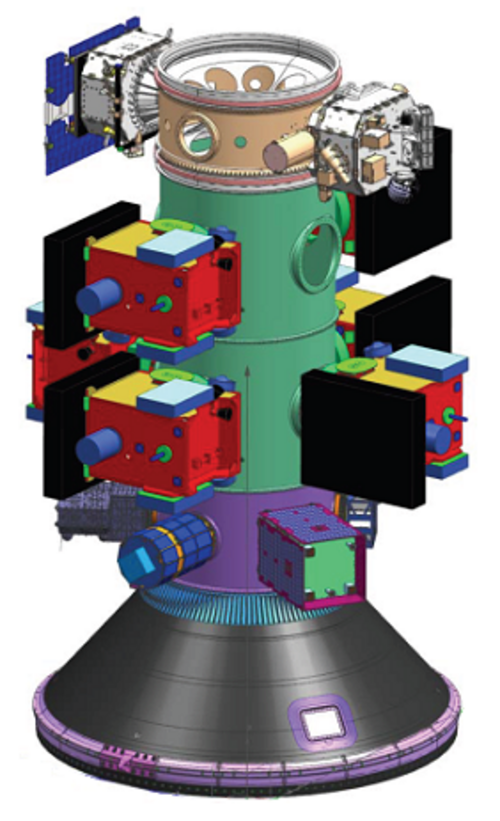
تم إطلاق حمولة STP -2 (برنامج اختبار الفضاء التابع لوزارة الدفاع) على متن صاروخ فالكون الثقيل التابع لشركة سبيس إكس في 25 يونيو 2019. [ 17 ]
تضمنت المجموعة القمر الصناعي COSMIC-2 ، وهو عبارة عن ستة أقمار صناعية، يزن كل منها 277.8 كيلوغرامًا (612 رطلًا) . [ 18 ] يتمثل الدور الرئيسي لمجموعة أقمار COSMIC-2 في توفير بيانات التغطية الراديوية بمتوسط زمن استجابة يبلغ 45 دقيقة. وُضعت الأقمار الستة في مدار بميل يتراوح بين 24° و28.5°، مع خطط لنقلها لاحقًا إلى ستة مستويات مدارية منفصلة تفصل بينها زاوية 60°. [ 19 ] دُمجت حمولة القمر الصناعي باستخدام حلقة ESPA . استُخدمت حلقتان من نوع ESPA Grande لتثبيت أقمار COSMIC-2 الستة أسفل محول الحمولة العلوي الذي يستضيف حمولة DSX ووحدات إلكترونيات الطيران. [ 20 ]
نشرت مهمة STP-2 أيضًا عددًا من الأقمار الصناعية المكعبة (CubeSats) كحمولات ثانوية ، [ 18 ] بما في ذلك الأقمار الصناعية المكعبة E-TBEx وPSAT وTEPCE و ELaNa 15. [ 21 ] ويحمل القمر الصناعي النانوي Prox-1 القمر الصناعي LightSail 2. [ 22 ] وشملت الأقمار الصناعية والحمولات الأخرى القمر الصناعي النانوي Oculus-ASR، [ 23 ] و GPIM ، [ 24 ] [ 25 ] [ 26 ] وساعة الفضاء السحيق الذرية . [ 27 ]
أُطلق القمر الصناعي STPSat-4 في 2 نوفمبر 2019 على متن مهمة Cygnus NG-12 ، ثم وُضع في مداره من محطة الفضاء الدولية في 29 يناير 2020. [ 28 ] حمل القمر الصناعي مجموعة متنوعة من التقنيات التجريبية، منها: iMESA-R، وهي مهمة تابعة للقوات الجوية الأمريكية لقياس كثافة وطاقة البلازما؛ وMATRS، وهي مصفوفة شمسية معيارية لم تُنشر بالكامل؛ وNISTEx، وهو جهاز تتبع النجوم بالتداخل الضوئي؛ وNTE، وهو عاكس ضوئي سلبي. [ 29 ] خرج القمر الصناعي من مداره في 4 أكتوبر 2022. [ 30 ]
2021
(SpaceX had bid a Falcon Heavy in December 2016 for this launch.[31]) The STP-3 mission was originally scheduled to be launched on a ULAAtlas V 551launch vehicle in 2020.[31][32] It was launched on 7 December 2021 at 10:19 UTC.[33]
STP-3 includes the STPSat-6 satellite with the Space and Atmospheric Burst Reporting System-3 (SABRS-3) for National Nuclear Security Administration (NNSA), Laser Communications Relay Demonstration (LCRD) payload for NASA, and seven secondary payloads for the U.S. Air Force. STPSat-6 is destined for an orbit slightly above the geostationary orbit.[32]
2023
The STP-27VPD mission was launched on LauncherOne's first mission from Spaceport Cornwall (and last mission overall) on 9 January 2023. The launch resulted in a failure, with the rocket and all its payloads being destroyed in-flight.[34] The mission consisted of two pairs of cubesats from both British and American agencies.[35] The CIRCE 1 and 2 cubesats were developed by the DSTL and the NRL using 6U platforms provided by Blue Canyon Technologies, and they would've flown in formation to study short-timescale dynamics in the ionosphere.[36] The Prometheus 2A and 2B cubesats have been built by In-Space Missions for the UK Ministry of Defence and the NRO and they would've provided a test platform for monitoring radio signals.[37]
The STP-CR2301 mission was successfully launched on a Falcon 9 Block 5 rocket on 12 June 2023 as part of the Transporter-8 rideshare mission.[38] The mission consisted of two Modular Intelligence, Surveillance, and Reconnaissance (MISR) cubesats to demonstrate two-way communications with ground devices and the XVI cubesat to test the capacity of the Link-16 network to communicate to space.[39]
References
- ↑"Space Test Program (STP) Payloads". Gunter's Space Page. Retrieved 1 March 2025.
- ↑"Atlas V 401 - STP-2, FalconSat-3 & Others". Next Spaceflight. Retrieved 1 March 2025.
- ↑"Falcon Heavy - STP-2". Next Spaceflight. Retrieved 1 March 2025.
- ↑"Atlas V 551 - STP-3 (STPSat-6 & LDPE-1)". Next Spaceflight. Retrieved 1 March 2025.
- ↑"Vulcan Centaur - STP-5 (SIRI-3 & PUMA)". Next Spaceflight. Retrieved 1 March 2025.
- ↑"2001 Aeronautics and Space Report of the President". NASA.
 This article incorporates text from this source, which is in the public domain.
 - ↑NASA: Kodiak Star 2001Archived 2012-03-24 at the Wayback Machine This article incorporates text from this source, which is in the public domain.
- ↑"WINDSAT Project Description". NOAA. Archived from the original on 9 November 2005. This article incorporates text from this source, which is in the public domain.
- ↑"Space Test Program (STP) Payloads". Gunter's Space Page. 2 November 2021. Retrieved 19 November 2021.
- ↑"Atlas V Multiple and Secondary Payload Carriers"(PDF). Lockheed Martin.
- ↑"Atlas V launch". YouTube.
- ↑Brinton, Turner. "Air Force's STP-S26 Mission Loaded with New Technologies". SpaceNews. Retrieved 8 December 2016.
- 12"STPSat-2 Experimental Satellite". Retrieved 19 December 2017.
- ↑STPSat-2
- ↑spaceflightinsider.com: ORS-3 and Minotaur 1 launch tiny CubeSats full of big promise
- ↑"US DoD awards STPSat-5 satellite production contract to Sierra Nevada". airforce-technology.com. 16 October 2014. Retrieved 16 October 2014.
- ↑"SpaceX ready for most-challenging flight with Falcon Heavy's STP-2 mission". NASASpaceFlight.com. 24 June 2019. Retrieved 25 June 2019.
- 12"Mission Requirements Document (MRD) FA8818-12-R-0026 T.O. SM-2.4".
- ↑"NARLabs-FORMOSAT-7-COSMIC-2-Mission". NARLabs.
- ↑"DSX (Cygnus)". Gunter's Space Page.
- ↑STP-2
- 12"Lightsail". Planetary Society. Retrieved 21 April 2015.
- ↑"Oculus-ASR". Gunter's Space Page. Retrieved 15 March 2016.
- ↑"About Green Propellant Infusion Mission (GPIM)". NASA. 2014. Retrieved 26 February 2014. This article incorporates text from this source, which is in the public domain.
- ↑"Green Propellant Infusion Mission (GPIM)". Ball Aerospace. 2014. Retrieved 26 February 2014.
- ↑"The Green Propellant Infusion Mission (GPIM)"(PDF). Ball Aerospace & Technologies Corp. March 2013. Archived from the original(PDF) on 20 December 2015. Retrieved 26 February 2014.
- ↑"Deep Space Atomic Clock". Jet Propulsion Laboratory. NASA. 27 April 2015. Retrieved 28 October 2015. This article incorporates text from this source, which is in the public domain.
- ↑Kater, Bill (29 January 2020). "ISS Daily Summary Report – 1/29/2020". NASA. Retrieved 2 February 2020.
- ↑Krebs, Gunter. "STPSat 4". Gunter's Space Page. Retrieved 19 August 2023.
- ↑Krebs, Gunter (2 November 2019). "STPSat 4". Gunter's Space Page. Retrieved 4 November 2019.
- 12Swarts, Phillip (29 June 2017). "ULA wins competition for US$191 million Air Force launch". SpaceNews. Retrieved 1 February 2018.
- 12Krebs, Gunter (5 December 2021). "STPSat 6". Gunter's Space Page. Retrieved 7 December 2021.
- ↑"Fuel leak at launch pad delays Atlas 5 mission". Spaceflight Now. 5 December 2021. Retrieved 6 December 2021.
- ↑ غروش، لورين (9 يناير 2023). "صاروخ فيرجن أوربت يتعرض لعطل خلال أول رحلة له في المملكة المتحدة - بي إن إن بلومبيرغ" . بي إن إن بلومبيرغ . مؤرشف من الأصل في 10 يناير 2023. تم الاطلاع عليه في 10 يناير 2023 .
- ↑ كريبس، غونتر. "حمولات برنامج اختبار الفضاء (STP)" . صفحة غونتر للفضاء . تم الاطلاع عليه بتاريخ 18 ديسمبر 2023 .
- ↑ كريبس، غونتر. "الدائرة 1، 2" . صفحة غونتر الفضائية . تم الاسترجاع في 18 ديسمبر 2023 .
- ↑ كريبس، غونتر. "بروميثيوس 2" . صفحة غونتر الفضائية . تم الاطلاع عليه بتاريخ 18 ديسمبر 2023 .
- ↑ «أطلقت قيادة أنظمة الفضاء بنجاح ثلاثة أقمار صناعية لقوات الفضاء الأمريكية من كاليفورنيا على متن مهمة SpaceX Transporter-8» (ملف PDF) . قيادة أنظمة الفضاء (بيان صحفي). ١٢ يونيو ٢٠٢٣.
- ↑ «قيادة أنظمة الفضاء، وشركة رحلات الفضاء تستعدان لإطلاق أقمار صناعية تجريبية» . قيادة أنظمة الفضاء (بيان صحفي). 10 يونيو 2023.
روابط خارجية
- وكالات الفضاء
- القوات الجوية الأمريكية
- برنامج الفضاء العسكري للولايات المتحدة