
7.62×39 مم
تُعدّ خرطوشة 7.62×39 ملم (وتُسمى أيضًا 7.62 سوفييتي ، وكانت تُعرف سابقًا باسم .30 روسي قصير ) [ 5 ] خرطوشة متوسطة الحجم ذات عنق ضيق وبدون حافة، وهي من أصل سوفيتي . وقد شاع استخدامها عالميًا نظرًا لانتشار بندقية AK-47 وبنادق كلاشينكوف المشابهة لها ، وبندقية SKS نصف الآلية، والرشاشات الخفيفة RPD / RPK .
صُممت بندقية AK-47 بعد الحرب العالمية الثانية بفترة وجيزة ، ثم أصبحت تُعرف باسم AKM نظرًا للمشاكل التي واجهت إنتاج أجزاء الهيكل المعدنية في بداياتها. تُعد هذه البندقية اليوم أكثر البنادق العسكرية انتشارًا في العالم. وظلت خرطوشة 7.62×39 ملم هي المعيار السوفيتي حتى سبعينيات القرن العشرين. استُبدلت جزئيًا في الخدمة السوفيتية بخرطوشة 5.45×39 ملم ، التي طُرحت مع بندقية AK-74 الجديدة، ولا تزال تُستخدم في بندقية AK-74M المُحدثة للقوات المسلحة الروسية ، بالإضافة إلى بندقية AK-12 . وفي القرن الحادي والعشرين، لا تزال خرطوشة 7.62×39 ملم شائعة الاستخدام في البنادق العسكرية، بما في ذلك البنادق الحديثة مثل AK-15 .
تاريخ


On July 15, 1943, the Technical Council of the People's Commissariat for Armaments (Russian: Техсовет Наркомата Вооружения) met to discuss the introduction of a Soviet intermediate cartridge. The Soviet planners also decided at this meeting that their new cartridge was to be used in a whole range of infantry weapons, including a semi-automatic carbine, a selective fire submachine gun (in modern terms, a select-fire weapon firing an intermediate cartridge is considered an assault rifle), and a light machine gun. The job of designing the Soviet intermediate cartridge was assigned to a committee led by chief designer N.M. Elizarov (Н.М. Елизаров), assisted by P.V. Ryazanov (П.В. Рязанов), B.V. Semin (Б.В. Семин), and I.T. Melnikov (И.Т. Мельников). Elizarov collaborated closely with some leading weapons designers, including Fedorov, Tokarev, Simonov, and Shpagin. About 314 cartridge designs were considered theoretically, before narrowing the selection down to eight models that were physically constructed and tested.[6] Most of the development work on the new cartridge took place at OKB-44, which was soon thereafter renamed as NII-44, and which in 1949 was merged with NII-61, itself merged with TsNIITochMash ("Central Scientific-Research Institute for Precision Machine Engineering") in 1966.[7]
The first variant of the new cartridge was officially adopted for service after completing range trials in December 1943; it was given the GRAU index 57-N-231. This cartridge actually had a case length of 41 mm, so it is sometimes referred to as the 7.62×41. The bullet it contained was 22.8 mm long and had a core made entirely of lead. This bullet has a somewhat stubbier appearance than later 7.62×39 bullets, with its maximal radius being attained after only 13.01 mm from its tip, and it was lacking a boat tail. After some further refinements, a pilot production series of this cartridge began in March 1944.[7]
بعد توفر نتائج اختبارات أكثر تفصيلًا، بدأ مصنع أوليانوفسك لبناء الآلات في عام 1947 بتعديل الخرطوشة لتحسين دقتها وقدرتها على الاختراق. في البداية، تم الاستغناء عن الجزء الخلفي المدبب لأن المصممين السوفييت افترضوا (خطأً) أنه لن يُحدث فرقًا إلا في المدى البعيد، عندما تصبح سرعة الرصاصة دون سرعة الصوت، واعتُبرت دقة الخرطوشة المتوسطة في هذه المدى غير ذات أهمية. ومع ذلك، أظهرت اختبارات لاحقة أن الجزء الخلفي المدبب يُحسّن الدقة حتى في المدى الأقصر، حيث لا تزال سرعة الرصاصة فوق سرعة الصوت. وللحفاظ على الكتلة الإجمالية للرصاصة، بعد إضافة الجزء الخلفي المدبب، تم إطالة الجزء الأمامي المخروطي للرصاصة أيضًا، مما جعلها أكثر انسيابية بشكل عام. أصبح نصف القطر الأقصى الآن على بُعد 15.95 ملم تقريبًا من طرف الرصاصة، وزاد طولها الإجمالي إلى 26.8 ملم. للحفاظ على الطول الإجمالي للخرطوشة، تم تقصير غلافها إلى 38.7 ملم (ويُشار إليها عادةً بالتقريب بـ 7.62×39). إضافةً إلى ذلك، احتوت الرصاصة الجديدة على لب مصنوع من الرصاص مغلف بالفولاذ منخفض الكربون. كان الدافع الرئيسي لاستخدام الفولاذ منخفض الكربون (الفولاذ الطري) هو الرغبة في إعادة استخدام بعض المعدات الصناعية التي كانت تُستخدم في تصنيع خرطوشة توكاريف 7.62×25 ملم ، وليس مراعاةً لتفتت الرصاصة. أُطلق على هذه الرصاصة الاختصار "7.62 PS" (7.62 ПС). في البداية، كان الحرف "S" يرمز إلى "بديل" ( surrogatirovannaya )، ولكن لاحقًا أصبح يشير إلى المكون الفولاذي (stalnoy ) للّب ، والذي شكّل حوالي 50% من حجم اللب. في منتصف عام 1947، تم التغلب أخيرًا على جميع اعتراضات وحدة المدفعية الرئيسية (GAU) على خرطوشة 7.62×39 المزودة برصاصة PS، حيث صدر أمر بإنتاجها بكميات كبيرة وحصلت على الرمز 57-N-231S. [ 7 ] أُجريت اختبارات ميدانية للخرطوشة والنموذج الأولي الجديد لبندقية AK-47 في المعهد الوطني لأبحاث الأسلحة والذخائر (NIPSVO) في الفترة من 16 ديسمبر 1947 إلى 11 يناير 1948.
يُظهر التصميم الذي اختاره السوفييت في نهاية المطاف تشابهاً أكبر في الأبعاد مع خرطوشة GECO المستخدمة في بندقية فولمر M35 مقارنةً بخرطوشة Polte المستخدمة في بندقية Sturmgewehr الألمانية اللاحقة. وقد تكهن بعض المؤلفين، بمن فيهم سي جيه تشيفرز ، بأن السوفييت ربما اطلعوا على أعمال شركتي GECO وفولمر خلال عام 1940 عندما سمح هتلر لعدد كبير من المهندسين السوفييت بجولة في مصانع الأسلحة الألمانية المختلفة. [ 8 ] ومع ذلك، يرى أنتوني جي ويليامز أن خرطوشة M43 السوفيتية كانت مختلفة لدرجة أنه كان من الممكن استبعاد فكرة أنها نسخة من أي خرطوشة ألمانية كانت موجودة في ذلك الوقت. [ 9 ]
استخدمت خرطوشة 57-N-231S غلافًا "ثنائي المعدن" (فولاذ ونحاس ). في أوائل الستينيات، طُرح غلاف فولاذي "مطلي"، وأُطلق على الخرطوشة الجديدة في البداية اسم 57-N-231SL. في محاولة لتبسيط المصطلحات، أُعيد استخدام تسمية 57-N-231 لاحقًا للدلالة على جميع ذخائر 7.62×39 السوفيتية ذات القلب الفولاذي، بغض النظر عن نوع الغلاف. [ 7 ]
في منتصف خمسينيات القرن العشرين، قام فريق إليزاروف، الذي كان يعمل آنذاك في معهد NII-61، بتطوير رصاصة خاصة دون سرعة الصوت لخرطوشة 7.62×39 ملم. تم اعتمادها للخدمة في عام 1962، وحصلت على التسمية العسكرية "7.62 US" ( حيث تشير US إلى " السرعة المنخفضة") ورمز GRAU 57-N-231U. كانت الرصاصة دون سرعة الصوت أطول بكثير (33.62 ملم) وأثقل (12.5 غرام) من رصاصة PS، كما تميزت ببنية لبية مختلفة غير متعددة الطبقات. كان لب قسم رأسها مصنوعًا بالكامل من فولاذ الأدوات ، يليه قسم آخر مصنوع بالكامل من الرصاص. تتميز الرصاصة دون سرعة الصوت أيضًا بقطر أقصى أكبر يبلغ 7.94 ملم مقارنةً بجميع رصاصات 7.62×39 ملم الأخرى التي يبلغ قطرها الأقصى 7.91 ملم. كان الهدف من القطر الأكبر لقسم اللب الرصاصي هو توفير تثبيت أكثر إحكامًا في ماسورة البندقية من خلال تحسين تعشيق أخاديد الحلزنة. صُممت ذخيرة 7.62 دون سرعة الصوت لإطلاقها من بنادق من طراز AK-47 مزودة بكاتم صوت PBS-1، وتصل سرعتها الابتدائية إلى حوالي 285-300 متر/ثانية. ولتمييزها، عادةً ما تكون رؤوس الرصاص مطلية باللون الأسود مع شريط أخضر أسفلها. [ 7 ]
After 1989, the regular (PS) Russian bullets started to be manufactured with a steel core with a higher carbon concentration and subjected to heat treatment . This change improved their penetration by 1.5–2 times. It is not possible to externally distinguish these bullets from the earlier, softer PS ones except by year of fabrication. At about the same time, tool steel was adopted for a normal velocity 7.62×39 bullet. Called BP, this bullet was developed in the 1980s and 1990s. It was officially adopted for Russian service in 2002 under the service name "7.62 BP", and with the GRAU designation 7N23. The BP bullet is claimed to achieve over three times the penetration of the PS bullet; it can defeat the Russian bullet-proof vest with designation 6B5 at distances below 250 meters. The BP cartridge has the tip of its bullet painted black. يبلغ طول رصاصة BP نفسها 27.4 ملم، وهي أطول قليلاً من رصاصة PS، ولكن لها نفس الكتلة البالغة 7.9 غرام. [ 7 ]
في الاجتماع نفسه الذي عُقد عام 1943 والذي تقرر فيه تطوير خرطوشة جديدة، قرر المخططون السوفييت استخدام هذه الخرطوشة في مجموعة كاملة من الأسلحة الصغيرة الجديدة، بما في ذلك بندقية نصف آلية، وبندقية آلية بالكامل، ومدفع رشاش خفيف. وبدأت مسابقات تصميم هذه الأسلحة الجديدة على نطاق واسع في عام 1944. [ 6 ]
المتغيرات
M43


رصاصات M43 السوفيتية الأصلية هي رصاصات ذات قاعدة مخروطية الشكل، وزنها 123 حبة ، بغلاف فولاذي مطلي بالنحاس، وقلب فولاذي كبير، وبعض الرصاص بين القلب والغلاف. تتكون الخرطوشة نفسها من غلاف مخروطي الشكل (عادةً من الفولاذ) مزود بكبسولة إشعال من نوع بيردان، حيث يُثبّت الرصاصة ويحتوي على شحنة البارود. يُسهّل هذا الشكل المخروطي عملية التلقيم والإخراج، نظرًا لقلة الاحتكاك بجدران حجرة الإطلاق حتى تستقر الرصاصة تمامًا. هذا الشكل المخروطي هو ما يُميّز مخازن الذخيرة المنحنية في بندقية AK-47 (مما يُساعد على تمييزها عن AK-74 ، التي تُلقّم من مخزن أكثر استقامة). على الرغم من أن تصميم الرصاصة قد خضع لبعض التعديلات، إلا أن الخرطوشة نفسها ظلت دون تغيير يُذكر. يبلغ معامل المقذوفات (G7 BC) لرصاصة M1943 ذات الغلاف المعدني الكامل 0.138. [ 10 ]
إن صلابة قذيفة M43 الكاملة هي عيبها الوحيد، فهي مستقرة للغاية حتى أثناء اختراقها للأنسجة. ولا تبدأ بالانحراف إلا بعد اختراقها ما يقارب 26 سم (10 بوصات ) من الأنسجة. [ 11 ] وهذا يقلل بشكل كبير من فعالية القذيفة في إحداث الجروح.
النوع 56: قلب من الفولاذ الطري الصيني
الذخيرة العسكرية الصينية (النوع 56) (التي طُوّرت عام 1956) هي خرطوشة من طراز M43 ذات قلب من الفولاذ الطري وغلاف فولاذي مطلي بالنحاس. في عام 1956، طوّر الصينيون بندقيتهم الهجومية الخاصة عيار 7.62×39 ملم، والتي سُمّيت أيضًا النوع 56. وهي نسخة معدّلة من بنادق AK-47 السوفيتية (وتحديدًا النوع 3 وAKM). بدأ الإنتاج عام 1956 في مصنع الدولة رقم 66، ثم نُقل لاحقًا إلى شركة نورينكو ، التي لا تزال تُصنّع البندقية، بشكل أساسي للتصدير. طوّرت نورينكو وأنتجت ذخيرة عيار 7.62×39 ملم لبندقية النوع 56. يُحظر حاليًا استيراد الذخيرة الصينية (وكذلك جميع ذخائر M43 الأخرى) إلى الولايات المتحدة لأن القانون الفيدرالي الأمريكي يُصنّفها كذخيرة خارقة للدروع للمسدسات. يعتمد هذا التصنيف على المواد وتصميم الرصاصة وليس على القدرة التجريبية على اختراق الدروع. [ 12 ]
Kal. 7,62mm×38 "Dutch"
In the late 1950s West Germany was investigating the concept of an intermediate service cartridge (Mittelpatrone). As part of a ballistic study, the West German government commissioned reverse-engineered copies of the 7.62 mm M43 round. It was made for use in SKS rifles and RPD light machine guns that they had obtained from East German Army defectors. The Dutch firm Nederlandsche Wapen-en Munitiefabriek (NWM) was contracted in 1958 to make the ammunition. Specifications based on captured samples were drawn up in April 1958 and production began in 1959.
There were two different cartridges commissioned. The first was a lead-core bullet (Weichkern, or "soft core") with a gilding-metal jacket. It had a plain tip and red lacquer around the primer annulus to indicate that it was standard Ball ammunition. The other was an armour piercing bullet (Eisenkern, or "iron core") with a mild steel core and a gilding-metal jacket. It had black lacquer around the primer annulus to indicate it was armour piercing. (The early rounds were marked Pantser (Dutch: "armour", i.e. armour-piercing) on the packaging and had a black lacquered tip as per NATO standard markings). The brass cases were required to have a length between 38.36 and 38.7 mm, so the cartridge was designated the "7.62×38 mm". It was loaded with Kugelpulver (German: "ball powder"] and used non-corrosive Sinoxid primers. The headstamp bore the metric designation (7.62×38 mm) at 12 o'clock, the 2-digit year at 4 o'clock, and the contractor (NWM) at 8 o'clock.
They were packed in 25-round cartons. The early cartons were marked in Dutch with black text on a plain white label. The later cartons were marked in German with a colored border (a red border for ball and a black border for armour-piercing).
M67
In the 1960s, Yugoslavia experimented with new bullet designs to produce a round with a superior wounding profile, speed, and accuracy to the M43. The M67 projectile is shorter and flatter-based than the M43. This is mainly due to the removal of the mild steel insert. This has the side effect of shifting the center of gravity rearward in comparison to the M43. This allows the projectile to destabilize nearly 17 cm (6.7 in) earlier in tissue.[11] This causes a pair of large stretch cavities at a depth likely to cause effective wound trauma. When the temporary stretch cavity intersects with the skin at the exit area, a larger exit wound will result, which takes longer to heal. Additionally, when the stretch cavity intersects a stiff organ like the liver, it will cause damage to that organ. However, the wounding potential of M67 is mostly limited to the small permanent wound channel the bullet itself makes, especially when the bullet does not yaw (tumble).[11]
Commercial ammunition
Commercial Russian-made 7.62×39 mm ammunition, such as those sold under the Wolf Ammunition brand name, are also available in full metal jacket (FMJ), soft-point (SP) and hollow-point (HP) variety.[3] The SP bullets offer improved expansion. Commercial American Made 7.62×39 mm Non-Corrosive Steel Case ammunition, such as those made by and sold under the Advanced Armament Company brand name, are also available in full metal jacket (FMJ) and black tip variety [13] Commercial ammunition differs from most military ammunition in regard to bullet composition, specifically heavy use of lead instead of soft steel or tool steel.
Cartridge dimensions
The 7.62×39 mm has a 2.31 mL (35.6 gr H2O) cartridge case capacity.

Americans define the shoulder angle at alpha/2 ≈ 16.4 degrees. The common riflingtwist rate for this cartridge is 240 mm (1 in 9.45 in), 4 grooves, Ø lands = 7.62 millimetres (0.300 in), Ø grooves = 7.92 millimetres (0.312 in), land width = 3.81 millimetres (0.150 in) and the primer type is usually large rifle, with the exception of commercial Remington/UMC brass using small rifle primers.
According to the official C.I.P. (French: Commission Internationale Permanente pour l'Epreuve des Armes à Feu Portatives) rulings the 7.62×39 mm can handle up to 355.00 MPa (51,488 psi) Pmax piezo pressure. In C.I.P. regulated countries every rifle cartridge combo has to be proofed at 125% of this maximum C.I.P. pressure to certify for sale to consumers. This means that 7.62×39 mm chambered arms in C.I.P. regulated countries are currently (2015) proof tested at 444.00 MPa (64,397 psi) PE piezo pressure.[14]
The SAAMI maximum average pressure (MAP) for this cartridge is 310 MPa (45,000 psi) piezo pressure.[15]
Basic specifications of 21st century Russian service loads

The 7.62×39 mm rounds in use with the Armed Forces of the Russian Federation are designed for AKM assault rifles and AK-derived light machine guns. As per 2003 there were several variants of 7.62×39 mm produced for various purposes. All use clad metal as case material.
The 57-N-231 conventional steel-core bullet is designed to engage personnel and weapon systems. The bullet has a steel core and has a ballistic coefficient (G1 BC) of approximately 0.304 and (G7 BC) of approximately 0.152. The tip has no distinguishing colour. It can penetrate a 6 mm (0.2 in) thick St3 steel plate at 300 m (328 yd).
The 7N23 armour-piercing bullet, introduced in 2002, has a 3.6 g (55.6 gr) sharp-pointed steel penetrator made of steel U12A and retains the soft lead plug in the nose for jacket discarding. The bullet has a black tip.[16][17]
The 57-N-231P is a tracer round designed for fire adjustment and target designation. The bullet has a green tip and the tracer burns for 800 m (875 yd). The 57-T-231PM1 is an improved tracer round which initiates at 50 m (55 yd) from the muzzle and burns for 850 m (930 yd).
| تسمية الخرطوشة [ 18 ] [ 19 ] | 57-N-231 | 57-N-231P (متتبع) | 57-T-231PM1 (متتبع) |
|---|---|---|---|
| وزن الخرطوشة | 16.3 غرام (252 غرام) | 16.1 غرام (248 غرام) | 16.05 غرام (248 غرام) |
| كتاب الرصاص | 7.9 غرام (121.9 غرام) | 7.57 غرام (116.8 غرام) | 7.55 غرام (116.5 غرام) |
| سرعة الفوهة | 718 م/ث (2356 قدم/ث) | 718 م/ث (2356 قدم/ث) | 718 م/ث (2356 قدم/ث) |
| طاقة فوهة البندقية | 2036 جول (1502 قدم رطل) | 1951 جول (1439 قدم رطل) | 1946 جول (1435 قدم رطل) |
| دقة إطلاق النار على مسافة 300 متر (328 ياردة) R 50 [A] | 75 مم (3.0 بوصة) | 140 مم (5.5 بوصة) | 140 مم (5.5 بوصة) |
يعني معدل R50عند300متر (328ياردة)أن أقرب 50% من مجموعة الطلقات ستكون جميعها ضمن دائرة قطرها المذكور عند مسافة300متر (328ياردة). ويُزعم أن ذخيرة B العسكرية عيار 7.62×39ملم قد خضعت لاختبارات أثبتت كفاءتها في درجات حرارة تتراوح بين-50 و50درجة مئوية (-58 إلى 122درجة فهرنهايت)،مما يؤكد فعاليتها في ظروف المناطق القطبية الباردة أو الصحاري الحارة.
الاستخدام في الصيد والرياضة
منذ حوالي عام 1990، شاع استخدام خرطوشة 7.62×39 ملم في أسلحة الصيد بالولايات المتحدة لصيد طرائد يصل حجمها إلى حجم غزال ذيل أبيض ، نظرًا لأنها أقل قوة بقليل من خرطوشة .30-30 وينشستر ، ولها خصائص باليستية مماثلة. [ 20 ] يتوفر عدد كبير من البنادق نصف الآلية المستوردة، مثل بنادق SKS و AK-47 المقلدة والمتغيرة، بهذا العيار. وتنتج رومانيا بندقية WASR-10 الرياضية الحديثة عيار 7.62×39 ملم، المصممة خصيصًا للسوق الرياضي. انخفاض تكلفة الذخيرة العسكرية الفائضة وتوفرها بكثرة يجعلان هذه الخرطوشة جذابة للعديد من الصيادين المدنيين، وهواة الرماية، ورماة الأهداف المعدنية .
In addition, several AR-15 manufacturers have produced the 7.62×39mm option. Some current and past companies include AR-Stoner, Armalite, Colt, Rock River Arms, Olympic Arms, DPMS, Del-Ton Inc, and ModelOne Sales. Custom builds and conversion kits are available as well. Wide availability and low-cost ammo with a wide variety of manufacturers make it a much lower cost of operation compared to other 5.56×45 mm alternatives. Conversions include a new bolt, firing pin, extractor, barrel, and magazine.[21] On December 1, 2014, CMMG introduced the Mk47 Mutant (later rebranded to Resolute line) rifle in 7.62×39 mm, using a cut-down AR10 bolt.
Ruger produces the Ruger Mini Thirty as a 7.62×39 mm version of its popular Ruger Mini-14 rifle.[22][23] In 2017, Ruger began production of a model of the American Rifle in 7.62×39.[24] They have also offered variants of the bolt-action M77 in this caliber.[25]
Remington Arms advertised the compact Model 799 Mini Mauser bolt-action rifle chambered in 7.62×39 mm in 2006.[26] The Mauser action is a copy of the Gewehr 98 model rifle's action.CZ-USA sells the CZ 527 carbine, a "micro length Mauser style" bolt-action rifle chambered in 7.62×39mm and .223 Remington.[27]
Savage Arms has introduced (around 2010–2011) their own bolt-action 10 FCM scout rifle in 7.62×39 mm.[28] Both the SIG Sauer SIG516 Russian and the SIG 556R are chambered in 7.62×39 mm. In 2016, Howa introduced a bolt-action rifle chambered in 7.62×39 mm that uses their long-standing Howa M1500 barreled action. The model is called the Howa Mini-Action and is specifically designed for shorter intermediate cartridges.[29]
Gallery
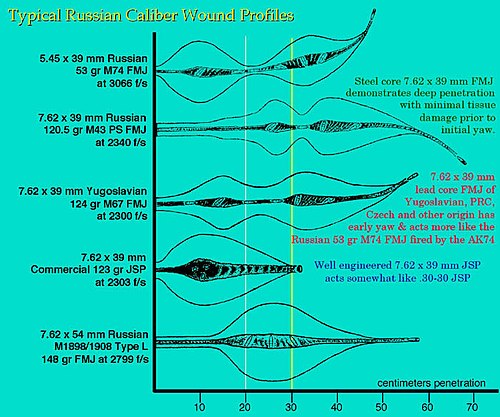 Wound profiles of Russian small-arms ammunition compiled by Martin Fackler on behalf of the U.S. military
 Wound ballistics profile of 7.62×39 mm
 7.62×39 mm ammunition and snap cap
 SKS rifle with a 10-round stripper clip of 7.62×39 mm ammunition
 Magazine for a Finnish RK-62 loaded with 7.62×39 mm ammunition
 "Bakelite" polymer AK magazines loaded with 7.62×39 mm ammunition
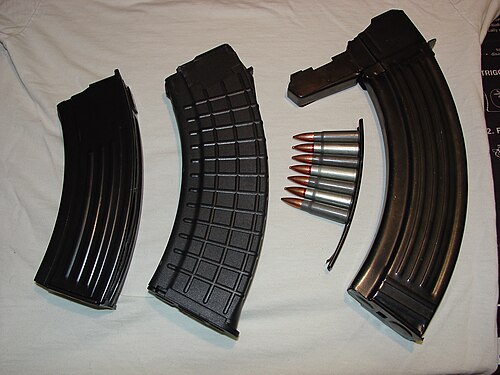 Magazines for three different 7.62×39 mm rifles and a stripper clip loaded with ammunition
 Loading 7.62×39 mm ammunition into an AK magazine
 An AK magazine loaded with 7.62×39 mm ammunition
See also
References
- ↑"SAAMI spec sheet (7.62x39mm on page 53)"(PDF). Archived from the original(PDF) on 2019-01-25. Retrieved 2019-01-24.
- ↑"CIP spec sheet for 7.62x39mm"(PDF). Archived(PDF) from the original on 2018-07-14. Retrieved 2019-01-24.
- 12"Steel Cased Ammo – Wolf Performance Ammunition". Archived from the original on 6 November 2016. Retrieved 30 January 2016.
- ↑"Product detail 7,62×39 — Sellier & Bellot". Archived from the original on 5 December 2015. Retrieved 30 January 2016.
- ↑Lawrence, Erik (2015). Practical Guide to the Operational Use of the RPD Machine Gun. Erik Lawrence Publications. p. 17. ISBN 978-1-941998-35-9.
- 12Monetchikov, Sergei (2005). История русского автомата[The History of Russian Assault Rifle] (in Russian). St. Petersburg: Military Historical Museum of Artillery, Engineers and Signal Corps. pp. 24–25. ISBN 978-5-98655-006-0.
- 123456"Патрон – основа оружия. Глава третья. Из истории автоматного 7,62-мм патрона образца 1943 г. (7,62х39)", Оружие 2005/9, pp. 21–44
- ↑C. J. Chivers (2010). The Gun. Simon & Schuster. pp. 166–167. ISBN 978-1-4391-9653-3. Retrieved 2016-11-02.
- ↑Williams, Anthony G (November 2014). "Assault Rifles and Their Ammunition: History and Prospects". Archived from the original on 17 July 2015.
- ↑"The 6.5×40 Cartridge: Longer Reach for the M4 & M16". Small Arms Defense Journal. Archived from the original on 2015-01-23. Retrieved 2015-01-14.
- 123"Best Online Casinos 2026: Safe & Fast Payouts 🇺🇸 - UTHR Casino Reviews". casinousa.uthr.org. 2025-12-25. Retrieved 2026-06-16.
- ↑"US Code: Title 18, Part 1, Chapter 44, § 921". Archived from the original on 2 January 2016.
- ↑Y, Daniel (2024-05-07). "AAC Soviet Ammo 7.62×39 Steel Case Ammo Now Shipping". thefirearmblog.com. Retrieved 2024-08-16.
- 12"C.I.P. TDCC sheet 7,62 x 39"(PDF). Archived(PDF) from the original on 2015-01-22. Retrieved 2015-01-22.
- ↑"ANSI/SAAMI Velocity & Pressure Data: Centerfire Rifle"(PDF). SAAMI. Archived from the original(PDF) on 2 July 2013. Retrieved 24 July 2026.
- ↑"патрон 7,62х39 7н23". patronen.su. Archived from the original on 2019-02-12. Retrieved 2019-02-11.
- ↑Соловцов Е.В. Российские боеприпасы Промежуточные патроны(PDF) (in Russian). Archived(PDF) from the original on 2019-02-02. Retrieved 2019-02-11.
- ↑"Russian 7.62x39mm Rounds for Rifles and Machine Guns, Land Forces Weapons Export Catalog"(PDF). p. 85. Archived from the original on 16 December 2011.
- ↑"warfare.be". warfare.be. Archived from the original on 2015-11-07. Retrieved 2013-01-21.
- ↑Warner, Ken (1989). Gun Digest 1990: 44th Edition. DBI Books. p. 147. ISBN 978-0-87349-038-2.
Trajectories are identical according to Remington
- ↑Adelmann, Steve (2014-09-26). "AR Accuracy with 7.62x39 mm". www.shootingillustrated.com. Archived from the original on 2016-09-16. Retrieved 2017-04-07.
- ↑Warner, Ken (1989). Gun Digest 1990: 44th Edition. DBI Books. p. 147. ISBN 978-0-87349-038-2.
Trajectories are identical according to Remington
- ↑"Ruger® Mini-14® Mini Thirty® Rifle Autoloading Rifle Models".
- ↑"Ruger News". www.ruger.com. Archived from the original on 2017-10-19. Retrieved 2017-10-18.
- ↑"Ruger News". www.ruger.com. Archived from the original on 2017-10-19. Retrieved 2017-10-18.
- ↑"Mauser Action Rifles Now in Remington Country". Archived from the original on 2010-07-01. Retrieved 2010-08-28.
- ↑Rand. "CZ-USA". Archived from the original on 2010-09-01. Retrieved 2010-08-28.
- ↑"Savage Arms". Archived from the original on 2011-05-03. Retrieved 2011-05-23.
- ↑"Test:Howa 1500 Mini Bolt Highlander 7.62x39 mm Rifle by B. Gil Horman – Friday, January 13, 2017". Archived from the original on April 9, 2017. Retrieved April 8, 2017.
Further reading
- Пономарёв, Юрий (2004). "БИОГРАФИЯ ПАТРОНА"(PDF). Kalashnikov. Arms, Ammo, Equipment (in Russian). No. 8. pp. 10–16. Retrieved 24 July 2026.
- Соловьев, К. (1996). ""Попурри" для символов 7,62" ["Potpourri" for 7.62 symbols]. Ружье. Оружие и амуниция (in Russian). No. 1. pp. 28–33.
External links
- "7.62x39 submachine gun cartridges". Archived from the original on 7 January 2014. Retrieved 24 July 2026.
- "Various photos of 7.62×39mm ammunition". Conjay. Archived from the original on 6 June 2011. Retrieved 24 July 2026.
- 7.62×39mm firearms
- Military cartridges
- Pistol and rifle cartridges
- Weapons and ammunition introduced in 1944
- Soviet inventions