
Agungi
An agungi (Korean: 아궁이[1]) is a firebox found in traditional Korean kitchens which is used to burn firewood or other fuel for cooking. It is also a part of the traditional floor heating system, or ondol.[2][3] The flat cooktop counter or hearth installed over the agungi is called a buttumak (부뚜막).[4][5]
History
Early buttumak have been dated to the 10th‒4th century BCE.[6] Iron and ceramic buttumaks, similar to their later forms, were excavated from Goguryeo 1st century BCE historical sites, such as Anak Tomb No. 3.[7]
Many Korean agrarian kitchens had buttumak with charcoal-fueled agungi until the early 1970s.[3]
 Iron buttumak from Goguryeo (37 BCE ‒ 668 CE)
 Agungi door from agrarian South Korea in the mid-20th century
Structure
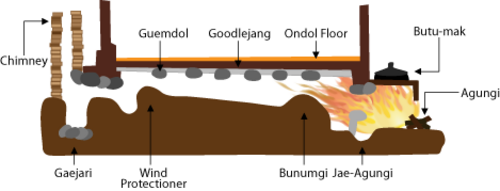
Buttumaks in agrarian Korean kitchens were commonly made from brick or stone and then smoothed with clay.[5]
Above each agungi is an upward opening where gamasot (big pot or cauldron used on agungi) can be set onto the buttumak.[5] A kitchen may have buttumak with multiple agungi holes and upward openings, or a single agungi hole and a single upward opening.[5] Each agungi can be covered with an iron plate or door to control the fire.[5]
يُعدّ كلٌّ من "أغونغي" و "بوتوماك" من المكونات الرئيسية لنظام "أوندول" التقليدي (التدفئة الأرضية). تُفتح فتحات التهوية الموجودة في الجزء الخلفي من "أغونغي" في الأيام الباردة للسماح للدخان والهواء الساخن بالمرور عبر المداخن الموجودة أسفل غرف "أوندول" والخروج إلى المدخنة في الطرف الآخر من المنزل. [ 3 ]
التأثيرات
كان مصطلح "كامادو" الياباني تحريفًا لكلمة "بوتوماك" الكورية. [ 8 ] [ 9 ] وتعود جذور كلمة "كامادو" (竈) أيضًا إلى الكلمة الكورية " غاما" (가마)، وهي مرادف لكلمة "بوتوماك" . تُستخدم كلمة "غاما" في اللغة الكورية الحديثة عادةً للإشارة إلى الأفران ، ولكن يمكن إيجاد استخدام الكلمة بمعنى "بوتوماك" في بعض المركبات مثل " غاماسوت " (وتعني حرفيًا "مرجل غاما ")، في إشارة إلى المرجل المستخدم في "بوتوماك" .
انظر أيضاً
مراجع
- ↑ "آغوي" . موسوعة الثقافة الكورية .
- ↑ "أغونغي" . قاموس المتعلمين الكوري-الإنجليزي . تم الاطلاع عليه بتاريخ 5 يناير 2018 .
- 1 2 3 ألبالا، كين ، أد. (2011). الثقافات الغذائية في الموسوعة العالمية . المجلد. 2. سانتا باربرا، كاليفورنيا: جرينوود . ص. 139. ردمك 978-0-313-37626-9تم الاطلاع عليه بتاريخ 4 يناير 2018 .
- ↑ "Buttumak" . قاموس المتعلمين الكوري-الإنجليزي . تم الاطلاع عليه بتاريخ 5 يناير 2018 .
- 1 2 3 4 5 بيتيد، مايكل ج. (2008). المطبخ الكوري: تاريخ مصور . لندن، المملكة المتحدة: رياكشن بوكس . ص 144. ISBN 978-1-86189-348-2تم الاطلاع عليه بتاريخ 5 يناير 2018 .
- ↑ يون، سانغ جون؛ وودسترا، جان (صيف 2007). "تقنيات البستنة المتقدمة في كوريا: أقدم البيوت الزجاجية الموثقة". تاريخ الحدائق . 35 (1): 68-84 . JSTOR 25472355 .
- ↑Kim, Kwang-on. "Buttumak". Encyclopedia of Korean Culture (in Korean). Academy of Korean Studies. Retrieved 4 January 2018.
- ↑Kim, Kwang-on (Autumn 2017). "A Family Tree: Traditional Kitchens of China, Korea and Japan". Koreana. Vol. 31, no. 3. Retrieved 4 January 2018.
- ↑Ekuan, Kenji (1976). Daidokoro dōgu no rekishi[History of Kitchen Utensils] (in Japanese). Tokyo, Japan: Shibata Shoten.
- Fireplaces
- Hanok
- Cooking appliances
- Stoves
- Architectural element stubs
- Korea stubs