
لحظة مركزية
في نظرية الاحتمالات والإحصاء ، يُعرف العزم المركزي بأنه عزم توزيع احتمالي لمتغير عشوائي حول متوسطه ؛ أي أنه القيمة المتوقعة لقوة عددية صحيحة محددة لانحراف المتغير العشوائي عن المتوسط. تشكل العزوم المختلفة مجموعة من القيم التي يمكن من خلالها وصف خصائص التوزيع الاحتمالي بشكل مفيد. يُفضل استخدام العزوم المركزية على العزوم العادية، المحسوبة بدلالة الانحرافات عن المتوسط بدلاً من الصفر، لأن العزوم المركزية ذات الرتب العليا تتعلق فقط بمدى التوزيع وشكله، وليس بموقعه .
يمكن تعريف مجموعات من اللحظات المركزية لكل من التوزيعات أحادية المتغير ومتعددة المتغيرات.
اللحظات أحادية المتغير
العزم النوني حول المتوسط (أو العزم المركزي النوني ) لمتغير عشوائي حقيقي X هو الكمية μn : = E[( X − E[ X ] ) n ] ، حيث E هو عامل التوقع . بالنسبة لتوزيع احتمالي أحادي المتغير مستمر بدالة كثافة احتمالية f ( x ) ، فإن العزم النوني حول المتوسط μ هو [ 1 ].
![{\displaystyle \mu _{n}=\operatorname {E} \left[{\left(X-\operatorname {E} [X]\right)}^{n}\right]=\int _{-\infty }^{+\infty }(x-\mu )^{n}f(x)\,\mathrm {d} x.}](https://wikimedia.org/api/rest_v1/media/math/render/svg/6ac11b1b87909c237be8a0357e3cccacb1bf8271)
بالنسبة للمتغيرات العشوائية التي ليس لها متوسط، مثل توزيع كوشي ، فإن العزوم المركزية غير محددة.
اللحظات المحورية القليلة الأولى لها تفسيرات بديهية:
- العزم المركزي "الصفري" μ 0 يساوي 1.
- العزم المركزي الأول μ 1 هو 0 (لا ينبغي الخلط بينه وبين العزم الخام الأول أو القيمة المتوقعة μ ).
- يُطلق على العزم المركزي الثاني μ 2 اسم التباين ، ويُشار إليه عادةً بالرمز σ 2 ، حيث يمثل σ الانحراف المعياري .
- يتم استخدام العزم المركزي الثالث والرابع لتحديد العزم المعياري الذي يستخدم لتحديد الالتواء والتفرطح ، على التوالي.
ملكيات
لكل n ، تكون العزم المركزي من الدرجة n متجانسة من الدرجة n :

Only for n such that n equals 1, 2, or 3 do we have an additivity property for random variables X and Y that are independent:
provided n ∈ {1, 2, 3}.

A related functional that shares the translation-invariance and homogeneity properties with the n-th central moment, but continues to have this additivity property even when n ≥ 4 is the n-th cumulantκn(X). For n = 1, the n-th cumulant is just the expected value; for n = either 2 or 3, the n-th cumulant is just the n-th central moment; for n ≥ 4, the n-th cumulant is an n-th-degree monic polynomial in the first n moments (about zero), and is also a (simpler) n-th-degree polynomial in the first n central moments.
Relation to moments about the origin
Sometimes it is convenient to convert moments about the origin to moments about the mean. The general equation for converting the n-th-order moment about the origin to the moment about the mean is
![{\displaystyle \mu _{n}=\operatorname {E} \left[\left(X-\operatorname {E} [X]\right)^{n}\right]=\sum _{j=0}^{n}{\binom {n}{j}}{\left(-1\right)}^{n-j}\mu '_{j}\mu ^{n-j},}](https://wikimedia.org/api/rest_v1/media/math/render/svg/9a67da8f24ea8a7cb43fc0d027d38eb34e19fc8b)
where μ is the mean of the distribution, and the moment about the origin is given by
![{\displaystyle \mu '_{m}=\int _{-\infty }^{+\infty }x^{m}f(x)\,dx=\operatorname {E} [X^{m}]=\sum _{j=0}^{m}{\binom {m}{j}}\mu _{j}\mu ^{m-j}.}](https://wikimedia.org/api/rest_v1/media/math/render/svg/809c339a16e4f6b0582cb12ccc2040febc9d09da)
For the cases n = 2, 3, 4 — which are of most interest because of the relations to variance, skewness, and kurtosis, respectively — this formula becomes (noting that and ):


which is commonly referred to as
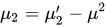
![{\displaystyle \operatorname {Var} (X)=\operatorname {E} [X^{2}]-\left(\operatorname {E} [X]\right)^{2}}](https://wikimedia.org/api/rest_v1/media/math/render/svg/b5eb5288e0881a5de3bd5ff90d00db095b9f1b07)

... and so on,[2] following Pascal's triangle, i.e.

because .

The following sum is a stochastic variable having a compound distribution

where the are mutually independent random variables sharing the same common distribution and a random integer variable independent of the with its own distribution. The moments of are obtained as


![{\displaystyle \operatorname {E} [W^{n}]=\sum _{i=0}^{n}\operatorname {E} \left[{\binom {M}{i}}\right]\sum _{j=0}^{i}{\binom {i}{j}}{\left(-1\right)}^{i-j}\operatorname {E} \left[\left(\sum _{k=1}^{j}Y_{k}\right)^{n}\right],}](https://wikimedia.org/api/rest_v1/media/math/render/svg/9fe24b681f1a84215f7e8d40543e30b450cede2f)
where is defined as zero for .
![{\textstyle \operatorname {E} \left[{\left(\sum _{k=1}^{j}Y_{k}\right)}^{n}\right]}](https://wikimedia.org/api/rest_v1/media/math/render/svg/89946c0d41c10371c3b9223cc75711d99433ff20)

Symmetric distributions
في التوزيعات المتناظرة حول متوسطاتها (غير المتأثرة بانعكاسها حول المتوسط)، فإن جميع العزوم المركزية الفردية تساوي صفرًا كلما وجدت، لأنه في صيغة العزم النوني ، كل حد يتضمن قيمة X أقل من المتوسط بمقدار معين يلغي تمامًا الحد الذي يتضمن قيمة X أكبر من المتوسط بنفس المقدار.
اللحظات متعددة المتغيرات
بالنسبة لتوزيع احتمالي ثنائي المتغيرات مستمر ذي دالة كثافة احتمالية f ( x , y )، فإن العزم ( j , k ) حول المتوسط μ = ( μX , μY ) هو
![{\displaystyle {\begin{aligned}\mu _{j,k}&=\operatorname {E} \left[{\left(X-\operatorname {E} [X]\right)}^{j}{\left(Y-\operatorname {E} [Y]\right)}^{k}\right]\\[2pt]&=\int _{-\infty }^{+\infty }\int _{-\infty }^{+\infty }{\left(x-\mu _{X}\right)}^{j}{\left(y-\mu _{Y}\right)}^{k}f(x,y)\,dx\,dy.\end{aligned}}}](https://wikimedia.org/api/rest_v1/media/math/render/svg/7550f60243d5e2bdc5308e1ecd670fce113f553d)
العزم المركزي للمتغيرات العشوائية المعقدة
يتم تعريف العزم المركزي من الرتبة n لمتغير عشوائي معقد X على النحو التالي [ 3 ]
![{\displaystyle \alpha _{n}=\operatorname {E} \left[{\left(X-\operatorname {E} [X]\right)}^{n}\right],}](https://wikimedia.org/api/rest_v1/media/math/render/svg/b29e0d378626fe360d4667a81f967c6a5309d530)
يُعرَّف العزم المركزي المطلق من الرتبة n للمصفوفة X على النحو التالي:
![{\displaystyle \beta _{n}=\operatorname {E} \left[{\left|\left(X-\operatorname {E} [X]\right)\right|}^{n}\right].}](https://wikimedia.org/api/rest_v1/media/math/render/svg/e3c1a182aedc40e06ae7e64cd896f2466561e05e)
يُطلق على العزم المركزي من الدرجة الثانية β 2 اسم تباين X بينما يُطلق على العزم المركزي من الدرجة الثانية α 2 اسم التباين الزائف لـ X.
انظر أيضاً
مراجع
- ↑ غريمت، جيفري؛ ستيرزاكر، ديفيد (2009). الاحتمالات والعمليات العشوائية . أكسفورد، إنجلترا: مطبعة جامعة أكسفورد. ISBN 978-0-19-857222-0.
- ↑ "اللحظة المركزية" .
- ↑ إريكسون، يان؛ أوليلا، إيسا؛ كويفونين، فيزا (2009). "مراجعة إحصاءات المتغيرات العشوائية المعقدة". المؤتمر الدولي لهندسة الصوت والكلام ومعالجة الإشارات لعام 2009، معهد مهندسي الكهرباء والإلكترونيات . الصفحات 3565-3568 . doi : 10.1109/ICASSP.2009.4960396 . ISBN 978-1-4244-2353-8. S2CID 17433817 .
- الانحراف الإحصائي والتشتت
- العزوم (الرياضيات)