
Flight zone
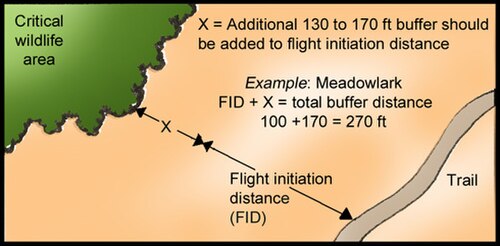
The flight zone of an animal is the perimeter area surrounding it that, if encroached upon by a potential predator or threat (including approaching humans), will cause alarm and escape behavior. The flight zone is determined by the animal's flight distance, sometimes also called[3]flight initiation distance (FID)[4] which extends horizontally from the animal and sometimes vertically. It may also be termedescape distance, alert distance, flush distance, and escape flight distance.
Swiss zoologist Heini Hediger distinguished between flight distance (escape boundary), critical distance (attack boundary), personal distance (distance separating members of non-contact species, as a pair of swans), and social distance (intraspecies communication distance).
Flight distance can be used as a measure of the willingness of an animal to take risks. Escape theory predicts that the probability of fleeing and flight distance increases as perceived predation risk increases and decreases as escape cost increases.[5] Flight initiation distance is one measure of animals' fear responses to humans.[6]Urban wildlifes, domesticated and captive animals, which are more accustomed to the presence of humans, have significantly shorter flight distances than wild animals.
In a study comparing 56 bird species with long flight distances, it was found these had declining populations in Europe. This indicates that standardized measures of flight distance can provide reliable information about the population consequences of risk-taking behaviour by individuals and the susceptibility of different species to increased levels of disturbance by humans.[5] A further study analyzing 75 flight initiation distance studies of 212 species found that larger species are more tolerant of humans.[6]
When the flight zone of a group of bulls was invaded by a mechanical trolley, the bulls moved away and maintained a constant distance between themselves and the trolley.[7] This indicates animals sometimes maintain a flight zone around unfamiliar inanimate objects.
The flight initiation distance is being used as a tool in wildlife management.[8] By studying flight zones, wildlife managers are able to reduce the impact of humans by creating ecological buffer zones between human settlements and animal habitats.[8]
The alert distance (AD) is the distance, by definition greater, within which the animal changes its behaviour in a manner enabling it to better observe the stimulus, as by raising the head in an alert posture, but does not necessarily flee unless the stimulus is also within the escape distance.[9][10][11] These measures are usually used to quantify the tolerance of wildlife to humans.
Factors influencing size
Animals faced with approaching predators must decide at which distance to initiate their flight, and they are expected to do so in a way that maximizes their fitness. As flight has both costs (including lost opportunity) and benefits, there will be in general an optimal flight initiation distance, defined as the first point in a predator's approach at which the benefit of flight exceeds the cost. The benefit of flight is equivalent to the cost of remaining in place or, in other words, to the risk of capture. The size of the flight zone can therefore vary according to circumstances. However, it has been shown in burrowing owls that individuals showed high repeatability in their FID.[12]
- Behaviour of the threat: In horned lizards, FID decreased as the distance between a turning predator and prey increased, but was greater when the predator turned toward than away from the fleeing animal.[13] The FID and alert response of American robins to approaching humans was investigated; the greatest FID was when the approaching person was not on paths and was looking at the birds, while the lowest FID occurred when the person was on a path and not looking at the robins. The authors suggested this indicated that they use gaze direction to assess risk.[14]
- Social: In lizards, FID was shorter during social encounters than when they were solitary.[13] and FID was shorter in female lizards when they were interacting with males than when they were alone; it was also shorter in males interacting with either sex.[15]
- Distance to refuge: Gray squirrels (Sciurus carolinensis) typically run to the nearest tree to escape from predators. As the risk of capture increases with distance from the refuge tree, squirrels feeding far from trees should have greater FID than those feeding closer by. Confirming this, FID in response to a motorized model predator (a cat) increased as distance to refuge increased.[16] Burrowing Owls breeding in territories far from roads showed larger FIDs than individuals breeding closer to roads and mated owls showed similar FIDs. Individual owls showed high repeatability in their FID.[12]
- Training and learning: The size of the flight zone can depend upon the tameness or level of habituation of the animal. Completely tame animals have no flight zone for humans; that is, they will allow a person to approach and touch them. Wild, feral, and unbroken animals can have very large flight zones.
Wildlife management
Wildlife managers often use ED and FID to develop set-back distances to reduce human impacts on wildlife,[17][18][1][4] both in wildlife refuges, and, e.g., in planning areas for outdoor recreation.[19]
These measures are also important in birding and nature photography.
The FID in multiple species differs from rural to urban areas.[20] A study by Møller et al. examined 811 FIDs from 37 species of birds and determined that the FID of birds in urban areas is reduced, compared to the FID of birds in rural areas.[20] Urbanization of birds has also been shown to correlate with changes in stress physiology and anti predator behaviour.[20] Similarly, a circumtropical study that studied escape responses of 10,249 bird individuals from 842 bird species inhabiting open tropical ecosystems in Africa, South America, and Australia found that FIDs are smaller in urban than rural habitats and decline also with increasing human footprint.[21] This may be due to a number of factors differing in rural vs urban areas, such as; difference in predator communities, length of exposure time to humans, relative abundance of humans, and the presence/abundance of food (bird-feeders in winter for example).[20] Wildlife managers must adjust buffer zones depending on urban/rural environments. However, a situation may differ between taxa - a study on dragonflies and damselflies (Odonata) found that while urbanization level did not directly affect their escape behavior, escape responses of Odonata were delayed in areas with high human activity.[22]
Some physical characteristics are very important to determine an animal's FID.[23] Eye size and brain size have a role in determining the FID.[23] FID in 107 species of birds was studied in relation to eye size and brain size and was shown that FID increases with larger eyes and decreases with larger brains.[23] Larger eyes mean that predators can be detected from further away and thus the FID would be larger compared to smaller eyes.[23] Larger brains decrease the FID compared to smaller brains, since they can better process the intent of predators and can delay their flight response for as long as possible.[23]
FID can be highly variable, but it can also be viewed as a species-specific trait.[8] A study conducted using eight species of shorebirds at six different sites in Australia was conducted to determine if FID was species specific.[8] It was demonstrated that while both the species and the site influenced the FID, there was no significant interaction between them.[8] This indicates that FID is species-specific, and while sites do influence the FID of a species, the average FID is a good reference for wildlife managers to use when creating buffer zones.[8]
While escape distance has been generally used as a measure of tolerance, other changes in animal behavior in presence of humans, such as increased vigilance time at the cost of decreased feeding time, may have significant overall impact on wildlife. Therefore, it is suggested that a more conservative measure, namely, the alert distance, should be used in determining minimum approaching distance.[19] The latter typically adds a certain buffer distance to the given tolerance measure.[4]
Animal handling
The flight zone is an important principle for herding, working, and mustering livestock. An animal can be stimulated to move simply by skirting its flight zone, and the animal will move in the desired direction according to the point of balance. The point of balance is usually located at the animal's shoulder according to their wide angled vision. An overstimulated animal will have a larger flight zone, for example an excited or scared animal.[24] A Cumulative Flight Zone is formed when animals move in a herd. In this situation the lead animal's and the following animals' Points of Balance, within the cumulative flight zone, must both be crossed to entice movement.[24]
The flight distance during handling is usually 1.5 to 7.6 m for beef cattle raised in a feeding operation and up to 30 m on mountain ranges.[25]Brahman cattle have a larger flight zone than most English breeds.[26] The flight zone can be thought of as the animal's personal space. The size of the flight zone is determined by the tameness of the animal; the more domesticated an animal, the smaller the zone. Fully tame animals have no flight zone.[27]
The flight zones in cattle vary depending on the situation they are experiencing.[28] Novel situations increase their flight zone, while accustomed stimuli will decrease their flight zone.[28] The flight zone is larger in the front than behind, due to the majority of their senses pointing forward.[28] As the animal becomes more relaxed in a situation or with a person its flight zone will reduce.[28] The cow's prior experiences with humans has also been shown to affect their flight zone.[28] Cows with positive handling experiences were shown to have smaller flight zones than those with negative handling experiences.[28]
Studies with sheep indicated that animals confined in a narrow alley had a smaller flight zone compared to animals confined in a wider alley.[29]
Handlers sometimes make the mistake of deeply invading the flight zone when animals are being driven down an alley or into an enclosed area such as a crowd pen. If the handler deeply penetrates the flight zone, the animals may turn back and run over them in an attempt to escape.[30] Confining a livestock animal in a crush (chute) or alley can make it feel more secure and thus reduce the size of the flight zone; however, it does not eliminate the flight zone. An animal in a livestock raceway or alley that feels threatened may panic and injure itself or other animals.[31] If handlers lean over fences around animals they penetrate the "zone of safety" and may cause the animals to rear.[32]
Husbandry
Animals have a tendency to move in the opposite direction when their handler walks deep into their flight zone. By crossing an animal's point of balance, within the flight zone, a handler can move the herd in a particular direction and control their speed of movement. For example, crossing the point of balance from front to back will move the animal forwards, while the opposite is also true. The handler's pace should always reflect the animal's speed when herding. Additionally, pressure should be alternated on the flight zone to reduce stress.[27] Constant pressure should never be applied.
If animals turn to face the handler he or she is considered to be no longer penetrating the flight zone.[27]
من المهم ألا يلاحق المربي أي حيوان يقاوم، لأن ذلك سيسبب له إجهادًا لا داعي له. بدلًا من ذلك، ينبغي السماح للحيوان بالعودة إلى المجموعة، فالحيوانات بطبيعتها تمتلك غريزة القطيع، وستتبع قائد المجموعة. من الممارسات الجيدة في الرعي، تطبيق هذه الغريزة، تحريك الحيوانات عبر ممر مع الحفاظ على تدفق ثابت لها، بدلًا من رعيها في مجموعات، مما يسمح للحيوانات الجديدة باتباع القائد بهدوء. [ 33 ] عند حصر الحيوانات في الحظيرة، يجب أن يكون لديها دائمًا مساحة كافية للابتعاد عن المربي لتقليل الإجهاد. فالإجهاد الأدنى يمنع إصابة الحيوان ويحافظ على إنتاجية جيدة، مثل زيادة جودة اللحوم وتحسين نسب العضلات والدهون. [ 31 ]
يمكن أن يؤدي الاختراق المتكرر والمناسب لمنطقة الهروب إلى تدريب الحيوانات على تقليل منطقة هروبها من المدرب. [ 27 ]
تؤدي مهارات الرعاية السيئة، بما في ذلك الإفراط في اختراق منطقة الهروب، إلى السلوكيات التالية: التوتر، والذعر، والعدوانية، والهروب، وسلوك الافتراس، والهجوم، والإغماء، والمرض، وإيذاء النفس. كما أن التعامل الخشن، مثل الضغط المستمر على منطقة الهروب، قد يرفع معدل ضربات قلب الحيوان. وتعكس هذه العوامل جميعها متلازمة التكيف العام.
متلازمة التكيف العام
متلازمة التكيف العام (GAS) هي استجابة ثلاثية المراحل للإجهاد عند الحيوانات.
- المرحلة الأولى هي استجابة الكر والفر ، وتشمل منطقة الهروب لدى الحيوان. يؤدي فرط تنشيط هذه المنطقة إلى تحفيز الجهاز العصبي الودي . يُحدث الجهاز العصبي الودي تعديلات واستجابات موضعية، بما في ذلك إفراز كميات كبيرة من الأدرينالين من لب الغدة الكظرية. [ 34 ] يُعرف الأدرينالين أيضًا باسم الأدرينالين. يزيد الأدرينالين من إمداد الأكسجين للأعضاء الحيوية ويقلله للأعضاء الأخرى. [ 35 ] يؤدي التعرض المتكرر لمواقف الكر والفر إلى اضطرابات غدية حادة.
- المرحلة الثانية هي التكيف والمقاومة. وهي تقوم على فكرة أن التعرض المتكرر يبني مناعة طبيعية، [ 35 ] وأن حركة المربي المشتركة والرعي يقلل من منطقة هروب الحيوان.
- المرحلة الثالثة هي الإنهاك. قد يؤدي التحفيز القوي والمستمر والمتكرر لمنطقة الهروب لدى الحيوان إلى الموت، وانخفاض الإنتاج، وتدني جودة الحياة. ووفقًا لنظرية التكيف العام، فإن التعافي الكامل من الإنهاك ممكن مع مرور الوقت. [ 35 ]
قيم العينة
مسافات الهروب النموذجية (معظمها متوسط) من البشر:
طيور أوروبا

| صِنف | ED [ م ] | المرجع. |
|---|---|---|
| إوزة برنت | (130–1000) 319 | [ 10 ] |
| البط الشمالي | (100–500) 294 | [ 10 ] |
| مالك الحزين الرمادي | 255 | [ 11 ] |
| البط البري | (60–400) 236 | [ 10 ] |
| زقزاق شمالي | 162 | [ 11 ] |
| دنلين | (15–450) 70 | [ 10 ] |
| غرّة أوراسية | 68 | [ 11 ] |
| وينشات | 20-30 | [ 36 ] |
| طائر الشحرور الأوراسي | 10 | [ 36 ] |
| القرقف الأزرق | 10 | [ 36 ] |
طيور أمريكا الشمالية [ 4 ]
| الثدييات في أمريكا الشمالية [ 4 ]
|
العوامل المؤثرة على مسافات هروب الطيور

قد تختلف مسافة الهروب اختلافًا كبيرًا تبعًا للعديد من الظروف. يُعدّ حجم الجسم العامل العام الأكثر شهرةً الذي يؤثر على الاختلافات بين الأنواع. غالبًا ما تكون الأنواع الكبيرة أكثر خجلًا من الأنواع الصغيرة، لأن الحجم يؤثر على سرعة إقلاع الطائر. [ 11 ] [ 10 ] ومن المثير للدهشة أن تحليلًا لمئات الدراسات وجد أن الطيور الأكبر حجمًا أكثر تسامحًا مع البشر، على الرغم من وجود أبحاث كثيرة تُظهر أن الحيوانات الأكبر حجمًا أقل تسامحًا مع البشر. [ 6 ]
من بين العوامل المؤثرة:
- الأنواع [ 10 ] [ 9 ] [ 18 ] [ 17 ] [ 11 ] [ 36 ] – على سبيل المثال، البط البري Anas platyrhynchos لديه ED أقصر من البط ذي الذيل المدبب Anas acuta [ 10 ] .
- العمر – الطيور الصغيرة أقل خجلاً، على سبيل المثال طائر الزقزاق الرملي (Calidris alpina )
- التعود على وجود الناس يمشون . [ 10 ] البط البري (Anas platyrhynchos) أو الإوز الكندي (Branta canadensis) أقل خجلاً في الحديقة مقارنةً بأماكن تواجدها في البرية. طيور القرقف والزرزور بالقرب من المغذيات أو في الحديقة أقل خجلاً مما هي عليه في البرية.
- الموسم. على سبيل المثال، طيور الحسون الشتوية (Pyrrhula pyrrhula) لديها فترات حضانة أقصر من تلك التي تتكاثر. [ 36 ]
- Origin of birds – sometimes wintering birds from the north, perhaps not knowing people, are less shy than native, for example nutcracker Nucifraga caryocatactes[36]
- Given bird individual
- Color of clothes of an observer and observer's behaviour[36]
- Hunting status – quarry species have longer EDs than non-quarry, increasing during hunting season or after days with hunting.[10][11]
- Flock size[11]
- Flock composition – for example birds in mixed flocks of mallard Anas platyrhynchos and teal Anas crecca react at longer distances than those in single species flocks for either species.[11] Or dunlin Calidris alpina in flocks with other waders.[36]
- Visibility of the stimulus to the birds[11]
- Wind force[10]
- Vegetation height[11]
See also
References
- 12Bentrup G. (2008). "Conservation buffers: design guidelines for buffers, corridors, and greenways". Gen. Tech. Rep. SRS-109. Asheville, NC: USDA, Forest Service, Southern Research Station.
- ↑Bentrup, G. (2008). "Flight Initiation Distance Buffers". USDA National Agroforestry Center. Retrieved 6 September 2012.
{{cite web}}: CS1 maint: deprecated archival service (link) - ↑Grandin, Temple; Deesing, Mark (2014). Genetics and Behavior During Handling, Restraint, and Herding. Elsevier Inc. p. 121.
- 12345Bentrup, G. (2008). "Flight Initiation Distance Buffers". USDA National Agroforestry Center. Retrieved 6 September 2012.
{{cite web}}: CS1 maint: deprecated archival service (link) - 12Moller, A.P. (2008). "Flight distance and population trends in European breeding birds". Behavioral Ecology. 19 (6): 1095–1102. doi:10.1093/beheco/arn103.
- 123Stuart Wolpert (16 November 2015). "Why are some wild animals more tolerant to human interaction than others?". UCLA. Retrieved 30 December 2016.
- ↑Kilgour, R., (1971). Animal handling in works, pertinent behaviour studies. 13th Meat Industry Research Conference, Hamilton, New Zealand. pp. 9–12
- 123456Blumstein, D. T.; Anthony, L. L.; Harcourt, R.; Ross, G. (2003). "Testing a key assumption of wildlife buffer zones: is flight initiation distance a species-specific trait?". Biological Conservation. 110 (1): 97–100. Bibcode:2003BCons.110...97B. doi:10.1016/s0006-3207(02)00180-5.
- 12Ruddock M., Whitfield D. P. (2007). "A Review of Disturbance Distances in Selected Bird Species, A report from Natural Research (Projects) Ltd to Scottish Natural Heritage"(PDF). Archived from the original(PDF) on February 28, 2013. Retrieved September 4, 2012.
- 1234567891011Laursen K.; Kahlert J.; Frikke; J. (2005). "Factors affecting escape distances of staging waterbirds"(PDF). Wildlife Biology. 11 (1): 13–19. doi:10.2981/0909-6396(2005)11[13:faedos]2.0.co;2. S2CID 86208796. Retrieved 4 September 2012.
- 1234567891011Bregnballe T.; Aaen K.; Fox A. D. (2009). "Escape distances from human pedestrians by staging waterbirds in a Danish wetland"(PDF). Wildfowl (Special Issue 2): 115–130. Retrieved 4 September 2012.
- 1 2 كاريتي، م.؛ تيلا، ج. ل. (2009). "الاتساق الفردي في مسافات بدء الطيران لدى بوم الجحور: فرضية جديدة حول اختيار الموائل الناجم عن الاضطراب" . رسائل علم الأحياء . 6 (2): 167-170 . doi : 10.1098/rsbl.2009.0739 . PMC 2865052. PMID 19864278 .
- 1 2 كوبر، دبليو إي (2000). "قرارات الهروب البدائية في السحالي المقرنة الخفية (Phrynosoma) التي تمتلك دفاعات متطورة للغاية ضد الافتراس" . تم الاسترجاع في 20 أبريل 2013 .
- ↑ إيسون، ب.ك.؛ شيرمان، ب.ت.؛ رانكين، أ.؛ كولمان، ب. (2006). "العوامل المؤثرة على مسافة بدء الطيران لدى طائر أبو الحناء الأمريكي". مجلة إدارة الحياة البرية . 70 (6): 1796-1800 . doi : 10.2193/0022-541x(2006)70 [ 1796:fafidi ] 2.0.co ; 2. S2CID 85926285 .
- ↑ كوبر، دبليو إي (2009). "تتناقص مسافة بدء الطيران أثناء النشاط الاجتماعي لدى السحالي (سكيلوبوروس فيرجاتوس)". علم البيئة السلوكي وعلم الأحياء الاجتماعي . 63 (12): 1765-1771 . Bibcode : 2009BEcoS..63.1765C . doi : 10.1007/s00265-009-0799-1 . S2CID 24549272 .
- ↑ ديل، إل إم؛ هوتمان، آر. (1989). "تأثير المسافة إلى الملجأ على مسافة بدء الطيران لدى السنجاب الرمادي (Sciurus carolinensis)" (ملف PDF) . المجلة الكندية لعلم الحيوان . 67 (1): 233-235 . Bibcode : 1989CaJZ...67..233D . doi : 10.1139/z89-033 .
- 1 2 فرنانديز-جوريسيك إي؛ خيمينيز إم دي؛ لوكاس إي (2001). "مسافة التنبيه كمقياس بديل لتحمل الطيور للإزعاج البشري - الآثار المترتبة على تصميم الحدائق" (ملف PDF) . الحفاظ على البيئة . 28 (3): 263-269 . Bibcode : 2001EnvCo..28..263F . doi : 10.1017/S0376892901000273 . S2CID 44189097. تم الاسترجاع في 4 سبتمبر 2012 .
- 12Blumstein D. T. (Oct 2003). "Flight-Initiation Distance in Birds Is Dependent on Intruder Starting Distance"(PDF). The Journal of Wildlife Management. 67 (4). Allen Press: 852–857. doi:10.2307/3802692. JSTOR 3802692. Retrieved 4 September 2012.
- 12Alert distance as an alternative measure of bird tolerance to human disturbance: implications for park design
- 1234Møller, A. P.; Tryjanowski, P; Díaz, M; Kwieciński, Z; Indykiewicz, P; Mitrus, C; Golawski, A; Polakowski, M (2015). "Urban habitats and feeders both contribute to flight initiation distance reduction in birds". Behavioral Ecology. 26 (3): 861–865. doi:10.1093/beheco/arv024.
- ↑Mikula P, Tomášek O, Romportl D, Aikins TK, Avendaño JE, Braimoh-Azaki BD, Chaskda A, Cresswell W, Cunningham SJ, Dale S, Favoretto GR, Floyd KS, Glover H, Grim T, Henry DA, Holmern T, Hromada M, Iwajomo SB, Lilleyman A, Magige FJ, Martin RO, Maximiano MF, Nana ED, Ncube E, Ndaimani H, Nelson E, van Niekerk JH, Pienaar C, Piratelli AJ, Pistorius P, Radkovic A, Reynolds C, Røskaft E, Shanungu GK, Siqueira PR, Tarakini T, Tejeiro-Mahecha N, Thompson ML, Wamiti W, Wilson M, Tye DR, Tye ND, Vehtari A, Tryjanowski P, Weston MA, Blumstein DT, Albrecht T (2023). "Bird tolerance to humans in open tropical ecosystems". Nature Communications. 14 (1): 2146. Bibcode:2023NatCo..14.2146M. doi:10.1038/s41467-023-37936-5. hdl:10023/27452. PMC 10119130. PMID 37081049.
- ↑Mikula P, Czechowski P, Dubicka-Czechowska A, Jerzak L, Menzel A, Tryjanowski P (2025). "Understanding antipredator strategies of insects: Human presence and escape behaviour in Odonata". Ecological Entomology. doi:10.1111/een.13430.
- 12345Møller, A. P.; Erritzøe, J. (2013). "Predator-prey interactions, flight initiation distance and brain size". Journal of Evolutionary Biology. 26 (1): 23–42. doi:10.1111/jeb.12272. PMID 25990564. S2CID 41897304.
- 12Grandin, Temple. "Behavioural Principles of Livestock Handling". Vision, Hearing, and Handling methods in Cattle and Pigs. American Registry of Professional Animal Scientists. Retrieved 7 October 2013.
- ↑Grandin, T (1980). "Observations of cattle behavior applied to the design of cattle-handling facilities". Appl. Anim. Ethol. 6: 19–31. doi:10.1016/0304-3762(80)90091-7.
- ↑Grandin, T (1978). "Observations of the spatial relationships between people and cattle during handling". Proc. Western Sect., Am. Soc. Anim. Sci. 29: 76–79.
- 1234Grandin, Temple. "Behavioural Principles of Livestock Handling". Vision, Hearing, and Handling methods in Cattle and Pigs. American Registry of Professional Animal Scientists. Retrieved 7 October 2013.
- 123456Moran, J; Doyle, R (2015). Cow talk: understanding dairy cow behaviour to improve their welfare on Asian farms. Clayton South, Vic: CSIRO Publishing. pp. 48–49.
- ↑Hutson, G.D. (1982). "Flight distance in Merino sheep". Animal Production. 35 (2): 231–235. doi:10.1017/s0003356100027409.
- ↑Grandin T. (1989). "Behavioral principles of livestock handling". Retrieved 22 April 2013.
- 12Chambers, P.G.; Grandin, T.; Heinz, G.; Srisuvan, T. (2001). "Guidelines for Humane Handling, Transport and Slaughter of Livestock". Food and Agriculture Organization of the United Nations – Regional Office for Asia and the Pacific. Retrieved 22 April 2013.
- ↑ جراندين، ت. (1983). مناولة ومعالجة ماشية التسمين. في: جي بي طومسون وسي سي أو ماري (محرران) مزرعة التسمين، ليا وفيبيجر، فيلادلفيا. ص 213-235
- ↑ جراندين، تمبل. "فهم مناطق الطيران ونقطة التوازن" . برو واي . معدات برو واي للماشية . تم الاطلاع عليه بتاريخ 30 سبتمبر 2020 .
- ↑ لوي، آرثر. "الجهاز العصبي البشري" . بريتانيكا . تم الاطلاع عليه في 7 أكتوبر 2013 .
- 1 2 3 مجهول، مجهول. "متلازمة التكيف العام" . مؤسسة أوراكل التعليمية. مؤرشف من الأصل في 19 أكتوبر 2013. تم الاطلاع عليه في 7 أكتوبر 2013 .
- 1 2 3 4 5 6 7 8 جوتزمان ج.؛ ديسلبيرجر ج. (1979). Z lornetką wśród ptaków [مع مناظير بين الطيور] . Nasze Hobby [هوايتنا] (باللغة البولندية) ( الطبعة الأولى). وارسو: Państwowe Wydawnictwo Rolnicze i Leśne (PWRiL).
للمزيد من القراءة
- كوبر، دبليو إي؛ فريدريك، دبليو جي (2007). "المسافة المثلى لبدء الطيران". مجلة البيولوجيا النظرية . 244 (1): 59-67 . Bibcode : 2007JThBi.244...59C . doi : 10.1016/j.jtbi.2006.07.011 . PMID 16949619 .
- مراقبة الطيور
- علم السلوك الحيواني
- يخاف
- الماشية
- التصوير الفوتوغرافي للطبيعة