
حاصل ضرب GIT
في الهندسة الجبرية ، يُعرف خارج القسمة التآلفي GIT ، أو خارج القسمة التآلفي لنظرية الثوابت الهندسية ، للمخطط التآلفيمع إجراء من قبل مخطط المجموعة G هو المخطط الأفيني، الطيف الأولي لحلقة الثوابت لـ A ، ويُرمز إليه بـ. إن خارج القسمة GIT هو خارج قسمة فئوي : أي تشاكل ثابت يحلل بشكل فريد من خلاله.


أخذ الإسقاط ( لحلقة متدرجة ) بدلاً من، يحصل المرء على خارج قسمة GIT الإسقاطي (وهو خارج قسمة مجموعة النقاط شبه المستقرة ).

حاصل القسمة الهندسي هو حاصل قسمة فئوي لموضع النقاط شبه المستقرة؛ أي حاصل قسمة الموضع شبه المستقر. ولأن حاصل القسمة الفئوي فريد، فإذا وُجد حاصل قسمة هندسي ، فإن المفهومين يتطابقان: على سبيل المثال، يكون لدينا
![{\displaystyle G/H=G/\!/H=\operatorname {Spec} \!{\big (}k[G]^{H}{\big )}}](https://wikimedia.org/api/rest_v1/media/math/render/svg/cfcc870e585bcb1f6058c952ca8bc2567a883252)
بالنسبة لمجموعة جبرية G على حقل k ومجموعة فرعية مغلقة H.
إذا كان X عبارة عن مجموعة إسقاطية سلسة معقدة وإذا كانت G عبارة عن مجموعة لي معقدة مختزلة ، فإن خارج قسمة GIT لـ X بواسطة G يكون متماثلًا مع خارج القسمة التبسيطية لـ X بواسطة مجموعة فرعية مضغوطة قصوى من G ( نظرية كيمبف-نيس ).
بناء حاصل قسمة GIT
ليكن G زمرة اختزالية تعمل على مخطط شبه إسقاطي X فوق حقل، وليكن L حزمة خطية واسعة خطية على X.
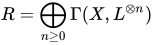
ليكن حلقة المقطع. بحسب التعريف، الموضع شبه المستقرهو مكمل مجموعة الأصفارفي X ؛ بعبارة أخرى، هو اتحاد جميع المجموعات الجزئية المفتوحةبالنسبة للأقسام العالمية من، ن كبير. بالوفرة، كلهو خطي؛ قلوهكذا يمكننا تكوين حاصل قسمة GIT الأفيني


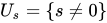




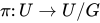
لاحظ أنهي من النوع المحدود وفقًا لنظرية هيلبرت على حلقة الثوابت . وبحسب الخاصية العامة للقسمات الفئوية ، فإن هذه القسمات الأفينية تلتصق وتؤدي إلى


وهو حاصل قسمة GIT لـ X بالنسبة إلى L. لاحظ أنه إذا كان X إسقاطيًا؛ أي أنه Proj لـ R ، فإن حاصل القسمةيُعطى ببساطة على أنه إسقاط حلقة الثوابت.


The most interesting case is when the stable locus[1] is nonempty; is the open set of semistable points that have finite stabilizers and orbits that are closed in . In such a case, the GIT quotient restricts to


which has the property: every fiber is an orbit. That is to say, is a genuine quotient (i.e., geometric quotient) and one writes . Because of this, when is nonempty, the GIT quotient is often referred to as a "compactification" of a geometric quotient of an open subset of X.



A difficult and seemingly open question is: which geometric quotient arises in the above GIT fashion? The question is of a great interest since the GIT approach produces an explicit quotient, as opposed to an abstract quotient, which is hard to compute. One known partial answer to this question is the following:[2] let be a locally factorial algebraic variety (for example, a smooth variety) with an action of . Suppose there are an open subset as well as a geometric quotient such that (1) is an affine morphism and (2) is quasi-projective. Then for some linearlized line bundle L on X. (An analogous question is to determine which subring is the ring of invariants in some manner.)




Examples
Finite group action by

A simple example of a GIT quotient is given by the -action on sending
![{\displaystyle \mathbb {C} [x,y]}](https://wikimedia.org/api/rest_v1/media/math/render/svg/bef1bb44559f9eb88d544757f8f49058b6ef3374)

Notice that the monomials generate the ring . Hence we can write the ring of invariants as

![{\displaystyle \mathbb {C} [x,y]^{\mathbb {Z} /2\mathbb {Z} }}](https://wikimedia.org/api/rest_v1/media/math/render/svg/8ec47c06307880e92734a390d00505389b61d2e2)
![{\displaystyle \mathbb {C} [x,y]^{\mathbb {Z} /2\mathbb {Z} }=\mathbb {C} [x^{2},xy,y^{2}]={\frac {\mathbb {C} [a,b,c]}{(ac-b^{2})}}}](https://wikimedia.org/api/rest_v1/media/math/render/svg/192c55c574bd79af3db7139acac349b12049bd90)
Scheme theoretically, we get the morphism
![{\displaystyle \mathbb {A} ^{2}\to {\text{Spec}}\left({\frac {\mathbb {C} [a,b,c]}{(ac-b^{2})}}\right)=:\mathbb {A} ^{2}/(\mathbb {Z} /2\mathbb {Z} )}](https://wikimedia.org/api/rest_v1/media/math/render/svg/e8c50607a8f36313f459239461dbef92c9a65a7e)
which is a singular subvariety of with isolated singularity at . This can be checked using the differentials, which are



hence the only point where the differential and the polynomial both vanish is at the origin. The quotient obtained is a conical surface with an ordinary double point at the origin.

Torus action on plane
Consider the torus action of on by . Note this action has a few orbits: the origin , the punctured axes, , and the affine conics given by for some . Then, the GIT quotient has structure sheaf which is the subring of polynomials , hence it is isomorphic to . This gives the GIT quotient







![{\displaystyle \mathbb {C} [xy]}](https://wikimedia.org/api/rest_v1/media/math/render/svg/31dc5cdb7b0ffed1006b4a2bf121fdb109b35eca)


Notice the inverse image of the point is given by the orbits , showing the GIT quotient isn't necessarily an orbit space. If it were, there would be three origins, a non-separated space.[3]


See also
Notes
- ↑NB: In (Mumford, Fogarty & Kirwan 1994), it was called the set of properly stable points
- ↑ مامفورد، فوغارتي وكيروان 1994 ، كونفرس 1.13. ملاحظة: على الرغم من أن النتيجة مذكورة لمجموعة متنوعة سلسة، إلا أن البرهان هناك صالح لمجموعة عاملية محلية.
- ↑ توماس، ريتشارد ب. (2006). "ملاحظات حول نظرية الاختزال التبسيطي العام والاختزال التبسيطي للحزم والمتنوعات". دراسات في الهندسة التفاضلية . 10 (1). دار النشر الدولية في بوسطن: 221-273 . arXiv : math/0512411 . doi : 10.4310 / sdg.2005.v10.n1.a7 . ISSN 1052-9233 . MR 2408226. S2CID 16294331 .
مراجع
تربوي
- موكاي، شيغيرو (2002). مقدمة في الثوابت والمعاملات . دراسات كامبريدج في الرياضيات المتقدمة. المجلد 81. ISBN 978-0-521-80906-1.
- بريون، ميشيل. "مقدمة في تأثيرات المجموعات الجبرية" (PDF) .
- لازا ، رادو (2012/03/15). “GIT وmoduli مع تطور”. أرخايف : 1111.3032 [ math.AG ].
- توماس، ريتشارد ب. (2006). "ملاحظات حول نظرية الاختزال التبسيطي والاختزال التبسيطي للحزم والمتنوعات". إهداء إلى البروفيسور س. س. تشيرن . دراسات في الهندسة التفاضلية. المجلد 10. الصفحات 221-273 . arXiv : math/0512411 . doi : 10.4310/SDG.2005.v10.n1.a7 . MR 2408226. S2CID 16294331 .
مراجع
- ألبر، جارود (2008-04-14). "مساحات المعاملات الجيدة لمكدسات أرتين". arXiv : 0804.2242 [ math.AG ].
- دورن، برنت؛ كيروان، فرانسيس (2007). "نحو نظرية الثوابت الهندسية غير الاختزالية". مجلة الرياضيات البحتة والتطبيقية الفصلية . 3 (1، عدد خاص: تكريمًا لروبرت د. ماكفرسون. الجزء 3): 61-105 . arXiv : math /0703131 . Bibcode : 2007math......3131D . doi : 10.4310/PAMQ.2007.v3.n1.a3 . MR 2330155. S2CID 3190064 .
- هوسكينز، فيكتوريا. "القسمة في الهندسة الجبرية والتماثلية" .
- كيروان، فرانسيس سي. (1984). علم التماثل للقسمة في الهندسة المعقدة والجبرية . ملاحظات رياضية. المجلد 31. برينستون، نيوجيرسي: مطبعة جامعة برينستون .
- مومفورد, ديفيد ; فوغارتي، جون. كيروان، فرانسيس (1994). النظرية الهندسية الثابتة . Ergebnisse der Mathematik und ihrer Grenzgebiete (2) [النتائج في الرياضيات والمجالات ذات الصلة (2)]. المجلد. 34 ( الطبعة الثالثة). برلين، نيويورك: سبرينغر-فيرلاغ . رقم ISBN 978-3-540-56963-3MR 1304906 .
- الهندسة الجبرية