
Governor-General of Tuvalu
The governor-general of Tuvalu is the representative of the Tuvaluan monarch, currently King Charles III, in the country of Tuvalu.
The governor-general performs the monarch's duties in Tuvalu. The constitutional convention is that the governor-general represents the monarch and acts on the advice of the prime minister.
The office of the governor-general was created on 1 October 1978, when Tuvalu gained independence from the United Kingdom as a sovereign state and an independent constitutional monarchy. Since then, ten individuals have served as governor-general. The incumbent, since 28 September 2021, is Sir Tofiga Vaevalu Falani.
Constitutional status and appointment
The monarchy of Tuvalu exists in a framework of a parliamentaryrepresentative democracy. As a constitutional monarch, the King acts entirely on the advice of his government ministers in Tuvalu.[2] The monarch is recognised in section 50 of the Constitution of Tuvalu, as a symbol of the unity and identity of Tuvalu. The powers and functions of the head of state are set out in Part IV of the Constitution.[3]
As set out in section 55 of the Constitution, the King's representative in Tuvalu is the governor-general, who must be at least 50 years of age and be qualified to be elected as a member of parliament. The governor-general is appointed by the monarch for a four-year term. The appointment is made upon the advice of the Tuvaluan prime minister, "after the Prime Minister has, in confidence, consulted the members of Parliament".[4][5]
Section 59(1) of the Constitution requires the governor-general to perform the monarch's functions when the sovereign is outside Tuvalu or otherwise incapacitated.[3]
Vacancies and removal
The governor-general may be removed from office by the King upon the advice of the prime minister, after consultation with parliament. The office becomes vacant if the governor-general ceases to be qualified to be elected as a member of parliament, and the governor-general may also resign by submitting written notice to the speaker of the Parliament of Tuvalu.[4]
Functions


The governor-general has constitutional responsibilities and reserve powers in relation to the ordering the Parliament of Tuvalu to convene and the appointment and dismissal of the prime minister.[3]
Exercise of reserve powers
In 2003, the Chief Justice of the High Court of Tuvalu delivered directions as to how the governor-general should proceed to take any action they considers to be appropriate under Section 116(1) of the Constitution, acting in his own deliberate judgment, rather than as advised by the cabinet.[6] That is, the governor-general could consider whether it was appropriate to exercise their reserve powers in calling Parliament.
The then Governor-General, Sir Iakoba Italeli was called on to exercise the reserve powers when Prime Minister Willy Telavi refused to recall parliament after the 2013 Nukufetau by-election. A constitutional crisis developed when Prime Minister Telavi responded that, under the Constitution, he was only required to convene parliament once a year, and was thus under no obligation to summon it until December 2013.[7] Tuvalu's opposition then requested the governor-general to intervene against the prime minister's decision.[8] On 3 July, Italeli exercised his reserve powers in ordering parliament to convene, against the prime minister's wishes, on 30 July.[9]
When the Parliament met on 30 July, the Speaker (Sir Kamuta Latasi) refused to allow a debate on a motion of no confidence in the government of Willy Telavi. After further political maneuvers,[10] Italeli then proceeded to exercise his reserve powers to order Telavi to stand down as prime minister and appointed Enele Sopoaga as interim prime minister.[11] The governor-general also ordered that parliament sit on Friday 2 August to allow a vote of no-confidence in Telavi and his government.[12] Telavi then proceeded to write to Elizabeth II, Queen of Tuvalu, informing her that he was dismissing Italeli from his position as governor-general.[11] The Queen made no reaction at all, thus leaving Sir Iakoba secure in his post.[13]
The constitutional crisis was resolved by a motion of no confidence in the government of Willy Tevali, which was held on 2 August 2013: the voting was eight for the motion, four against and one abstention.[14] On 4 August the parliament elected Enele Sopoaga as prime minister.[14][15][16]
Symbols and privileges

The governor-general uses a personal flag, which features a lion passant atop a St. Edward'sroyal crown with "Tuvalu" written across a scroll underneath, all on a blue background. It is flown on buildings and other locations in Tuvalu to mark the governor-general's presence.
All governors-general have been awarded the Order of St Michael and St George. Faimalaga Luka had thus far been the only governor-general to decline a knighthood.
Residence
Government House in Funafuti is the official residence of the governor-general of Tuvalu.
List of governors-general
Following is a list of people who have served as Governor-General of Tuvalu since independence in 1978.[17]
A total of ten people have held the position on a permanent basis, while an additional three people have held it on an interim basis due to a vacancy. Teniku Talesi was the first woman to be appointed to the role (albeit for an interim period),[18][19][20] holding office from the resignation of Iakoba Italeli in August 2019,[21] until being replaced by Samuelu Teo (then also serving as Speaker of Parliament) in January 2021.[22]
| No. | Portrait | Name(Birth–Death) | Term of office | Monarch(Reign) | ||
|---|---|---|---|---|---|---|
| Took office | Left office | Time in office | ||||
| 1 | 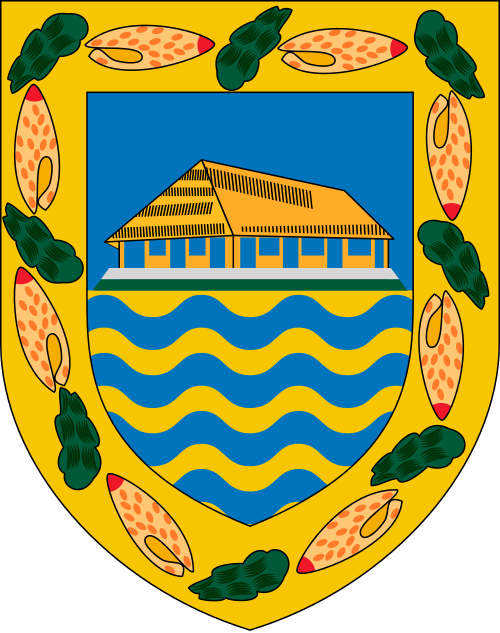 | Sir Fiatau Penitala Teo(1911–1998) | 1 October1978 | 1 March1986 | 7 years, 151 days |  Elizabeth II(1978–2022) Elizabeth II(1978–2022) |
| 2 | | Sir Tupua Leupena(1922–1996) | 1 March1986 | 1 October1990 | 4 years, 214 days | |
| 3 | | Sir Toaripi Lauti(1928–2014) | 1 October1990 | 1 December1993 | 3 years, 61 days | |
| 4 | | Sir Tomu Sione(1941–2016) | 1 December1993 | 21 June1994 | 202 days | |
| 5 | | Sir Tulaga Manuella(born 1936) | 21 June1994 | 26 June1998 | 4 years, 5 days | |
| 6 | | Sir Tomasi Puapua(born 1938) | 26 June1998 | 9 September2003 | 5 years, 75 days | |
| 7 | 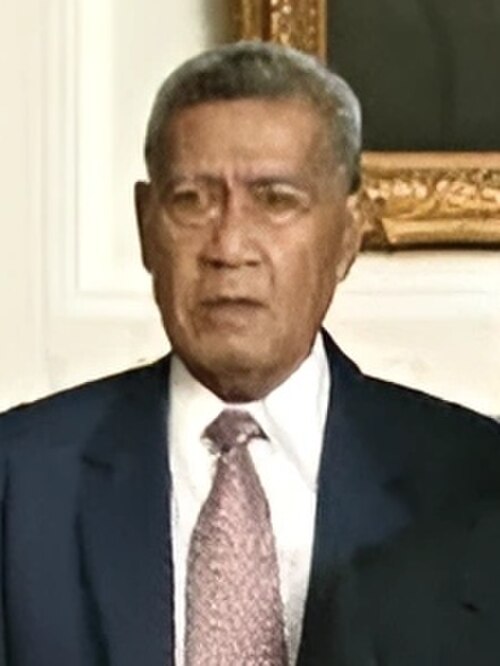 | Faimalaga Luka(1940–2005) | 9 September2003 | 15 April2005 | 1 year, 218 days | |
| 8 | 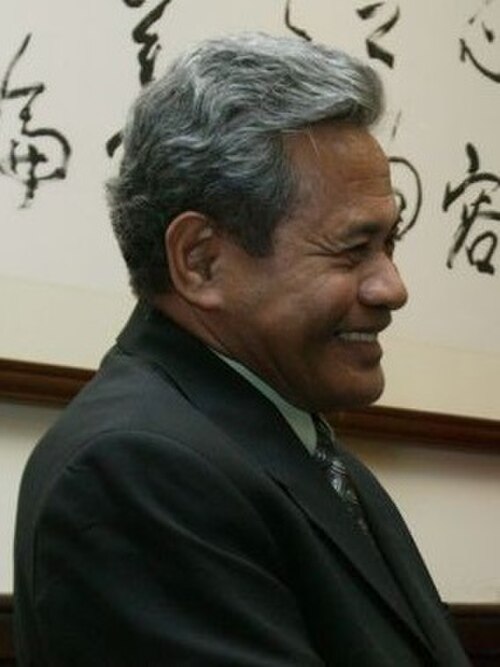 | Sir Filoimea Telito(1945–2011) | 15 April2005 | 19 March2010 | 4 years, 338 days | |
| – |  | Sir Kamuta Latasi(born 1936)Acting Governor-General | 19 March2010 | 16 April2010 | 28 days | |
| 9 |  | Sir Iakoba Italeli(b. ?) | 16 April2010 | 22 August2019 | 9 years, 128 days | |
| – |  | Teniku Talesi(b. ?)Acting Governor-General | 22 August2019 | January2021 | 1 year, 4 months | |
| – |  | Samuelu Teo(1957–2024)Acting Governor-General | January2021 | 28 September2021 | 8 months | |
| 10 | 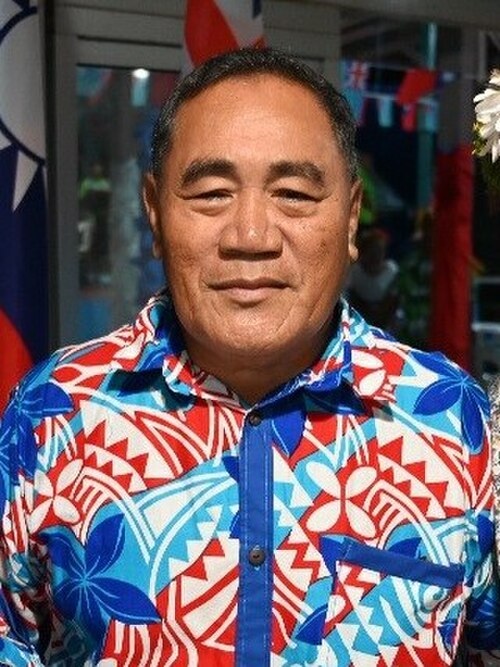 | Sir Tofiga Vaevalu Falani(b. ?) | 28 September2021 | Incumbent | 4 years, 306 days | |
 Charles III(2022–present) Charles III(2022–present) | ||||||
See also
References
- ↑Tuvalu. "Prescription of Salaries (Amendment) Act 2020". paclii.org.
- ↑"The Queen's Role in Tuvalu". Official website of the British Monarchy. Retrieved 4 April 2014.
- 123"Constitution of Tuvalu"(PDF). Government of Tuvalu. 1 October 2023. Part IV. Archived from the original(PDF) on 3 December 2023. Retrieved 27 November 2023.
- 12"Constitution of Tuvalu"(PDF). Government of Tuvalu. 1 October 2023. Section 56. Archived from the original(PDF) on 3 December 2023. Retrieved 27 November 2023.
- ↑Taafaki, Tauaasa (1996). "South Pacific – Governance in the Pacific: the dismissal of Tuvalu's Governor-General"(PDF). Research School of Pacific and Asian Studies, ANU (No 96/5). Retrieved 28 August 2021.
- ↑"Amasone v Attorney General [2003] TVHC 4; Case No 24 of 2003 (6 August 2003)". PACLII. Retrieved 5 April 2015.
- ↑"Parliament needs one yearly meeting only says defiant Tuvalu PM". Radio New Zealand International. 2 July 2013. Retrieved 14 September 2014.
- ↑Coutts, Geraldine (2 July 2013). "Tuvalu opposition demands parliament be allowed to sit after weekend by-election". Radio Australia. Retrieved 19 July 2013.
- ↑Matau, Robert (3 July 2013). "Tuvalu's parliament convenes July 30". Islands Business. Archived from the original on 21 September 2013. Retrieved 5 August 2013.
- ↑Matau, Robert (5 August 2013). "Tuvalu govt bombshells". Islands Business. Archived from the original on 29 April 2014. Retrieved 5 August 2013.
- 12AFP (2 August 2013). "Dismissal crisis rocks Tuvalu". Sydney Morning Herald. Retrieved 5 August 2013.
- ↑Cooney, Campbell (1 August 2013). "Tuvalu government faces constitutional crisis". Australia News Network. Retrieved 5 August 2013.
- ↑"Dismissal crisis rocks Tuvalu". Sydney Morning Herald. 2 August 2013. Retrieved 8 December 2021.
- 12Cooney, Campbell (4 August 2013). "Tuvalu parliament elects new prime minister". Australia News Network. Retrieved 5 August 2013.
- ↑Cooney, Campbell (5 August 2013). "Sopoaga elected new PM in Tuvalu". Radio Australia. Retrieved 5 August 2013.
- ↑"Enele Sopoaga Sworn-in Today as Tuvalu's New PM". Islands Business. 5 August 2013. Archived from the original on 21 September 2013. Retrieved 5 August 2013.
- ↑"Tuvalu: Governors-General: 1978-2008". Archontology. Archived from the original on 9 October 2008.
- ↑"United Nations – Heads Of State"(PDF). United Nations – Protocol and Liaison Service. 2020. Archived from the original(PDF) on 14 September 2020. Retrieved 10 January 2021.
- ↑"GG's Appointment: Nanumaga Continues To Defy Government's Request". Kitiona Tausi, Tuvalu Paradise – Issue No. 44/2020. 9 October 2020. Archived from the original on 8 January 2021. Retrieved 4 January 2021.
- ↑Lansford, Tom, ed. (2021). Political Handbook of the World 2020-2021. CQ Press (Sage Knowledge).
- ↑"The Embassy Held a Reception to Celebrate the 108th National Day of the R.O.C. (Taiwan) and the 40th Anniverary [sic] of Diplomatic Relationship between the R.O.C. (Taiwan) and Tuvalu". Embassy of the Republic of China (Taiwan) in Tuvalu. 5 October 2019. Retrieved 16 October 2021.
- ↑"LCT 'Moeiteava' Christened And Commissioned". Kitiona Tausi, Tuvalu Paradise – Issue No. 06/2021. 29 January 2021. Archived from the original on 7 August 2021. Retrieved 16 October 2021.
- 1978 establishments in Tuvalu
- Government of Tuvalu
- Governors-general of Tuvalu
- Lists of governors-general
- Tuvalu politics-related lists