Pseudo-arc
In general topology, the pseudo-arc is the simplest nondegenerate hereditarilyindecomposable continuum. The pseudo-arc is an arc-like homogeneous continuum, and played a central role in the classification of homogeneous planar continua. R. H. Bing proved that, in a certain well-defined sense, most continua in n≥ 2, are homeomorphic to the pseudo-arc.

History
In 1920, Bronisław Knaster and Kazimierz Kuratowski asked whether a nondegenerate homogeneous continuum in the Euclidean plane must be a Jordan curve. In 1921, Stefan Mazurkiewicz asked whether a nondegenerate continuum in that is homeomorphic to each of its nondegenerate subcontinua must be an arc. In 1922, Knaster discovered the first example of a hereditarily indecomposable continuum K, later named the pseudo-arc, giving a negative answer to a Mazurkiewicz question. In 1948, R. H. Bing proved that Knaster's continuum is homogeneous, i.e. for any two of its points there is a homeomorphism taking one to the other. Yet also in 1948, Edwin Moise showed that Knaster's continuum is homeomorphic to each of its non-degenerate subcontinua. Due to its resemblance to the fundamental property of the arc, namely, being homeomorphic to all its nondegenerate subcontinua, Moise called his example M a pseudo-arc.[a] Bing's construction is a modification of Moise's construction of M, which he had first heard described in a lecture. In 1951, Bing proved that all hereditarily indecomposable arc-like continua are homeomorphic — this implies that Knaster's K, Moise's M, and Bing's B are all homeomorphic. Bing also proved that the pseudo-arc is typical among the continua in a Euclidean space of dimension at least 2 or an infinite-dimensional separable Hilbert space.[b] Bing and F. Burton Jones constructed a decomposable planar continuum that admits an open map onto the circle, with each point preimage homeomorphic to the pseudo-arc, called the circle of pseudo-arcs. Bing and Jones also showed that it is homogeneous. In 2016 Logan Hoehn and Lex Oversteegen classified all planar homogeneous continua, up to a homeomorphism, as the circle, pseudo-arc and circle of pseudo-arcs. A continuum is called "hereditarily equivalent" if it is homeomorphic to each of its non-degenerate sub-continua. In 2019 Hoehn and Oversteegen showed that the single point, the arc, and the pseudo-arc are topologically the only hereditarily equivalent planar continua, thus providing a complete solution to the planar case of Mazurkiewicz's problem from 1921.

Construction
The following construction of the pseudo-arc follows Lewis (1999).
Chains
At the heart of the definition of the pseudo-arc is the concept of a chain, which is defined as follows:
- A chain is a finite collection of open sets in a metric space such that if and only if The elements of a chain are called its links, and a chain is called an ε-chain if each of its links has diameter less than ε.



While being the simplest of the type of spaces listed above, the pseudo-arc is actually very complex. The concept of a chain being crooked (defined below) is what endows the pseudo-arc with its complexity. Informally, it requires a chain to follow a certain recursive zig-zag pattern in another chain. To 'move' from the m-th link of the larger chain to the n-th, the smaller chain must first move in a crooked manner from the m-th link to the (n − 1)-th link, then in a crooked manner to the (m + 1)-th link, and then finally to the n-th link.
More formally:
- Let and be chains such that


- each link of is a subset of a link of , and
- for any indices i, j, m, n with , , and , there exist indices and with (or ) and and
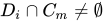
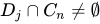






- Then is crooked in

Pseudo-arc
For any collection C of sets, let C* denote the union of all of the elements of C. That is, let

The pseudo-arc is defined as follows:
- Let p, q be distinct points in the plane and be a sequence of chains in the plane such that for each i,

- the first link of contains p and the last link contains q,
- the chain is a -chain,
- the closure of each link of is a subset of some link of , and
- the chain is crooked in .


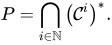
- Let
- Then P is a pseudo-arc.
Notes
- ↑Henderson (1960) later showed that a decomposable continuum homeomorphic to all its nondegenerate subcontinua must be an arc.
- ↑The history of the discovery of the pseudo-arc is described in Nadler (1992), pp. 228–229.
References
- Bing, R.H. (1948), "A homogeneous indecomposable plane continuum", Duke Mathematical Journal, 15 (3): 729–742, doi:10.1215/S0012-7094-48-01563-4
- Bing, R.H. (1951), "Concerning hereditarily indecomposable continua", Pacific Journal of Mathematics, 1: 43–51, doi:10.2140/pjm.1951.1.43
- Bing, R.H.; Jones, F. Burton (1959), "Another homogeneous plane continuum", Transactions of the American Mathematical Society, 90 (1): 171–192, doi:10.1090/S0002-9947-1959-0100823-3
- Henderson, George W. (1960), "Proof that every compact decomposable continuum which is topologically equivalent to each of its nondegenerate subcontinua is an arc", Annals of Mathematics, 2nd series, 72 (3): 421–428, doi:10.2307/1970224
- Hoehn, Logan C.; Oversteegen, Lex G. (2016), "A complete classification of homogeneous plane continua", Acta Mathematica, 216 (2): 177–216, arXiv:1409.6324, doi:10.1007/s11511-016-0138-0
- Hoehn, Logan C.; Oversteegen, Lex G. (2020), "A complete classification of hereditarily equivalent plane continua", Advances in Mathematics, 368 107131, arXiv:1812.08846, doi:10.1016/j.aim.2020.107131
- Irwin, Trevor; Solecki, Sławomir (2006), "Projective Fraïssé limits and the pseudo-arc", Transactions of the American Mathematical Society, 358 (7): 3077–3096, doi:10.1090/S0002-9947-06-03928-6
- Kawamura, Kazuhiro (2005), "On a conjecture of Wood", Glasgow Mathematical Journal, 47 (1): 1–5, doi:10.1017/S0017089504002186
- Knaster, Bronisław (1922), "Un continu dont tout sous-continu est indécomposable", Fundamenta Mathematicae, 3: 247–286, doi:10.4064/fm-3-1-247-286
- Lewis, Wayne (1999), "The Pseudo-Arc", Boletín de la Sociedad Matemática Mexicana, 5 (1): 25–77
- Lewis, Wayne; Minc, Piotr (2010), "Drawing the pseudo-arc"(PDF), Houston Journal of Mathematics, 36: 905–934
- Moise, Edwin (1948), "An indecomposable plane continuum which is homeomorphic to each of its nondegenerate subcontinua", Transactions of the American Mathematical Society, 63 (3): 581–594, doi:10.1090/S0002-9947-1948-0025733-4
- Nadler, Sam B. Jr. (1992), Continuum theory. An introduction, Monographs and Textbooks in Pure and Applied Mathematics, vol. 158, Marcel Dekker, Inc., New York, ISBN 0-8247-8659-9
- Rambla, Fernando (2006), "A counterexample to Wood's conjecture", Journal of Mathematical Analysis and Applications, 317 (2): 659–667, doi:10.1016/j.jmaa.2005.07.064
- Rempe-Gillen, Lasse (2016), Arc-like continua, Julia sets of entire functions, and Eremenko's Conjecture, arXiv:1610.06278
- Continuum theory