
فيداست
كان فيداست أو فيداستوس ، المعروف أيضًا باسم القديس فاست ( بالفلمنكية والنورماندية والبيكاردية ) أو القديس واست (أيضًا بالبيكاردية والوالونية ) ، والقديس جاستون بالفرنسية، وفوستر بالإنجليزية (توفي حوالي عام 540 ) ، أسقفًا مبكرًا في مملكة الفرنجة . بعد انتصار تولبياك ، ساعد فيداست في تعليم الملك الفرنجي كلوفيس العقيدة المسيحية لزوجته الملكة كلوتيلد .
تختلف الآراء حول ما إذا كان ريميجيوس ، أسقف ريمس ، قد عهد بأبرشية أراس وأبرشية كامبراي إلى فيداست كما هو متعارف عليه تقليديًا، أو ما إذا كان فيداست أسقفًا متجولًا بدون كرسي محدد.
حياة مهنية
من المحتمل أن يكون فيداست قد ولد في قرية فيلا في بيريجور . وفي شبابه، انتقل إلى تول ، حيث لاحظ الأسقف فضائله العديدة، فقام بسيامته كاهناً. [ 2 ]
كان كلوفيس، ملك الفرنجة، عائداً من انتصاره على الألمان ، في طريقه إلى ريمس، وكان يفكر في تعميد زوجته كلوتيلد ، فتوقف في تول ليطلب من أحد الكهنة أن يرشده إلى الطريق. فوافق فيداست على مرافقة الملك. [ 3 ]
يُعتقد أنه في عام 499، عيّنه ريميجيوس أول أسقف لأراس ، فرنسا؛ [ 4 ] وحوالي عام 510، أُسندت إليه أيضًا مسؤولية الإشراف على كامبراي. [ 3 ] ومع ذلك، تعتبر الدراسات الحديثة فيداست "...أسقفًا متجولًا لم تكن له أسقفية محددة بوضوح." [ 5 ]
سير القديسين
في التقاليد المسيحية المقدسة، نُسبت معجزات شفاء خارقة إلى شفاعته. تروي إحدى الروايات أنه أثناء سيرهم في طريقهم إلى ريمس، التقوا بمتسوّل أعمى عند الجسر فوق نهر أيسن . استغاث الرجل بفيداست، فصلى الكاهن وبارك المتسول، فاستعاد الرجل بصره. [ 3 ] زاد هذا من مكانة فيداست في نظر الملك، فأصبح أحد مستشاريه.

Jonas of Bobbio wrote a Vita Vedastis to promote the cult of Vedast at the cathedral in Arras. He "presents Vedast as the model ascetic-bishop for the new Columbanian monk-bishops who occupied many of the sees of Neustria after the unification of the kingdom under Chlothar II in 613."[6] The incident of expelling the bear from the city mirrors Columbanus expelling a bear from his hermitage at Annegray.[6]
A Vita of Vedast by Alcuin recounts a story that on one occasion, having spent the day in instructing a nobleman, his host would see him on his way with a glass of wine to sustain him, but found the cask empty. Vedast bid the servant to bring whatever he should find in the vessel. The servant then found the barrel overflowing with excellent wine.[7]
Death and veneration
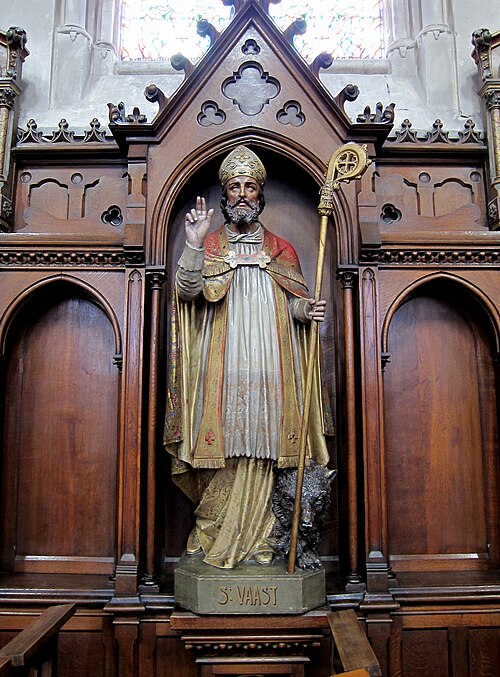
He died about 540 at Arras; that night the locals reportedly saw a luminous cloud ascend from his house, apparently carrying away Vedast's soul.[8] Vedast was buried in the old cathedral in Arras; his relics were later transferred to the new Abbey of St. Vaast founded in his honour in Arras.[9]
Vedast was venerated in Belgium as well as England (from the 10th century) where he was known as Saint Foster. St. Vedast Church, Vlamertinge is named for him. The spread of his cult was aided by the presence of Augustinians from Arras in England in the 12th century. Three ancient churches in England – St Vedast Foster Lane in London, and in Norwich and Tathwell in Lincolnshire – were dedicated to him.[10]
His feast is on 6 February.
Patronage
He is a patron saint invoked against eye trouble.
Notes
- ↑February 19 / February 6. https://www.holytrinityorthodox.com/htc/orthodox-calendar/
- ↑Simpson, W. Sparrow (1887) "St. Vedast", Journal of the British Archaeological Association, 43:1, 56-81doi:10.1080/00681288.1887.11888244
- 123Butler, Alban. "Saint Vedast, Bishop of Arras", The Lives of the Saints, Vol. II, 1866
- ↑Diocèse d'Arras, Histoire du diocèse d'Arras. (in French) Retrieved: 2016-09-02.
- ↑Verhulst, Adriaan. The Rise of Cities in North-West Europe, Cambridge University Press, 1999, p. 35ISBN 9780521469098
- 12O'Hara, Alexander. "Jonas of Bobbio and the Legacy of Columbanus: Sanctity and Community in the Seventh Century", Oxford University Press, 2018, no paginationISBN 9780190858025
- ↑Alcuin. the Life of St. Vedast, Bishop of Arras, Chapter V
- ↑Saint Vaast of Arras“. Saints.SQPN.com. 29 January 2014. Web 14 July 2014
- ↑Alston, George Cyprian. "Abbey of Saint Vaast." The Catholic Encyclopedia Vol. 15. New York: Robert Appleton Company, 1912. 27 August 2022
 This article incorporates text from this source, which is in the public domain.
 - ↑Saint of the Day, February 6: Vedast of ArrasSaintPatrickDC.org. Retrieved 2012-03-07.
Bibliography
- Dales, Douglas (2013). Alcuin: Theology and Thought. Cambridge UK: James Clarke & Co. pp. 122–131, 189–190. ISBN 978-0-227-17394-7.
- The Historical Works of Venerable Bede: Biographical writings, letters, and chronology. Vol. 2. Translated by Giles, J.A. London: J. Bohn. 1845. pp. 115–134. [Alcuin's life]
- Jonas (Abbas Elnonensis) (1905). Krusch, Bruno (ed.). Ionae Vitae Sanctorum Columbani, Vedastis, Iohannis. Monumenta Germaniae Historica (in German and Latin). Hannover: Impensis Bibliopolii Hahniani.
- Kreiner, Jamie (2014). The Social Life of Hagiography in the Merovingian Kingdom. Cambridge University Press. pp. 101–103, 160, 237–263. ISBN 978-1-107-05065-5.
- Shanzer, Danuta (2002). Avitus of Vienne. Liverpool University Press. pp. 362–373. ISBN 978-0-85323-588-0. [letter of Avitus on Clovis' baptism]
- Simpson, William Sparrow; Simpson, Gertrude Sparrow (1896). Carmina Vedastina. London: Elliot Stock.
- van der Essen, Léon (1907). Étude critique et littéraire sur les vitae des saints mérovingiens de l'ancienne Belgique (in French). Louvain: Bureaux du recueil. pp. 211–216. [Jonas]
External links
- Saint Vaast of Arras at Saints.SQPN.com
- 450s births
- 540 deaths
- 6th-century Frankish bishops
- Bishops of Arras
- Bishops of Cambrai
- 6th-century Frankish saints