
Cauchy's functional equation
Cauchy's functional equation is the functional equation:

A function that solves this equation is called an additive function. Over the rational numbers, it can be shown using elementary algebra that there is a single family of solutions, namely for any rational constant Over the real numbers, the family of linear maps now with an arbitrary real constant, is likewise a family of solutions; however there can exist other solutions not of this form that are extremely complicated. However, any of a number of regularity conditions, some of them quite weak, will preclude the existence of these pathological solutions. For example, an additive function is linear if:


- is continuous (Cauchy, 1821). In fact, it suffices for to be continuous at one point (Darboux, 1875).
- or for all .
- is monotonic on any interval.
- is bounded above or below on any interval.
- is Lebesgue measurable.
- for all real and some positive integer .
- The graph of is not dense in .





On the other hand, if no further conditions are imposed on , then (assuming the axiom of choice) there are infinitely many other functions that satisfy the equation. This was proved in 1905 by Georg Hamel using Hamel bases. Such functions are sometimes called Hamel functions.[1]
The fifth problem on Hilbert's list is a generalisation of this equation. Functions where there exists a real number such that are known as Cauchy–Hamel functions and are used in Dehn–Hadwiger invariants which are used in the extension of Hilbert's third problem from 3D to higher dimensions.[2]
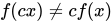
This equation is sometimes referred to as Cauchy's additive functional equation to distinguish it from the other functional equations introduced by Cauchy in 1821, the exponential functional equation, the logarithmic functional equation, and the multiplicative functional equation.



Solutions over the rational numbers
A simple argument, involving only elementary algebra, demonstrates that the set of additive maps , where are vector spaces over an extension field of , is a subset of the set of -linear maps from to .


Theorem:Let be an additive function. Then is -linear.
Proof: We want to prove that any solution to Cauchy’s functional equation, , satisfies for any and . Let .

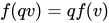


First note , hence , and therewith from which follows .




Via induction, is proved for any .

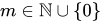
For any negative integer we know , therefore . Thus far we have proved



- for any .
Let , then and hence .



Finally, any has a representation with and , so, putting things together,

- , q.e.d.

Properties of nonlinear solutions over the real numbers
We prove below that any other solutions must be highly pathological functions. In particular, it is shown that any other solution must have the property that its graph is dense in , that is, that any disk in the plane (however small) contains a point from the graph. From this it is easy to prove the various conditions given in the introductory paragraph.

Lemma—Let . If satisfies the Cauchy functional equation on the interval , but is not linear, then its graph is dense on the strip .

![{\displaystyle [0,t]}](https://wikimedia.org/api/rest_v1/media/math/render/svg/37d2d2fa44908c699e2b7b7b9e92befc8283f264)
![{\displaystyle [0,t]\times \mathbb {R} }](https://wikimedia.org/api/rest_v1/media/math/render/svg/b69365f1419525ab7835544755e6edc98add09c0)
WLOG, scale on the x-axis and y-axis, so that satisfies the Cauchy functional equation on , and . It suffices to show that the graph of is dense in , which is dense in .
![{\displaystyle [0,1]}](https://wikimedia.org/api/rest_v1/media/math/render/svg/738f7d23bb2d9642bab520020873cccbef49768d)


![{\displaystyle [0,1]\times \mathbb {R} }](https://wikimedia.org/api/rest_v1/media/math/render/svg/471cfe49564c93148c0785222437bc7b8efbcdc1)
Since is not linear, we have for some .


Claim: The lattice defined by is dense in .

Consider the linear transformation defined by
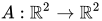
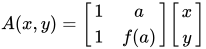
With this transformation, we have .

Since , the transformation is invertible, thus it is bicontinuous. Since is dense in , so is .



Claim: if , and , then .



If , then it is true by additivity. If , then , contradiction.


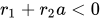
If , then since , we have . Let be a positive integer large enough such that . Then we have by additivity:

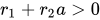


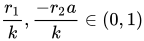

That is,

Thus, the graph of contains , which is dense in .

Expressed differently, nonlinearity in an additive function implies there is some such that . Let denote a series of rational approximation functions such that for all , (such as writing by its first decimals). Then, as is -linear, , even though . From this, one can construct an orthonormal basis: defining and , . Thus, for any , and , meaning any point can be approximated.


Existence of nonlinear solutions over the real numbers
The linearity proof given above also applies to , where is a scaled copy of the rationals. This shows that only linear solutions are permitted when the domain of is restricted to such sets. Thus, in general, we have for all and . However, as we will demonstrate below, highly pathological solutions can be found for functions based on these linear solutions, by viewing the reals as a vector space over the field of rational numbers. Note, however, that this method is nonconstructive, relying as it does on the existence of a (Hamel) basis for any vector space, a statement proved using Zorn's lemma. (In fact, the existence of a basis for every vector space is logically equivalent to the axiom of choice.) There exist models such as the Solovay model where all sets of reals are measurable which are consistent with ZF + DC, and therein all solutions are linear.[3]


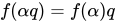

To show that solutions other than the ones defined by exist, we first note that because every vector space has a basis, there is a basis for over the field , i.e. a set with the property that any can be expressed uniquely as , where is a finite subset of , and each is in . We note that because no explicit basis for over can be written down, the pathological solutions defined below likewise cannot be expressed explicitly.
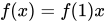


As argued above, the restriction of to must be a linear map for each . Moreover, because for , it is clear that is the constant of proportionality. In other words, is the map . Since any can be expressed as a unique (finite) linear combination of the , and is additive, is well-defined for all and is given by:


![{\displaystyle \xi \mapsto [f(x_{i})/x_{i}]\xi }](https://wikimedia.org/api/rest_v1/media/math/render/svg/afe476bd4284e69601be09f928883ae601a18dc1)



It is easy to check that is a solution to Cauchy's functional equation given a definition of on the basis elements, . Moreover, it is clear that every solution is of this form. In particular, the solutions of the functional equation are linear if and only if is constant over all . Thus, in a sense, despite the inability to exhibit a nonlinear solution, "most" (in the sense of cardinality[4]) solutions to the Cauchy functional equation are actually nonlinear and pathological.

See also
- Antilinear map – Conjugate homogeneous additive map
- Homogeneous function – Function with a multiplicative scaling behaviour
- Minkowski functional – Function made from a set
- Semilinear map
References
- ↑Kuczma (2009), p. 130
- ↑V.G. Boltianskii (1978) "Hilbert's third problem", Halsted Press, Washington
- ↑E. Caicedo, Andrés (2011-03-06). "Are there any non-linear solutions of Cauchy's equation $f(x+y)=f(x)+f(y)$ without assuming the Axiom of Choice?". MathOverflow. Retrieved 2024-02-21.
- ↑It can easily be shown that ; thus there are functions , each of which could be extended to a unique solution of the functional equation. On the other hand, there are only solutions that are linear.


- Kuczma, Marek (2009). An introduction to the theory of functional equations and inequalities. Cauchy's equation and Jensen's inequality. Basel: Birkhäuser. ISBN 9783764387495.
- Hamel, Georg (1905). "Eine Basis aller Zahlen und die unstetigen Lösungen der Funktionalgleichung: f(x + y) = f(x) + f(y)". Mathematische Annalen.
External links
- Solution to the Cauchy Equation Rutgers University
- The Hunt for Addi(c)tive Monster
- Martin Sleziak; et al. (2013). "Overview of basic facts about Cauchy functional equation". StackExchange. Retrieved 20 December 2015.
- Functional equations