
كوروش
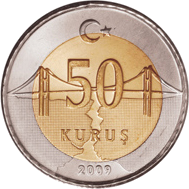
الكوروش ( تُلفظ / kəˈruːʃ / ، وتُنطق بالتركية: [ kuˈɾuʃ ] ) ، وتُعرف أيضًا باسم غروش، وإرش، وجرش، وغروشا، وغروسي، [2 ] هي جميعها أسماء لفئات العملة في الأراضي التي كانت جزءًا من الإمبراطورية العثمانية وما حولها . ويعود اختلاف التسمية إلى اختلاف اللغات التي استُخدمت فيها ( العربية، والأمهرية، والتركية ، واليونانية ) واختلاف كتابتها بالأبجدية اللاتينية . في اللغات الأوروبية ، كان الكوروش يُعرف باسم البيستر . [ 2 ]
اليوم ، يُعدّ الكوروش ( جمعه كوروشلار ) وحدة فرعية من العملة التركية، حيث تساوي الليرة التركية الواحدة 100 كوروش وفقًا لإعادة تقييم الليرة عام 2005. وحتى تقسيم الليرة الذهبية العثمانية السابقة عام 1844 ، كان الكوروش هو الوحدة النقدية القياسية في الإمبراطورية العثمانية ، وكان يُقسّم إلى 40 بارا أو 120 أكجة . وظل الكوروش الواحد مساويًا لـ 40 بارا خلال فترة الليرة التركية الأولى، [ 3 ] التي استمرت من عام 1923 حتى إعادة تقييمها عام 2005.
اسم
الكلمة التركية " كروش " ( بالتركية العثمانية : قروش ، kurûş ؛ باليونانية : γρόσι ، grosi ؛ جمعها γρόσια ، grosia ) مشتقة من الكلمة الفرنسية " gros " (ثقيل)، والتي بدورها مشتقة من الكلمة اللاتينية " grossus " (سميك). وهي مشابهة للكلمة الألمانية "Groschen "، والبولندية " grosz" ، والمجرية " garas" .
تاريخ
The Ottoman kuruş was introduced in 1688. It was initially a large silver piece (similar to the European thalers issued by the Ottomans), approximately equal to the French écu, or, from other sources, to the Spanish dollar. It was worth 40 para. In 1844, following sustained debasement, the goldlira was introduced, worth 100 kuruş. During the late 18th to early 19th centuries it was further reduced to a billon coin weighing less than 3 grams.
As the Ottoman Empire broke up, several successor states retained the kuruş as a denomination. These included Egypt, Saudi Arabia, Syria, Lebanon and Turkey itself. Others, including Jordan and Sudan, adopted the kuruş as a denomination when they established their own currencies.
At the beginning of the 19th century, silver coins were in circulation for 1 akçe, 1, 5, 10 and 20 para, 1, 2 and 2+1⁄2 kuruş, together with gold coins denominated in zeri mahbub (3,5 kurush) and altin. As the silver coins were debased, other denominations appeared: 30 para, 1+1⁄2, 3, 5 and 6 kuruş. The final coinage issued before the currency reform consisted of billon 1, 10 and 20 para, and silver 1+1⁄2, 3 and 6 kuruş.
In 1844, the Turkish gold lira was introduced as the new standard denomination. It was divided into 100 silver kuruş and the kuruş continued to circulate until the 1970s.
Kuruş eventually became obsolete due to the chronic inflation in Turkey in the late 1970s. A currency reform on 1 January 2005 provided its return as 1⁄100 of the new lira.
See also
References
- ↑"kurus". The Chambers Dictionary (9th ed.). Chambers. 2003. ISBN 0-550-10105-5.
- 12A Handbook of Cyprus, p. 111
- ↑"10 Para, Turkey". en.numista.com. Retrieved 30 August 2025.
Bibliography
- Krause, Chester L.; Clifford Mishler (1991). Standard Catalog of World Coins: 1801–1991 (18th ed.). Krause Publications. ISBN 0873411501.
روابط خارجية
- http://www.osmanliparalari.com كل ما يتعلق بالعملات العثمانية (باللغة التركية)
- عملات الإمبراطورية العثمانية
- عملات أوروبا
- عملات تركيا
- عملات آسيا
- كلمات وعبارات تركية
- ثقافة الإمبراطورية العثمانية
- عملات الإمبراطورية العثمانية
- العملات الحديثة البالية