
Arcellinida
Arcellinid testate amoebae or Arcellinida,[1]Arcellacean[2] or lobose testate amoebae[3] are single-celled protists partially enclosed in a simple test (shell).
Arcellinid testate amoebae are commonly found in soils, leaf litter, peat bogs and near/in fresh water.[1] They use their pseudopodia, a temporary cell extension, for moving and taking in food. Like most amoebae, they are generally believed to reproduce asexually via binary fission. However a recent review suggests that sexual recombination may be the rule rather than the exception in amoeboid protists in general, including the Arcellinid testate amoebae.[4]
Morphology
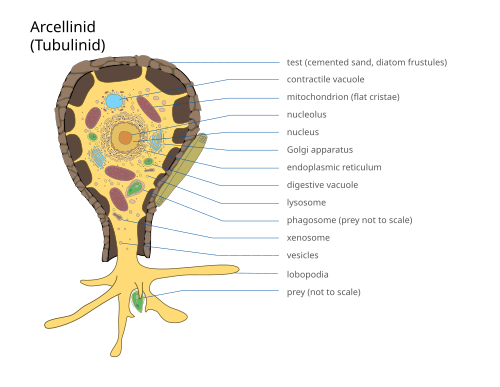
- Test, cemented sand, diatom frustules
- Contractile vacuole, regulates the quantity of water inside a cell
- Mitochondrion; creates ATP (energy) for the cell (flat cristae)
- Nucleolus
- Golgi apparatus, packages proteins
- Endoplasmic reticulum, the transport network for molecules going to specific parts of the cell
- Digestive Vacuole
- Lysosome, holds enzymes
- Phagosome, vesicle formed around a particle (prey not to scale)
- Xenosome, bacterium living inside cytoplasm
- Vesicles
- Lobopodia, a pseudopod or arm-like projection made of cytoplasm
- Prey (not to scale)
Arcellinida always have a shell or test. The tests lie outside the cell membrane and consist of organic or mineral materials that are either secreted or incorporate external particles. The test has a single main opening.[5]
Simple tests are made by secretion (autogenous tests), agglutination of foreign material (xenogenous tests), or sometimes a combination of both. Past environmental changes can be determined by analysing the composition of fossil tests, including the reconstruction of past climate change.[1] Testate amoebae species have been used to reconstruct hydrological changes over the late Holocene, as a result of individual species possessing a narrow tolerance for ecohydrological conditions such as water-table depth or pH.[6]
Evolutionary history
Fossils of arcellinid testate amoebae date back to the Tonian stage of the Proterozoic, around 789-759 million years ago. The fossils indicate that by 730 million years ago, arcellinids had already diversified into major lineages.[7]
Testate amoebae are theorized to be mostly polyphyletic (coming from more than one ancestral type), but testaceafilosea, one group of testate amoebae, are theorized to be monophyletic. Ancient tests of terrestrial fauna are commonly found in fossilized amber,[8] although mid-Cretaceous testate amoeba (i.e., Difflugia, Cucurbitella) have been found in ancient lake sediments.[9] It is likely that the group has evolved minimally over the course of the Phanerozoic.
Classification
| Phylogeny of Arcellinida in 2019[10] |
| Phylogeny of Arcellinida in 2022[11] |
The classification of Arcellinida, as of 2019:[12][5][10]
- Suborder PhryganellinaBovee 1985
- Family PhryganellidaeJung 1942
- PhryganellaPenard 1902
- Family CryptodifflugiidaeJung 1942
- ?PrantlitinaVasicek & Ruzicka 1957
- ?PseudocucurbitellaGauthier-Lievre & Thomas 1960
- ?PseudowailesellaSudzuki 1979
- CryptodifflugiaPenard 1890 [DifflugiellaCash 1904; GeococcusFrancé 1913 non Green 1902]
- MeisterfeldiaBobrov 2016
- WailesellaDeflandre 1928
- Family PhryganellidaeJung 1942
- Suborder OrganoconchaLahr et al. 2019
- Family MicrochlamyiidaeOgden 1985
- MicrochlamysCockerell 1911 [PseudochlamysClaparede & Lachmann 1859 non Lacordaire 1848 non Comas 1977]
- PyxidiculaEhrenberg 1838 non Ehrenberg 1834 non Strelnikova & Nikolajev 1986
- SpumochlamysKudryavtsev & Hausmann 2007
- Family MicrochlamyiidaeOgden 1985
- Suborder GlutinoconchaLahr et al. 2019
- Infraorder VolnustomaLahr et al. 2019
- Family HeleoperidaeJung 1942
- AwerintzewiaSchouteden 1906
- HeleoperaLeidy 1879
- Family HeleoperidaeJung 1942
- Infraorder HyalospheniformesLahr et al. 2019
- Family HyalospheniidaeSchulze, 1977 [Nebelidae Taranek 1882]
- ?ApolimiaKorganova 1987
- ?DeflandriaJung 1942
- ?HeleoporellaCouteaux 1978
- ?LeidyellaJung 1942
- ?MetaheleoperaBartos 1954
- ?MarsiposMedioli et al. 1990
- ?ParanebelaJung 1942
- ?PenardiellaKahl 1930
- ?PseudogeamphorellaDécloitre 1964 nomen nudum
- ?PseudohyalospheniaStepanek 1967 nomen nudum
- ?PterygiaJung 1942 non Roeding 1798 non Link 1807 non Laporte 1832
- ?SchaudinniaJung 1942 non Schulze 1900
- ?UmbonariaJung 1942
- AlabastaDuckert et al. 2018
- AlocoderaJung 1942a
- ApoderaLoeblich & Tappan 1961
- CertesellaLoeblich & Tappan 1961
- CornuthecaKosakyan et al. 2016
- GibbocarinaKosakyan et al. 2016
- HyalospheniaStein 1859
- LonginebelaKosakyan et al. 2016
- MrabellaKosakyan et al. 2016
- NebelaLeidy 1875
- PadaungiellaLara & Todorov 2012
- PlanocarinaKosakyan et al. 2016
- PorosiaJung 1942
- QuadrulellaCockerell 1909 [QuadrulaSchulze 1875 non Rafinesque 1820]
- Family HyalospheniidaeSchulze, 1977 [Nebelidae Taranek 1882]
- Infraorder ExcentrostomaLahr et al. 2019
- ?CentropyxiellaValkanov 1970
- ?OopyxisJung 1942
- Family Centropyxidae
- ArmipyxisDekhtiar 2009
- CentropyxisStein 1857 [EchinopyxisClaparede & Lachmann 1859 non Pantocsek 1913; CollaripyxidiaZivkovic 1975; ToquepyxisLaminger 1971]
- ConicocassisNasser & Patterson 2015
- ProplagiopyxisSchönborn 1964
- Family Plagiopyxidae
- BullinulariaDeflandre 1953 [BullinulaPenard 1911]
- GeoplagiopyxisChardez 1961
- HoogenraadiaGauthierLievre & Thomas 1958
- ParacentropyxisBonnet 1960
- PlagiopyxisPenard 1910
- PlanhoogenraadiaBonnet 1977
- ProtoplagiopyxisBonnet 1962
- Infraorder LongithecinaLahr et al. 2019
- Family Lesquereusiidae [Paraquadrulidae Deflandre 1953]
- FabalesquereusiaSnegovaya & Alekperov 2005
- LesquereusiaSchlumberger 1845
- MicroquadrulaGolemansky 1968
- ParaquadrulaDeflandre 1932
- PomoriellaGolemansky 1970
- Family DifflugiidaeWallich 1864
- ?LagenodifflugiaMedioli & Scott 1983
- ?MaghrebiaGauthier-Lievre & Thomas 1958
- ?PentagoninaBovee & Jahn 1974 [PentagoniaGauthier-Lievre & Thomas 1958 non Cozzens 1846; FalsidifflugiaHaman 1988]
- ?PseudopontigulasiaOye 1956
- ?SexangulariaAwerintzew 1906
- ?SuiadifflugiaGreen 1975
- ?ZivkoviciaOgden 1987
- ArmatodifflugiaSnegovaya & Alekperov 2005
- DifflugiaLeclere 1815 ex Lamarck 1816
- MediolusPatterson 2014
- NabranellaSnegovaya & Alekperov 2009
- PelecyamoebaSnegovaya & Alekperov 2005
- PontigulasiaRhumbler 1895
- PseudonebelaGauthier-Lievre 1954 non Schönborn 1964
- Family Lesquereusiidae [Paraquadrulidae Deflandre 1953]
- Infraorder SphaerothecinaKosakyan et al. 2016
- ?CornuapyxisCouteaux & Chardez 1981
- ?CucurbitellaPenard 1902 non Walpers 1846
- ?EllipsopyxellaBonnet 1975
- ?EllipsopyxisBonnet 1965
- ?ProtocucurbitellaGauthier-Lievre & Thomas 1960 non Naumov
- Family DistomatopyxidaeBonnet 1970
- DistomatopyxisBonnet 1970
- Family LamtopyxidaeBonnet 1974
- LamtopyxisBonnet 1974
- Family NetzeliidaeKosakyan et al. 2016 [Cyclopyxidae Schönborn 1989]
- CyclopyxisBonnet 1953
- NetzeliaOgden 1979
- Family ArcellidaeEhrenberg 1832
- AntarcellaEhrenberg 1838
- ArcellaDeflandre 1928 [ArcellinaCarter 1856 non DuPlessis 1876 non Haeckel 1894; CyphidiumEhrenberg 1837 non Magnus 1875; LeptocystisPlayfair 1918]
- TrigonopyxidaeLoeblich 1964
- GeopyxellaBonnet & Thomas 1955
- TrigonopyxisPenard 1912
- Infraorder VolnustomaLahr et al. 2019
Arcellinida incertae sedis:
- ArgynniaVucetich, 1974
- AwerintzewiaSchouteden, 1906
- GeamphorellaBonnet, 1959
- JungiaLoeblich & Tappan 1961
- LagenodifflugiaMedioli & Scott, 1983
- LamtoquadrulaBonnet 1975
- LeptochlamysWest 1901
- MaghrebiaGauthier-Lievre & Thomas, 1960
- OchrosMedioli et al. 1990
- †PalaeoleptochlamysStrullu-Derrien et al. 2019
- PhysochilaJung 1942
- PseudawerintzewiaBonnet 1959
- SacculusMedioli et al. 1990 non Gosse 1851 non Hirase 1927 non Neviani 1930
- SchoenborniaDecloitre 1964
- Swabia
- Family BipseudostomatidaeSnegovaya & Alekperov 2005
- BipseudostomatellaSnegovaya & Alekperov 2005
- GomocollariellaSnegovaya & Alekperov 2005
- Family MississippiellidaeHuddleston & Haman 1985
- MississippiellaHaman 1982
- Family ShamkiriidaeSnegovaya & Alekperov 2005
- ShamkiriellaSnegovaya & Alekperov 2005
References
- 123http://www.microscopy-uk.org.uk/mag/artjun03/gsamoebae.html Testate amoebae, peat bogs and past climates. accessed 16 march 2007
- ↑Identification key for holocene lacustrine arcellacean (thecamoebian) taxaArchived December 4, 2008, at the Wayback Machine
- ↑Lara E, Heger TJ, Ekelund F, Lamentowicz M, Mitchell EA (April 2008). "Ribosomal RNA genes challenge the monophyly of the Hyalospheniidae (Amoebozoa: Arcellinida)". Protist. 159 (2): 165–76. doi:10.1016/j.protis.2007.09.003. PMID 18023614.
- ↑Lahr DJ, Parfrey LW, Mitchell EA, Katz LA, Lara E (2011). "The chastity of amoebae: re-evaluating evidence for sex in amoeboid organisms". Proceedings of the Royal Society B: Biological Sciences. 278 (1715): 2081–2090. doi:10.1098/rspb.2011.0289. PMC 3107637. PMID 21429931.
- 12Adl SM, Simpson AG, Lane CE, Lukeš J, Bass D, Bowser SS, Brown MW, Burki F, Dunthorn M, Hampl V, Heiss A, Hoppenrath M, Lara E, le Gall L, Lynn DH, McManus H, Mitchell EA, Mozley-Stanridge SE, Parfrey LW, Pawlowski J, Rueckert S, Shadwick L, Schoch CL, Smirnov A, Spiegel FW (2012). "The Revised Classification of Eukaryotes". Journal of Eukaryotic Microbiology. 59 (5): 429–514. doi:10.1111/j.1550-7408.2012.00644.x. PMC 3483872. PMID 23020233.
- ↑Woodland, Wendy, A. (1998). "Quantitative estimates of water tables and soil moisture in Holocene peatlands from testate amoebae". The Holocene. 8 (3): 261–273. doi:10.1191/095968398667004497. S2CID 128897334.
{{cite journal}}: CS1 maint: multiple names: authors list (link) - ↑Lahr, Daniel J.G.; Kosakyan, Anush; Lara, Enrique; Mitchell, Edward A.D.; Morais, Luana; Porfirio-Sousa, Alfredo L.; Ribeiro, Giulia M.; Tice, Alexander K.; Pánek, Tomáš; Kang, Seungho; Brown, Matthew W. (2019-03-18). "Phylogenomics and Morphological Reconstruction of Arcellinida Testate Amoebae Highlight Diversity of Microbial Eukaryotes in the Neoproterozoic". Current Biology. 29 (6): 991–1001.e3. doi:10.1016/j.cub.2019.01.078. hdl:10261/240246. ISSN 0960-9822. PMID 30827918. S2CID 72333352.
- ↑Schmidt, A.R.; Ragazzi, E.; Coppellotti, O.; Roghi, G. (2006). "A microworld in Triassic amber". Nature. 444 (7121): 835. doi:10.1038/444835a. PMID 17167469.
- ↑Hengstum, Van; Reinhardt, E.G.; Medioli, F.S.; Grocke, D.R. (2007). "Exceptionally preserved late albian (Cretaceous) Arcellaceans (Thecamoebians) from the Dakota Formation near Lincoln, Nebraska"(PDF). Journal of Foraminiferal Research. 37 (4): 300–308. doi:10.2113/gsjfr.37.4.300.
- 12Lahr, Daniel J.G.; Kosakyan, Anush; Lara, Enrique; Mitchell, Edward A.D.; Morais, Luana; Porfirio-Sousa, Alfredo L.; Ribeiro, Giulia M.; Pánek, Tomáš; Kang, Seungho; Brown, Matthew W. (2019). "Phylogenomics and Morphological Reconstruction of Arcellinida Testate Amoebae Highlight Diversity of Microbial Eukaryotes in the Neoproterozoic". Current Biology. 29 (6): 991–1001. doi:10.1016/j.cub.2019.01.078. hdl:11380/1301486. PMID 30827918.
- ↑González-Miguéns, Rubén; Todorov, Milcho; Blandenier, Quentin; Duckert, Clément; Porfirio-Sousa, Alfredo L.; Ribeiro, Giulia M.; Ramos, Diana; Lahr, Daniel J.G.; Buckley, David; Lara, Enrique (2022). "Deconstructing Difflugia: The tangled evolution of lobose testate amoebae shells (Amoebozoa: Arcellinida) illustrates the importance of convergent evolution in protist phylogeny". Molecular Phylogenetics and Evolution. 175 107557. doi:10.1016/j.ympev.2022.107557. hdl:10261/281619. ISSN 1055-7903. PMID 35777650.
- ↑Ralf Meisterfeld: Arcellinida, In: John J. Lee, Gordon F. Leedale, Phyllis Bradbury (Hrsg.): Illustrated Guide to the Protozoa, 2nd Edition. Vol. 2, Society of Protozoologists, Lawrence, Kansas 2000, ISBN 1-891276-23-9, pp. 827-860
External links
- ISTAR, the International Society for Testate Amoeba Research
- Tree of Life: Arcellinida
- An article by G. T. Swindles
- Protozoa: The testate amoebae
- BioImages: The Virtual Field-Guide (UK) - TESTACEA (Testate amoebae)
- Pictures of testate amoebae
- The Cushman Foundation Thecamoebian Page
- Amoebozoa orders
- Tubulinea