
Reaction norm
In ecology and genetics, a reaction norm, also called a norm of reaction, describes the pattern of phenotypic expression of a single genotype across a range of environments. One use of reaction norms is in describing how different species—especially related species—respond to varying environments. But differing genotypes within a single species may also show differing reaction norms relative to a particular phenotypic trait and environment variable. For every genotype, phenotypic trait, and environmental variable, a different reaction norm can exist; in other words, an enormous complexity can exist in the interrelationships between genetic and environmental factors in determining traits. The concept was introduced by Richard Woltereck in 1909.[1][2][3][4][5]
A monoclonal example
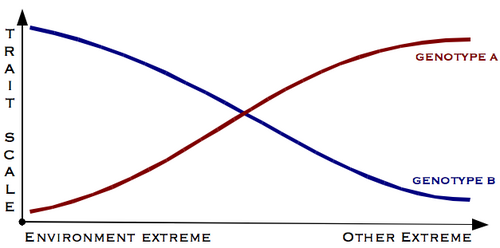
Scientifically analyzing norms of reaction in natural populations can be very difficult, simply because natural populations of sexually reproductive organisms usually do not have cleanly separated or superficially identifiable genetic distinctions. However, seed crops produced by humans are often engineered to contain specific genes, and in some cases seed stocks consist of clones. Accordingly, distinct seed lines present ideal examples of differentiated norms of reaction. In fact, agricultural companies market seeds for use in particular environments based on exactly this.
Suppose the seed line A contains an allele a, and a seed line B of the same crop species contains an allele b, for the same gene. With these controlled genetic groups, we might cultivate each variety (genotype) in a range of environments. This range might be either natural or controlled variations in environment. For example, an individual plant might receive either more or less water during its growth cycle, or the average temperature the plants are exposed to might vary across a range.
A simplification of the norm of reaction might state that seed line A is good for "high water conditions" while a seed line B is good for "low water conditions". But the full complexity of the norm of reaction is a function, for each genotype, relating environmental factor to phenotypic trait. By controlling for or measuring actual environments across which monoclonal seeds are cultivated, one can concretely observe norms of reaction. Normal distributions, for example, are common. Of course, the distributions need not be bell-curves.
Reaction norm from an inbred population
تتمثل إحدى مزايا النباتات في إمكانية تقييم النمط الوراثي نفسه، مثل السلالة المهجنة المتكررة (RIL)، بشكل متكرر في بيئات متعددة، أو من خلال تجربة متعددة البيئات (MET). ويمكن بعد ذلك استكشاف معيار الاستجابة بناءً على الموقع الجغرافي، أو متوسط قيمة السمة المُلخصة من جميع أفراد المجموعة في كل بيئة، أو مؤشر صريح لا يعتمد على الأداء ويلتقط مدخلات البيئة ذات الصلة. [ 6 ]
سوء فهم التفاعلات الجينية/البيئية
كثيرًا ما يُسيء الجمهور غير المتخصص أو غير العلمي فهم وجود معايير رد الفعل، أو يعجز ببساطة عن إدراكها. يسود اعتقاد شائع بأن لكل نمط جيني نطاقًا محددًا من التعبيرات الظاهرية الممكنة. في هذا المفهوم الشائع، يُعطي ما هو "أكثر وراثيًا" نطاقًا أضيق، بينما يُعطي ما هو "أقل وراثيًا (أكثر بيئيًا)" نطاقًا أوسع من الاحتمالات الظاهرية. هذا الإطار المفاهيمي المحدود شائع بشكل خاص في مناقشات السمات البشرية مثل معدل الذكاء ، والميول الجنسية ، والإيثار ، أو الفصام (انظر: الطبيعة مقابل التنشئة ).
المفهوم الشائع للتفاعل بين النمط الجيني والنمط الظاهري
مقياس السمات <--6----------5----------4----------3----------2----------1----------0--> ^ (النمط الجيني أ) ^ ^ (النمط الجيني ب) ^ | | | | البيئة <------> بيئة أخرى <------> أخرى شديد للغاية شديد للغاية شديد
لا تكمن مشكلة هذه الصورة المبسطة الشائعة في أنها لا تمثل معيارًا محتملاً للتفاعل، بل في أنها، باختزالها الصورة من بعدين إلى بعد واحد فقط، تركز فقط على التعبيرات الظاهرية المنفصلة وغير المتداخلة، وتخفي النمط الأكثر شيوعًا المتمثل في القيم الدنيا والقصوى المحلية في التعبير الظاهري، مع نطاقات متداخلة من التعبير الظاهري بين الأنماط الجينية.
انظر أيضاً
مراجع
- ↑ ليونتين ر، روز س، كامين ل ج (1984). ليس في جيناتنا: البيولوجيا، والأيديولوجيا، والطبيعة البشرية . ISBN 0-394-72888-2.
- ↑ ليونتين ر، ليفينز ر (1985). عالم الأحياء الجدلي . مطبعة جامعة هارفارد. ISBN 0-674-20283-X.
- ↑ ليونتين ر (1991). علم الأحياء كأيديولوجيا: مذهب الحمض النووي . ISBN 0-06-097519-9.
- ↑ ليونتين ر (2000). الحلزون الثلاثي: الجين، الكائن الحي، والبيئة . مطبعة جامعة هارفارد. ISBN 0-674-00159-1.
- ↑ غريفيثز إيه جيه، ميلر جيه إتش، سوزوكي دي تي، ليونتين آر سي، جيلبارت دبليو إم (2000). "معيار التفاعل والتوزيع الظاهري" . في غريفيثز إيه جيه (محرر). مقدمة في التحليل الجيني ( الطبعة السابعة).
- ↑ لي إكس، غو تي، مو كيو، لي إكس، يو جيه (يونيو 2018). "المحددات الجينومية والبيئية وتفاعلها الكامن وراء المرونة الظاهرية" . وقائع الأكاديمية الوطنية للعلوم في الولايات المتحدة الأمريكية . 115 (26): 6679-6684 . doi : 10.1073/pnas.1718326115 . PMC 6042117. PMID 29891664 .
- علم البيئة