
q-Gaussian process
q-Gaussian processes are deformations of the usual Gaussian distribution. There are several different versions of this; here we treat a multivariate deformation, also addressed as q-Gaussian process, arising from free probability theory and corresponding to deformations of the canonical commutation relations. For other deformations of Gaussian distributions, see q-Gaussian distribution and Gaussian q-distribution.
History
The q-Gaussian process was formally introduced in a paper by Frisch and Bourret[1] under the name of parastochastics, and also later by Greenberg[2] as an example of infinite statistics. It was mathematically established and investigated in papers by Bozejko and Speicher[3] and by Bozejko, Kümmerer, and Speicher[4] in the context of non-commutative probability.
It is given as the distribution of sums of creation and annihilation operators in a q-deformed Fock space. The calculation of moments of those operators is given by a q-deformed version of a Wick formula or Isserlis formula. The specification of a special covariance in the underlying Hilbert space leads to the q-Brownian motion,[4] a special non-commutative version of classical Brownian motion.
q-Fock space
In the following is fixed. Consider a Hilbert space . On the algebraic full Fock space
![{\displaystyle q\in [-1,1]}](https://wikimedia.org/api/rest_v1/media/math/render/svg/2384bf877e98c3832fc3a96bce97693268dfe33f)

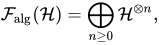
where with a norm one vector , called vacuum, we define a q-deformed inner product as follows:



where is the number of inversions of .


The q-Fock space[5] is then defined as the completion of the algebraic full Fock space with respect to this inner product
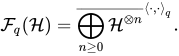
For the q-inner product is strictly positive.[3][6] For and it is positive, but has a kernel, which leads in these cases to the symmetric and anti-symmetric Fock spaces, respectively.


For we define the q-creation operator, given by



Its adjoint (with respect to the q-inner product), the q-annihilation operator, is given by


q-commutation relations
Those operators satisfy the q-commutation relations[7]

For , , and ويؤدي هذا إلى علاقات CCR، وعلاقات Cuntz، وعلاقات CAR، على التوالي. باستثناء الحالةالمشغلينمحدودة.


عناصر التوزيع الغاوسي q وتعريف التوزيع الغاوسي q متعدد المتغيرات (عملية q-غاوسية)
عوامل التشغيل من الشكل لوتسمى هذه العناصر عناصر q-Gaussian [ 5 ] (أو q-semicircular [ 8 ] ).

علىنعتبر حالة التوقع الفراغي، ل.


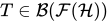
يُعرَّف التوزيع الغاوسي q (متعدد المتغيرات) أو عملية q-غاوسية [ 4 ] [ 9 ] بأنه التوزيع غير التبادلي لمجموعة من التوزيعات الغاوسية q بالنسبة لحالة التوقع الفراغي.التوزيع المشترك لـبالنسبة إلىيمكن وصفها بالطريقة التالية: [ 1 ] [ 3 ] لأيلدينا





أينيشير إلى عدد تقاطعات تقسيم الزوجهذه نسخة مشوهة من صيغة ويك/إيسرليس.


توزيع q-Gaussian في الحالة أحادية البعد
عندما تكون قيمة p تساوي 1، فإن توزيع q-Gaussian هو مقياس احتمالي على الفترة، مع صيغ تحليلية لكثافتها. [ 10 ] بالنسبة للحالات الخاصة،، و، وهذا يختزل إلى التوزيع الغاوسي الكلاسيكي، وتوزيع ويغنر نصف الدائري ، وتوزيع برنولي المتناظر على. يتم تحديد الكثافة من النتائج القديمة [ 11 ] على كثيرات الحدود المتعامدة المقابلة .
![{\displaystyle [-2/{\sqrt {1-q}},2/{\sqrt {1-q}}]}](https://wikimedia.org/api/rest_v1/media/math/render/svg/a8af90b8a36e142b175855fe8f522d9531c41901)

أسئلة جبرية تتعلق بالمؤثرات
جبر فون نيومان الناتج عن، ليمر عبر نظام متعامدمن المتجهات في، يقلل لـإلى عوامل المجموعة الحرة الشهيرةلقد كان فهم بنية جبر فون نيومان لقيم q العامة مصدرًا للعديد من الدراسات. [ 12 ] ومن المعروف الآن، بفضل أعمال غيونيه وشلياختينكو، [ 13 ] أنه على الأقل بالنسبة لقيم I المحدودة وقيم q الصغيرة، يكون جبر فون نيومان متماثلًا مع عامل المجموعة الحرة المقابل.


مراجع
- 1 2 فريش، يو.؛ بوريه، ر. (فبراير 1970). "الباراستوكاستيكس". مجلة الفيزياء الرياضية . 11 (2): 364-390 . Bibcode : 1970JMP....11..364F . doi : 10.1063/1.1665149 .
- ↑ غرينبيرغ، أو دبليو (12 فبراير 1990). "مثال على الإحصاءات اللانهائية". رسائل المراجعة الفيزيائية . 64 (7): 705-708 . رمز Bibcode : 1990PhRvL..64..705G . doi : 10.1103/PhysRevLett.64.705 . PMID 10042057 .
- 1 2 3 بوزيكو، ماريك؛ سبيشر، رولاند (أبريل 1991). "مثال على الحركة البراونية المعممة" . مجلة الاتصالات في الفيزياء الرياضية . 137 (3): 519-531 . Bibcode : 1991CMaPh.137..519B . doi : 10.1007/BF02100275 . S2CID 123190397 .
- 1 2 3 بوزيكو، م.؛ كوميرر، ب.؛ سبيشر، ر. (1 أبريل 1997). "عمليات غاوسية-q: جوانب غير تبادلية وكلاسيكية". اتصالات في الفيزياء الرياضية . 185 (1): 129-154 . arXiv : funct-an/9604010 . Bibcode : 1997CMaPh.185..129B . doi : 10.1007/s002200050084 . S2CID 2993071 .
- 1 2 إيفروس، إدوارد ج.؛ بوبا، ميهاي (22 يوليو 2003). "مخططات فاينمان ومنتجات ويك المرتبطة بفضاء كيو-فوك" . وقائع الأكاديمية الوطنية للعلوم . 100 (15): 8629-8633 . arXiv : math/0303045 . Bibcode : 2003PNAS..100.8629E . doi : 10.1073/pnas.1531460100 . PMC 166362. PMID 12857947 .
- ↑ زاغير، دون (يونيو 1992). "إمكانية تحقيق نموذج في إحصاءات لا نهائية". مجلة الاتصالات في الفيزياء الرياضية . 147 (1): 199-210 . Bibcode : 1992CMaPh.147..199Z . CiteSeerX 10.1.1.468.966 . doi : 10.1007/BF02099535 . S2CID 53385666 .
- ↑ كينيدي، ماثيو؛ نيكا، ألكساندرو (9 سبتمبر 2011). "دقة تمثيل علاقات التبادل q في فضاء فوك". مجلة الاتصالات في الفيزياء الرياضية . 308 (1): 115-132 . arXiv : 1009.0508 . Bibcode : 2011CMaPh.308..115K . doi : 10.1007/s00220-011-1323-9 . S2CID 119124507 .
- ↑ فيرجيس، ماثيو جوسوات (20 نوفمبر 2018). "مُعَقِّدات قانون شبه الدائرة q، ومتعددات حدود توت، والأكوام". المجلة الكندية للرياضيات . 65 (4): 863-878 . arXiv : 1203.3157 . doi : 10.4153/CJM-2012-042-9 . S2CID 2215028 .
- ↑ برايك، فلودزيميرز؛ وانغ، ييزاو (2016). "البنية المحلية لعمليات غاوسية من النوع q ". الاحتمالات والإحصاء الرياضي . 36 (2): 335-352 . arXiv : 1511.06667 . MR 3593028 .
- ↑ ليون، هانز فان؛ ماسن، هانز (سبتمبر 1995). " تشويه q لتوزيع غاوس". مجلة الفيزياء الرياضية . 36 (9): 4743-4756 . Bibcode : 1995JMP....36.4743V . doi : 10.1063/1.530917 . hdl : 2066/141604 .
- ^ سيجو، جي (1926). "Ein Beitrag zur Theorie der Thetafunktionen" [ مساهمة في نظرية وظائف ثيتا ] . Sitzungsberichte der Preussischen Akademie der Wissenschaften، Phys.-Math. كلاسي (بالألمانية): 242- 252.
- ↑ واسيلفسكي، ماتيوس (2021). "برهان بسيط لخاصية التقريب المتري الكامل لجبر غاوسي من الرتبة q ". كولوكيوم ماثيماتيكوم . 163 (1): 1-14 . arXiv : 1907.00730 . doi : 10.4064/cm7968-11-2019 . MR 4162298 .
- ^ جويونيت، أ. شلياختينكو، د. (13 نوفمبر 2013). “النقل الرتيب المجاني”. اختراعات الرياضيات . 197 (3): 613– 661. أرخايف : 1204.2182 . دوى : 10.1007/s00222-013-0493-9 . S2CID 16882208 .
- التوزيعات الاحتمالية