
Triflate
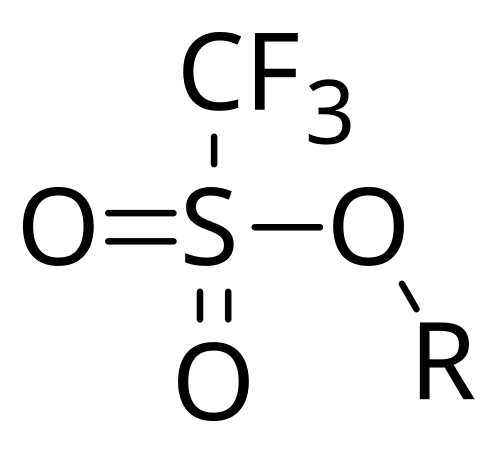

In organic chemistry, triflate (systematic name: trifluoromethanesulfonate), is a functional group with the formulaR−OSO2CF3 and structureR−O−S(=O)2−CF3. The triflate group is often represented by −OTf, as opposed to −Tf, which is the triflyl group, R−SO2CF3. For example, n-butyl triflate can be written as CH3CH2CH2CH2OTf.
The corresponding triflate anion, CF3SO−3, is an extremely stable polyatomic ion; this comes from the fact that triflic acid (CF3SO3H) is a superacid; i.e. it is more acidic than pure sulfuric acid, already one of the strongest acids known.
Applications
A triflate group is an excellent leaving group used in certain organic reactions such as nucleophilic substitution, Suzuki couplings and Heck reactions. Since alkyl triflates are extremely reactive in SN2 reactions, they must be stored in conditions free of nucleophiles (such as water). The anion owes its stability to resonance stabilization which causes the negative charge to be spread symmetrically over the three oxygen atoms. An additional stabilization is achieved by the trifluoromethyl group, which acts as a strong electron-withdrawing group using the sulfur atom as a bridge.
Triflates have also been applied as ligands for group 11 and 13 metals along with lanthanides.
Lithium triflates are used in some lithium ion batteries as a component of the electrolyte.
A mild triflating reagent is phenyl triflimide or N,N-bis(trifluoromethanesulfonyl)aniline, where the by-product is [CF3SO2N−Ph]−.
Triflate salts
تتميز أملاح التريفلات بثباتها الحراري العالي ، حيث تصل درجة انصهارها إلى 350 درجة مئوية لأملاح الصوديوم والبورون والفضة، خاصةً في صورتها الخالية من الماء. ويمكن الحصول عليها مباشرةً من حمض التريفليك وهيدروكسيد الفلز أو كربونات الفلز في الماء. كما يمكن الحصول عليها من تفاعل كلوريدات الفلزات مع حمض التريفليك النقي أو تريفلات الفضة ، أو من تفاعل تريفلات الباريوم مع كبريتات الفلزات في الماء: [ 1 ]
- MCl n + n HOTf → M(OTf) n + n HCl
- MCl n + n AgOTf → M(OTf) n + n AgCl↓
- M(SO₄ ) + n Ba(OTf) ₂ → M(OTf) ₂n + BaSO₄ ↓
تُستخدم ثلاثيات الفلزات كعوامل حفازة حمضية لويس في الكيمياء العضوية . وتُعدّ ثلاثيات اللانثانيدات من النوع Ln(OTf) ₃ (حيث Ln هو أحد اللانثانيدات ) ذات فائدة خاصة. ويُستخدم عامل حفاز شائع ذو صلة، وهو ثلاثيات السكانديوم، في تفاعلات مثل تفاعلات الألدول وتفاعلات ديلز-ألدر . ومن الأمثلة على ذلك تفاعل إضافة ألدول موكاياما بين البنزالدهيد وإيثر السيليل إينول للسيكلوهكسانون، والذي يحقق مردودًا كيميائيًا بنسبة 81% . [ 2 ] أما التفاعل المقابل باستخدام ملح الإيتريوم فيفشل.

التريفلات هو أنيون ضعيف التنسيق شائع الاستخدام .

انظر أيضاً
مراجع
- ↑ ديكسون، نبراسكا؛ لورانس، جورجيا؛ لاي، بنسلفانيا؛ سارجيسون، أريزونا؛ تاوب، هـ. (1990). "مركبات ثلاثي فلورو ميثان سلفونات ومركبات ثلاثي فلورو ميثان سلفوناتو- O ". التخليق غير العضوي . المجلد 28. الصفحات 70-76 . doi : 10.1002/9780470132593.ch16 . ISBN 9780470132593.
- ↑ كوباياشي، س. (1999). "تريفلات السكانديوم في التخليق العضوي". المجلة الأوروبية للكيمياء العضوية . 1999 (1): 15-27 . doi : 10.1002/(SICI)1099-0690(199901)1999:1 < 15::AID-EJOC15 > 3.0.CO ; 2-B .
- ↑ أيهارا، يوشينوري؛ تشاتاني، ناوتو (10 أبريل 2013). "الألكلة المباشرة المحفزة بالنيكل لروابط C–H في البنزاميدات والأكريلاميدات باستخدام هاليدات الألكيل الوظيفية عبر مساعدة التمخلب ثنائي السن". مجلة الجمعية الكيميائية الأمريكية . 135 (14): 5308–5311 . Bibcode : 2013JAChS.135.5308A . doi : 10.1021/ja401344e . PMID 23495861 .
- أحماض السلفونيك
- مجموعات السلفونيل
- مجموعات المغادرة
- ثلاثي الفلوروميثان سلفونات
- الأنيونات
- مركبات ثلاثي فلورو ميثيل