
يوان تي لي
يوان تسيه لي ( بالصينية :李遠哲؛ بينيين : Lǐ Yuǎnzhé ؛ ويد-جايلز : Li³ Yüan³-che² ؛ بيه-أو-جي : Lí Oán-tiat ؛ ولد في 19 نوفمبر 1936) هو كيميائي فيزيائي تايواني حصل على جائزة نوبل في الكيمياء عام 1986 لمساهماته في تطوير ديناميكيات التفاعل .
لي أستاذ فخري في جامعة كاليفورنيا، بيركلي ، ومدير فخري لمعهد الدراسات المتقدمة بجامعة ناغويا بالاشتراك مع ريوجي نويوري . [ 1 ] [ 2 ] [ 3 ] [ 4 ] حاز على جائزة نوبل مع جون سي. بولاني ودادلي آر. هيرشباخ لإسهاماتهم في ديناميكيات العمليات الكيميائية الأولية. [ 3 ] [ 5 ] كان أول تايواني يحصل على جائزة نوبل. انصبّ بحثه في الكيمياء الفيزيائية على استخدام تقنيات الحركية الكيميائية المتقدمة لدراسة سلوك التفاعلات الكيميائية والتحكم فيه باستخدام الحزم الجزيئية المتقاطعة . [ 3 ] [ 5 ] شغل لي منصب رئيس أكاديمية سينيكا من عام 1994 إلى عام 2006. [ 4 ] في عام 2011 ، انتُخب رئيسًا للمجلس الدولي للعلوم . [ 4 ]
الحياة المبكرة والتعليم

وُلد لي في شمال تايوان، في شينتشيكو ( هسينتشو حاليًا )، في 19 نوفمبر 1936. كان والده، لي تسي فان (李澤藩)، فنانًا، وكانت والدته، تساي باي (蔡配؛ Cài Péi )، مُعلمة في مدرسة ابتدائية من بلدة غوسيكو (梧棲港街) في محافظة تايتشو ( ووتشي حاليًا ، تايتشونغ ). [ 1 ] [ 3 ] [ 4 ] يقع منزل أجدادهم في نانآن ، فوجيان . [ 6 ]
لعب لي في فريقي البيسبول وتنس الطاولة في مدرسة هسينتشو الابتدائية، ثم درس في مدرسة هسينتشو الثانوية ، حيث مارس التنس وعزف على الترومبون والناي . أُعفي من امتحان القبول وقُبل مباشرةً في جامعة تايوان الوطنية ، وحصل على بكالوريوس العلوم عام ١٩٥٩. [ ١ ] [ ٣ ] ثم حصل على ماجستير العلوم من جامعة تسينغ هوا الوطنية عام ١٩٦١، ودكتوراه الفلسفة من جامعة كاليفورنيا، بيركلي ، عام ١٩٦٥ تحت إشراف بروس هـ. ماهان . [ ١ ] [ ٣ ] وكان عضوًا في المجلس الدولي للكيمياء من عام ١٩٧٧ إلى عام ١٩٨٤. [ ٤ ]
المسار العلمي
كيمياء
في فبراير 1967، بدأ العمل مع دادلي هيرشباخ في جامعة هارفارد على تفاعلات ذرات الهيدروجين وجزيئات القلويات ثنائية الذرة ، وعلى بناء جهاز عالمي للحزم الجزيئية المتقاطعة. بعد عام ما بعد الدكتوراه مع هيرشباخ، انضم إلى هيئة التدريس بجامعة شيكاغو عام 1968. وفي عام 1974، عاد إلى بيركلي أستاذاً للكيمياء وباحثاً رئيسياً في مختبر لورانس بيركلي الوطني ، وحصل على الجنسية الأمريكية في العام نفسه. لي أستاذ جامعي فخري في جامعة كاليفورنيا . [ 7 ]
جائزة نوبل
يُعدّ دراسة تحولات المواد أحد الأهداف الرئيسية للكيمياء ، حيث تلعب الحركية الكيميائية دورًا هامًا. وقد ذكر العلماء خلال القرن التاسع عشر أن العمليات الكيميائية العيانية تتكون من العديد من التفاعلات الكيميائية الأولية، والتي هي في حد ذاتها سلسلة من التفاعلات بين الذرات أو الجزيئات . ولفهم اعتماد التفاعلات الكيميائية على الزمن ، ركّز علماء الحركية الكيميائية تقليديًا على تحديد جميع التفاعلات الكيميائية الأولية الداخلة في عملية كيميائية عيانية، وتحديد معدلات حدوثها.
درس الكيميائي السويدي سفانتي أرهينيوس هذه الظاهرة خلال أواخر ثمانينيات القرن التاسع عشر، وذكر العلاقات بين التفاعلات الجزيئية ومعدلات التفاعلات (المصاغة من حيث طاقات التنشيط ).
Other scientists at the time also stated a chemical reaction is fundamentally a mechanical event, involving the rearrangement of atoms and molecules during a collision. Although these initial theoretical studies were only qualitative, they heralded a new era in the field of chemical kinetics; allowing the prediction of the dynamical course of a chemical reaction.
In the 1950s, 1960s and 1970s, with the development of many sophisticated experimental techniques, it became possible to study the dynamics of elementary chemical reactions in the laboratory. Such as the analysis of the threshold operating conditions of a chemical laser or the spectra obtained using various linear or non-linear laser spectroscopic techniques.
Professor Lee's research focused on the possibility to control the energies of the reagents, and to understand the dependence of chemical reactivity on molecular orientation, among other studies related to the nature of reaction intermediates, decay dynamics, and identifying complex reaction mechanisms. To do so, Professor Lee used a breakthrough laboratory technique at the time, called the "crossed molecular beams technique", where the information derived from the measurements of angular and velocity distributions allowed him and his team to understand the dynamics of elementary chemical reactions.[8]
In 2021, Lee donated his Nobel Prize medal to the National Museum of Taiwan History for exhibition.[9]
Later career
During his tenure, Lee has worked to create new research institutes, advance scientific research within Taiwan, and to recruit and cultivate top scholars for the Academia Sinica.
In 2010, Lee said that global warming would be much more serious than scientists previously thought, and that Taiwanese people needed to cut their per-capita carbon emissions from the current 12 tons per year to just three. This would take more than a few slogans, turning off the lights for one hour, or cutting meat consumption, noting: "We will have to learn to live the simple lives of our ancestors." Without such efforts, he said, "Taiwanese will be unable to survive long into the future".[10]
Lee was appointed the president of Academia Sinica in 1994 and renounced his U.S. citizenship to take the post.[11] As president of Academia Sinica he presided over the creation of the Taiwanese history textbook Knowing Taiwan.[12]
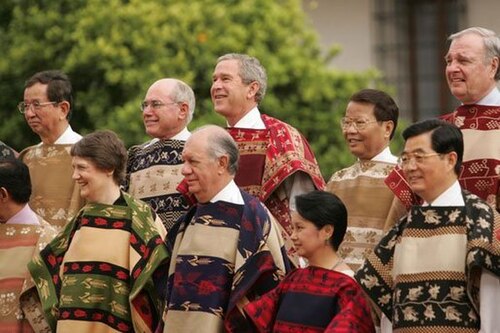
At the request of president Chen Shui-bian, Lee was Taiwan's representative in the 2002 APEC leaders' summit in Mexico. (Presidents of the Republic of China have been barred from joining the APEC summits because of objections from the People's Republic of China.) Lee represented Chen again in the 2003 and 2004 APEC summits in Thailand and Chile, respectively.[13]
In July 2024, Lee accepted president Lai Ching-te's invitation to serve as a consultant on the newly formed National Climate Change Strategy Committee.[14]
Lee was then elected President of the International Council for Science in 2008 and started his term in 2011.[15] He has been involved with the Malta Conferences, an initiative designed to bring together Middle Eastern scientists. As part of the initiative, he offered six fellowships to work on the synchrotron in Taiwan.[16] He is also a member of International Advisory Council in Universiti Tunku Abdul Rahman.[17]
Personal life
Lee's father was a painter in Taiwan, and his mother was an elementary school teacher. His elder brother Yuan-Chuan Lee has been a professor at Johns Hopkins University for 40 years and was awarded the honor Special Chair Lectureship in Academia Sinica in Taiwan. His younger brother Yuan-Pern Lee was also awarded this honor. Lee's sister Chi-Mei Lee has served as a professor at National Chung Hsing University.[18]
In 2003, he was one of 22 Nobel Laureates who signed the Humanist Manifesto.[19]
Politics
During the 2000 Taiwanese presidential election, Lee supported the pan-green coalition which advocates Taiwan independence. In the last week of the election he announced his support for the candidacy of Chen Shui-bian who subsequently defeated James Soong in the election. Chen intended to nominate Lee to become premier.
In January 2004, he and industrial tycoon Wang Yung-ching and theatre director Lin Hwai-min issued a joint statement to both Chen Shui-bian and Lien Chan. He backed Chen again in the 2004 elections, issuing a statement of support for the DPP on 17 March, three days before polls opened.
During the 2012 presidential election, Lee expressed his support for DPP candidate Tsai Ing-wen. In early 2016, he appeared and addressed a rally by New Power Party, a party formed by student activists involved in the Sunflower Movement.[20]
Climate change
Yuan Lee has signed the 2015 Mainau Declaration expressing concern about anthropogenic climate change.
Wu Chien-Shiung Foundation
Lee was one of the four Nobelists who established the Wu Chien-Shiung Foundation.
Recognition
In addition to the Nobel Prize, his awards and distinctions include Sloan Fellow (1969); Fellow of American Academy of Arts and Sciences (1975); Fellow Am. Phys. Soc. (1976); Guggenheim Fellow (1977); Member National Academy of Sciences (1979); Member International Academy of Science, Munich, Member Academia Sinica (1980); E.O. Lawrence Award (1981); Miller Professor, Berkeley (1981); Fairchild Distinguished Scholar (1983); Harrison Howe Award (1983); Peter Debye Award (1986); National Medal of Science (1986); Golden Plate Award of the American Academy of Achievement (1987) and Faraday Lectureship Prize (1992).[21] Yuan Tseh Lee was awarded the Othmer Gold Medal in 2008 in recognition of his outstanding contributions to progress in chemistry and science.[22][23][24] His post-doctoral supervisor and fellow Nobel Laureate Dudley Herschbach congratulated Lee.[25] In 2019 Yuan T. Lee was also awarded the Fray International Sustainability Award by FLOGEN Star Outreach at SIPS 2019.[26]
References
- 1234"Yuan T. Lee | College of Chemistry". chemistry.berkeley.edu. Retrieved 10 March 2019.
- ↑"Nobel Laureate Yuan T. Lee to speak on campus at international symposium exploring Nobel-caliber research | College of Chemistry". chemistry.berkeley.edu. Retrieved 10 March 2019.
- 123456"Yuan T. Lee Biographical (The Nobel Prize in Chemistry 1986)". NobelPrize.org. Retrieved 10 March 2019.
- 12345"Lee, Yuan Tseh, 1936–". history.aip.org. Retrieved 10 March 2019.
- 12"The Nobel Prize in Chemistry 1986". NobelPrize.org. Retrieved 10 March 2019.
- ↑"李远哲". Archived from the original on 24 November 2022. Retrieved 25 November 2018.
- ↑"Yuan T. Lee Professor Emeritus". Berkeley College of Chemistry. Retrieved 1 December 2016.
- ↑"Yuan T. Lee – Biographical". Nobel Prize.org. Retrieved 1 December 2016.
- ↑"Dare to be Different: The Humanism of a Taiwanese Scientist". National Museum of Taiwan History. 14 April 2023.
- ↑"Yuan Lee, Taiwan". Global Ideas. 7 September 2010.
- ↑"诺贝尔奖得主卸任 "李远哲时代" 黯然落幕". News.cn. 24 October 2006. Archived from the original on 23 March 2013.
- ↑Corcuff, Stephane (28 February 2002). Memories of the Future: National Identity Issues and the Search for a New Taiwan (1 ed.). Routledge. p. 86. ISBN 978-0765607911. Retrieved 5 March 2021.
- ↑Ko, Shu-ling (14 November 2004). "The struggle for an international voice". Taipei Times. Retrieved 1 December 2016.
- ↑Shan, Shelley (10 July 2024). "Lee Yuan-tseh joins Lai's climate change committee". Taipei Times. Retrieved 10 July 2024.
- ↑ «انتخاب عالم حائز على جائزة نوبل رئيسًا مستقبليًا للمجلس الدولي للعلوم» (ملف PDF) . مؤرشف من الأصل بتاريخ 25 مارس 2009. تم الاطلاع عليه بتاريخ 14 سبتمبر 2017 .
{{cite web}}: CS1 maint: bot: حالة عنوان URL الأصلي غير معروفة ( رابط ) . المجلس الدولي للعلوم . 7 نوفمبر 2008 - ↑ ليرمان، زافرا (10 فبراير 2015). "من النضال من أجل حقوق الإنسان إلى بناء جسر نحو السلام" . العلوم والدبلوماسية . 4 (1). مؤرشف من الأصل في 24 نوفمبر 2022. تم الاطلاع عليه في 10 فبراير 2015 .
- ^ "المجلس الاستشاري الدولي لـ UTAR" . جامعة تونكو عبد الرحمن (UTAR) . 20 ديسمبر 2020.
- ↑ "يوان تي لي - سيرة ذاتية" . موقع جائزة نوبل . تم الاطلاع عليه في 1 ديسمبر 2016 .
- ↑ «الموقعون البارزون» . الإنسانية وتطلعاتها . الجمعية الإنسانية الأمريكية . مؤرشف من الأصل في 5 أكتوبر 2012. تم الاطلاع عليه في 2 أكتوبر 2012 .
- ↑ أبراهام، جيربر. "حزب الشعب الجديد يركز على الأسرة في مسيرة ليلية" . صحيفة تايبيه تايمز . تم الاطلاع عليه بتاريخ 9 يناير 2016 .
- ↑ «الحائزون على جائزة اللوحة الذهبية من الأكاديمية الأمريكية للإنجاز» . www.achievement.org . الأكاديمية الأمريكية للإنجاز .
- ↑ «مؤسسة التراث الكيميائي تُقدّم ميدالية أوثمر الذهبية لعام 2008 إلى يوان تسيه لي» . كلية الكيمياء. 26 فبراير 2008. مؤرشف من الأصل في 30 أبريل 2013. تم الاطلاع عليه في 12 يونيو 2014 .
- ↑ «الأكاديمي يوان تسيه لي يحصل على الميدالية الذهبية لعام 2008 من مؤسسة التراث الكيميائي» . النشرة الإلكترونية لأكاديمية سينيكا . أكاديمية سينيكا، تايبيه، تايوان، جمهورية الصين. 2008. مؤرشف من الأصل في 2 مارس 2016. تم الاطلاع عليه في 12 يونيو 2014 .
- ↑ "ميدالية أوثمر الذهبية" . معهد تاريخ العلوم. 31 مايو 2016. تم الاطلاع عليه بتاريخ 22 مارس 2018 .
- ↑ ""ثلاثي رائع" ألقى ضوءاً جديداً على التفاعلات الكيميائية . صحيفة نيويورك تايمز . 16 أكتوبر 1986. تاريخ الاطلاع: 1 ديسمبر 2016 .
- ↑"Yuan T. Lee winner of the Fray Award".
Publications
- Lee, Y. T. "Crossed Molecular Beam Studies and Dynamics of Decomposition of Chemically Activated Radicals", University of Chicago, United States Department of Energy (through predecessor agency the Atomic Energy Commission), (September 1973).
- Lee, Y. T. & S. J. Sibener. "Internal Energy Dependence of Molecular Condensation Coefficients Determined from Molecular Beam Surface Scattering Experiments", Lawrence Berkeley Laboratory, University of California, Berkeley, United States Department of Energy, (May 1978).
- Lee, Y. T., Sibener, S. J. & R. J. Buss. "Development of a Supersonic Atomic Oxygen Nozzle Beam Source for Crossed Beam Scattering Experiments", Lawrence Berkeley Laboratory, University of California, Berkeley, United States Department of Energy, (May 1978).
- Lee, Y. T., Baseman, R. J., Guozhong, H. & R. J. Buss. "Reaction Mechanism of Oxygen Atoms with Unsaturated Hydrocarbons by the Crossed-Molecular-Beams Method", Lawrence Berkeley Laboratory, University of California, Berkeley, United States Department of Energy-Office of Basic Energy Science, (April 1982).
- Lee, Y. T. "Molecular-beam Studies of Primary Photochemical Processes", Lawrence Berkeley Laboratory, University of California, Berkeley, United States Department of Energy, (December 1982).
- Lee, Y. T., Continetti, R. E. & B. A. Balko. "Molecular Beam Studies of Hot Atom Chemical Reactions: Reactive Scattering of Energetic Deuterium Atoms", Lawrence Berkeley Laboratory, United States Department of Energy, (February 1989).
- Lee, Y.T., "Energy, Environment, and the Responsibility of Scientists", (2007).
External links
 Media related to Yuan T. Lee at Wikimedia Commons
- Yuan T. Lee on Nobelprize.org
- “Yuan T Lee – Science Video Interview”, Vega Science Trust (Archive)
- “Yuan Lee, Taiwan”, Global Ideas
- “Sustainability of the human society (part1)“, Akademi Sains Malaysia ASM
- “Sustainability of the human society (part2)“, ASM
- “Sustainability of the human society (part3)“, ASM
- “Dynamics of Chemical Reactions and Photochemical Processes (Lecture + Discussion)”, Yuan T. Lee (2010), Lindau Nobel Laureate Meetings
- 1936 births
- Living people
- Fellows of the American Academy of Arts and Sciences
- Fellows of the American Physical Society
- International members of the National Academy of Sciences
- Foreign fellows of the Indian National Science Academy
- Harvard University faculty
- Han Taiwanese
- Hokkien scientists
- Members of Academia Sinica
- Members of the Committee of 100
- National Medal of Science laureates
- National Taiwan University alumni
- National Tsing Hua University alumni
- Nobel laureates in Chemistry
- People from Hsinchu
- Taiwanese emigrants to the United States
- Naturalized citizens of the United States
- People who renounced United States citizenship
- Physical chemists
- Taiwanese chemists
- Taiwanese Nobel laureates
- Taiwanese people of Hoklo descent
- University of California, Berkeley alumni
- UC Berkeley College of Chemistry faculty