
Acarbose
Acarbose (INN)[1][2] is an anti-diabetic drug used to treat diabetes mellitus type 2 and (in some countries), prediabetes. It is sold in Europe and China as Glucobay (Bayer AG), in North America as Precose (Bayer Pharmaceuticals), and in Canada as Prandase (Bayer AG).
Acarbose is a starch blocker that works by inhibiting alpha glucosidase, an intestinal enzyme that releases glucose from larger carbohydrates such as starch and sucrose. It is composed of an acarviosinmoiety with a maltose at the reducing terminus. It can be degraded by gut bacteria.[3]
Acarbose is inexpensive and popular in China, but not in the U.S. One physician explains that U.S. use is limited, because it is not potent enough to offset side effects of diarrhea and flatulence.[4] However, a large 2013 study reported that "acarbose is effective, safe and well tolerated in a large cohort of Asian patients with type 2 diabetes."[5] One possible explanation for the differing claims is that acarbose is significantly more effective in patients eating a relatively high-starch, Eastern diet.[6]
Medical uses
Efficacy
In type II diabetic patients, acarbose averages an absolute decrease of 0.8 percentage points in HbA1c, which is a decrease of about 10% in typical HbA1c values in diabetes studies.[7] Individuals with higher baseline levels show higher reductions, about an 0.12% additional decrease for each point of baseline HbA1c.[7] Its effect on postprandial glucose, but not on HbA1c, scales with dose.[7] Among diabetic patients, acarbose may help reduce the damage done to blood vessels and kidneys by reducing glucose levels.[7]
أجرت مراجعة منهجية أجرتها مؤسسة كوكرين تقييمًا لتأثير مثبطات إنزيم ألفا غلوكوزيداز لدى الأشخاص المصابين بمقدمات السكري ، والتي تُعرَّف بأنها ضعف تحمل الغلوكوز، أو ارتفاع مستوى سكر الدم الصائم ، أو ارتفاع مستوى الهيموغلوبين السكري A1c (HbA1c ) . [ 8 ] ووجد أن الأكاربوز يقلل من معدل الإصابة بداء السكري من النوع الثاني مقارنةً بالدواء الوهمي، إلا أنه لم تتوفر أدلة قاطعة على أن الأكاربوز، مقارنةً بالنظام الغذائي والتمارين الرياضية، أو الميتفورمين ، أو الدواء الوهمي ، أو عدم التدخل، يُحسِّن معدل الوفيات لأي سبب ، أو يقلل أو يزيد من خطر الوفيات القلبية الوعائية، أو الآثار الجانبية الخطيرة أو غير الخطيرة، أو السكتة الدماغية غير المميتة ، أو قصور القلب الاحتقاني ، أو احتشاء عضلة القلب غير المميت . [ 8 ]
أظهرت العديد من الدراسات أن مثبطات الجلوكوزيداز ومثبطات ألفا-أميلاز تعزز فقدان الدهون الحشوية ومحيط الخصر من خلال العمل كمحاكيات لتقييد السعرات الحرارية (المرتبط بتأثيرها الشبيه بالأكاربوز). [ 9 ]
العلاج المركب
يؤدي الجمع بين أكاربوز وميتفورمين إلى انخفاضات أكبر في مستوى الهيموجلوبين السكري (HbA1c ) وسكر الدم الصائم وسكر الدم بعد الأكل مقارنةً بكل دواء على حدة. [ 10 ]
الآثار الجانبية
بما أن الأكاربوز يمنع تحلل الكربوهيدرات المعقدة إلى جلوكوز، فإن بعض الكربوهيدرات ستبقى في الأمعاء وتنتقل إلى القولون . في القولون، تقوم البكتيريا بهضم ( تخمير ) الكربوهيدرات المعقدة، مما يُسبب آثارًا جانبية هضمية مثل انتفاخ البطن (لدى 78% من المرضى) والإسهال ( لدى 14% من المرضى). ولأن هذه الآثار مرتبطة بالجرعة، يُنصح عمومًا بالبدء بجرعة منخفضة وزيادتها تدريجيًا إلى الكمية المطلوبة. وجدت إحدى الدراسات أن الآثار الجانبية الهضمية انخفضت بشكل ملحوظ (من 50% إلى 15%) على مدار 24 أسبوعًا، حتى مع ثبات الجرعة. [ 11 ] يُعد السكروز أكثر عرضة للتسبب في آثار جانبية هضمية مقارنةً بالنشا. [ 7 ]
يرتبط دواء أكاربوز بارتفاع نادر جدًا في إنزيمات ناقلة الأمين (19 حالة من أصل 500,000). [ 7 ] وقد سُجّلت حالات نادرة جدًا من التهاب الكبد مع استخدام أكاربوز، وعادةً ما يزول هذا الالتهاب عند التوقف عن تناول الدواء. يُنصح بفحص إنزيمات الكبد قبل وأثناء استخدام هذا الدواء كإجراء احترازي. [ 12 ] وتؤكد دراسة تحليلية شاملة أُجريت عام 2016 وجود ارتباط ذي دلالة إحصائية بين مثبطات ألفا غلوكوزيداز، بما في ذلك أكاربوز، وارتفاع مستويات إنزيمات ناقلة الأمين. [ 13 ]
علم الأدوية
آلية العمل
يُثبّط الأكاربوز الإنزيمات ( هيدرولازات الغليكوزيد ) اللازمة لهضم الكربوهيدرات ، وتحديدًا إنزيمات ألفا-غلوكوزيداز في الحافة الفرشاتية للأمعاء الدقيقة، وإنزيم ألفا-أميليز البنكرياسي . ويُعطّل الأكاربوز هذه الإنزيمات عن طريق محاكاة الحالة الانتقالية للركيزة برابطة الأمين. [ 14 ] مع ذلك، فإن إنزيمات ألفا-أميليز البكتيرية الموجودة في ميكروبيوم الأمعاء قادرة على تحليل الأكاربوز. [ 15 ] [ 16 ] [ 17 ]
يقوم إنزيم ألفا-أميليز البنكرياسي بتحليل النشويات المعقدة إلى سكريات قليلة التعدد في تجويف الأمعاء الدقيقة، بينما تقوم إنزيمات ألفا-غلوكوزيداز المعوية المرتبطة بالغشاء بتحليل السكريات قليلة التعدد ، والسكريات الثلاثية ، والسكريات الثنائية إلى غلوكوز وسكريات أحادية أخرى في الأمعاء الدقيقة. ويؤدي تثبيط هذه الأنظمة الإنزيمية إلى تقليل معدل هضم الكربوهيدرات المعقدة، مما يقلل من امتصاص الغلوكوز نتيجة عدم تحلل الكربوهيدرات إلى جزيئات غلوكوز. في مرضى السكري ، يتمثل التأثير قصير المدى لهذه العلاجات الدوائية في خفض مستويات الغلوكوز في الدم، بينما يتمثل التأثير طويل المدى في خفض مستوى الهيموغلوبين السكري (HbA1c) . [ 18 ]
الاسْتِقْلاب
يُعدّ تحلل الأكاربوز السمة الفريدة لإنزيمات تحلل الغليكوزيدات في الميكروبات المعوية ، وتحديدًا إنزيم غلوكوزيداز تحلل الأكاربوز ، الذي يُحلل الأكاربوز إلى أكارفيوزين-غلوكوز وغلوكوز. [ 17 ] تُحوّل الإنزيمات البشرية الأكاربوز أيضًا: إذ يستطيع إنزيم ألفا-أميليز البنكرياسي إجراء تفاعل إعادة ترتيب ، ناقلًا وحدة الغلوكوز من جزيء المالتوز "الذيل" إلى "رأس" الجزيء. أما الأدوية التناظرية التي أُزيل منها جزيء الغلوكوز "الذيل" أو عُكست إلى رابطة α(1-6) فتُقاوم هذا التحول. [ 14 ]
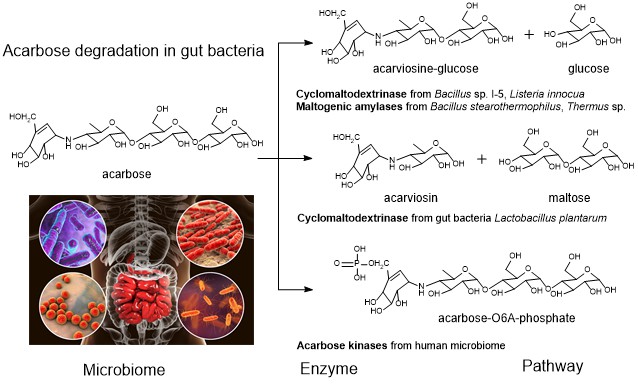
It has been reported that the maltogenic alpha-amylase from Thermus sp. IM6501 (ThMA) and a cyclodextrinase (CDase) from Streptococcus pyogenes could hydrolyse acarbose to glucose and acarviosine-glucose, ThMA can further hydrolyze acarviosine-glucose into acarviosin and glucose.[19][20] A cyclomaltodextrinase (CDase) from gut bacteria Lactobacillus plantarum degraded acarbose via two different modes of action to produce maltose and acarviosin, as well as glucose and acarviosine-glucose, suggest that acarbose resistance is caused by the human microbiome.[3] The microbiome-derived acarbose kinases are also specific to phosphorylate and inactivate acarbose.[21] The molecular modeling showed the interaction between gut bacterial acarbose degrading glucosidase and human α-amylase.[22]

Natural distribution
In nature, acarbose is synthesized by soil bacteriaActinoplanes sp through its precursorvalienamine.[23]
In molecular biology
Acarbose is described chemically as a pseudotetrasaccharide,[24] specifically a maltotetraose mimic inhibitor. As an inhibitor that mimics some natural substrates, it is useful for elucidating the structure of sugar-digesting enzymes, by binding into the same pocket.[25]
Research
Most studies investigating alpha-glucosidase and alpha-amylase inhibitory activity use acarbose as reference.[26][27]
In human T2DM patients, acarbose reduces total triglyceride levels.[28] Acarbose has a similar effect in non-T2DM patients with isolated familial hypertriglyceridemia.[7]
In smaller samples of healthy human volunteers, acarbose increases postprandial GLP-1 levels.[7]
In studies conducted by three independent laboratories by the US National Institute on Aging's intervention testing programme, acarbose was shown to extend the lifespan of female mice by 5% and of male mice by 22%.[29][30]
A pooled analysis of data from 10 observational studies show that acarbose appears to reduce body weight irrespective of glycemic control in diabetic patients. The effect is more pronounced in patients of the female sex, South East Asian and East Asian ethnicity, younger age, higher body mass index, short duration of diabetes, or no previous treatment.[31]
References
- ↑Elks J, Ganellin CR, eds. (1990). The Dictionary of Drugs: Chemical Data: Chemical Data, Structures and Bibliographies. Springer. pp. 1–. doi:10.1007/978-1-4757-2085-3. ISBN 978-1-4757-2085-3.
- ↑"International Nonproprietary Names for Pharmaceutical Substances. Recommended International Nonproprietary Names (Rec. INN): List 19"(PDF). World Health Organization. 1979. Retrieved 9 November 2016.
- 12Jang MU, Kang HJ, Jeong CK, Kang Y, Park JE, Kim TJ (February 2018). "Functional expression and enzymatic characterization of Lactobacillus plantarum cyclomaltodextrinase catalyzing novel acarbose hydrolysis". Journal of Microbiology. 56 (2): 113–118. doi:10.1007/s12275-018-7551-3. PMID 29392561. S2CID 2660911.
- ↑Kresge N (21 November 2011). "China's Thirst for New Diabetes Drugs Threatens Bayer's Lead". Bloomberg Business Week. Archived from the original on 21 November 2011. Retrieved 15 April 2016.
- ↑Zhang W, Kim D, Philip E, Miyan Z, Barykina I, Schmidt B, et al. (April 2013). "A multinational, observational study to investigate the efficacy, safety and tolerability of acarbose as add-on or monotherapy in a range of patients: the Gluco VIP study". Clinical Drug Investigation. 33 (4): 263–274. doi:10.1007/s40261-013-0063-3. PMID 23435929. S2CID 207483590.
- ↑Zhu Q, Tong Y, Wu T, Li J, Tong N (June 2013). "Comparison of the hypoglycemic effect of acarbose monotherapy in patients with type 2 diabetes mellitus consuming an Eastern or Western diet: a systematic meta-analysis". Clinical Therapeutics. 35 (6): 880–899. doi:10.1016/j.clinthera.2013.03.020. PMID 23602502.
- 12345678DiNicolantonio JJ, Bhutani J, O'Keefe JH (2015). "Acarbose: safe and effective for lowering postprandial hyperglycaemia and improving cardiovascular outcomes". Open Heart. 2 (1) e000327. doi:10.1136/openhrt-2015-000327. PMC 4620230. PMID 26512331.
- 12Moelands SV, Lucassen PL, Akkermans RP, De Grauw WJ, Van de Laar FA, et al. (Cochrane Metabolic and Endocrine Disorders Group) (December 2018). "Alpha-glucosidase inhibitors for prevention or delay of type 2 diabetes mellitus and its associated complications in people at increased risk of developing type 2 diabetes mellitus". The Cochrane Database of Systematic Reviews. 2018 (12) CD005061. doi:10.1002/14651858.CD005061.pub3. PMC 6517235. PMID 30592787.
- ↑Smith DL, Orlandella RM, Allison DB, Norian LA (June 2021). "Diabetes medications as potential calorie restriction mimetics-a focus on the alpha-glucosidase inhibitor acarbose". GeroScience. 43 (3): 1123–1133. doi:10.1007/s11357-020-00278-x. PMC 8190416. PMID 33006707.
- ↑Hedrington MS, Davis SN (December 2019). "Considerations when using alpha-glucosidase inhibitors in the treatment of type 2 diabetes". Expert Opinion on Pharmacotherapy. 20 (18): 2229–2235. doi:10.1080/14656566.2019.1672660. PMID 31593486. S2CID 203985605.
- ↑Hoffmann J, Spengler M (December 1997). "Efficacy of 24-week monotherapy with acarbose, metformin, or placebo in dietary-treated NIDDM patients: the Essen-II Study". The American Journal of Medicine. 103 (6): 483–490. doi:10.1016/S0002-9343(97)00252-0. PMID 9428831.
- ↑"Acarbose: hepatitis: France, Spain". WHO Pharmaceuticals Newsletter. 1999. Archived from the original on 15 October 2009.
- ↑Zhang L, Chen Q, Li L, Kwong JS, Jia P, Zhao P, et al. (September 2016). "Alpha-glucosidase inhibitors and hepatotoxicity in type 2 diabetes: a systematic review and meta-analysis". Scientific Reports. 6 (1) 32649. Bibcode:2016NatSR...632649Z. doi:10.1038/srep32649. PMC 5011653. PMID 27596383.
- 12Li C, Begum A, Numao S, Park KH, Withers SG, Brayer GD (March 2005). "Acarbose rearrangement mechanism implied by the kinetic and structural analysis of human pancreatic alpha-amylase in complex with analogues and their elongated counterparts". Biochemistry. 44 (9): 3347–3357. doi:10.1021/bi048334e. PMID 15736945.
- ↑Park KH, Kim MJ, Lee HS, Han NS, Kim D, Robyt JF (December 1998). "Transglycosylation reactions of Bacillus stearothermophilus maltogenic amylase with acarbose and various acceptors". Carbohydrate Research. 313 (3–4): 235–246. doi:10.1016/S0008-6215(98)00276-6. PMID 10209866.
- ↑Oh SW, Jang MU, Jeong CK, Kang HJ, Park JM, Kim TJ (August 2008). "Modulation of hydrolysis and transglycosylation activity of Thermus maltogenic amylase by combinatorial saturation mutagenesis". Journal of Microbiology and Biotechnology. 18 (8): 1401–1407. PMID 18756100.
- 12Kim TJ, Kim MJ, Kim BC, Kim JC, Cheong TK, Kim JW, et al. (April 1999). "Modes of action of acarbose hydrolysis and transglycosylation catalyzed by a thermostable maltogenic amylase, the gene for which was cloned from a Thermus strain". Applied and Environmental Microbiology. 65 (4): 1644–1651. Bibcode:1999ApEnM..65.1644K. doi:10.1128/AEM.65.4.1644-1651.1999. PMC 91232. PMID 10103262.
- ↑Drug Therapy in Nursing, 2nd Edition.
- ↑Jang MU, Kang HJ, Jeong CK, Oh GW, Lee EH, Son BS, et al. (2017). "Functional expression and enzymatic characterization of cyclomaltodextrinase from Streptococcus pyogenes". Korean Journal of Microbiology. 53 (3): 208–215. doi:10.7845/kjm.2017.7062. ISSN 0440-2413.
- ↑Baek JS, Kim HY, Abbott TP, Moon TW, Lee SB, Park CS, et al. (March 2003). "Acarviosine-simmondsin, a novel compound obtained from acarviosine-glucose and simmondsin by Thermus maltogenic amylase and its in vivo effect on food intake and hyperglycemia". Bioscience, Biotechnology, and Biochemistry. 67 (3): 532–539. doi:10.1271/bbb.67.532. PMID 12723600. S2CID 2813481.
- ↑Balaich J, Estrella M, Wu G, Jeffrey PD, Biswas A, Zhao L, et al. (December 2021). "The human microbiome encodes resistance to the antidiabetic drug acarbose". Nature. 600 (7887): 110–115. Bibcode:2021Natur.600..110B. doi:10.1038/s41586-021-04091-0. PMC 10258454. PMID 34819672. S2CID 244644880.
- ↑Park KH (2006). "Function and Tertiary- and Quaternary-structure of Cyclodextrin-hydrolyzing Enzymes (CDase), a Group of Multisubstrate Specific Enzymes Belonging to the α-Amylase Family". Journal of Applied Glycoscience. 53 (1): 35–44. doi:10.5458/jag.53.35. ISSN 1344-7882. S2CID 86894203.
- ↑Tsunoda T, Samadi A, Burade S, Mahmud T (June 2022). "Complete biosynthetic pathway to the antidiabetic drug acarbose". Nature Communications. 13 (1) 3455. Bibcode:2022NatCo..13.3455T. doi:10.1038/s41467-022-31232-4. PMC 9200736. PMID 35705566.
- ↑Bozonnet S, Jensen MT, Nielsen MM, Aghajari N, Jensen MH, Kramhøft B, et al. (October 2007). "The 'pair of sugar tongs' site on the non-catalytic domain C of barley alpha-amylase participates in substrate binding and activity". The FEBS Journal. 274 (19): 5055–5067. doi:10.1111/j.1742-4658.2007.06024.x. PMID 17803687. S2CID 25592455.
- ↑Miyazaki T, Park EY (June 2020). "Structure-function analysis of silkworm sucrose hydrolase uncovers the mechanism of substrate specificity in GH13 subfamily 17 exo-α-glucosidases". The Journal of Biological Chemistry. 295 (26): 8784–8797. doi:10.1074/jbc.RA120.013595. PMC 7324511. PMID 32381508.
- ↑Moreira FD, Reis CE, Gallassi AD, Moreira DC, Welker AF (9 October 2024). Dardari D (ed.). "Suppression of the postprandial hyperglycemia in patients with type 2 diabetes by a raw medicinal herb powder is weakened when consumed in ordinary hard gelatin capsules: A randomized crossover clinical trial". PLOS ONE. 19 (10) e0311501. Bibcode:2024PLoSO..1911501M. doi:10.1371/journal.pone.0311501. PMC 11463819. PMID 39383145.
 This article incorporates textfrom this source, which is available under the CC BY 4.0 license.
 - ↑Hayward NJ, McDougall GJ, Farag S, Allwood JW, Austin C, Campbell F, et al. (December 2019). "Cinnamon Shows Antidiabetic Properties that Are Species-Specific: Effects on Enzyme Activity Inhibition and Starch Digestion". Plant Foods for Human Nutrition. 74 (4): 544–552. Bibcode:2019PFHN...74..544H. doi:10.1007/s11130-019-00760-8. PMC 6900266. PMID 31372918.
- ↑Yousefi M, Fateh ST, Nikbaf-Shandiz M, Gholami F, Rastgoo S, Bagher R, et al. (November 2023). "The effect of acarbose on lipid profiles in adults: a systematic review and meta-analysis of randomized clinical trials". BMC Pharmacology & Toxicology. 24 (1) 65. doi:10.1186/s40360-023-00706-6. PMC 10664642. PMID 37990256.
- ↑Harrison DE, Strong R, Allison DB, Ames BN, Astle CM, Atamna H, et al. (April 2014). "Acarbose, 17-α-estradiol, and nordihydroguaiaretic acid extend mouse lifespan preferentially in males". Aging Cell. 13 (2): 273–282. doi:10.1111/acel.12170. PMC 3954939. PMID 24245565.
- ↑Ladiges W, Liggitt D (2017). "Testing drug combinations to slow aging". Pathobiology of Aging & Age Related Diseases. 8 (1) 1407203. doi:10.1080/20010001.2017.1407203. PMC 5706479. PMID 29291036.
- ↑Schnell O, Weng J, Sheu WH, Watada H, Kalra S, Soegondo S, et al. (May 2016). "Acarbose reduces body weight irrespective of glycemic control in patients with diabetes: results of a worldwide, non-interventional, observational study data pool". Journal of Diabetes and Its Complications. 30 (4): 628–637. doi:10.1016/j.jdiacomp.2016.01.023. PMID 26935335.
- Alpha-glucosidase inhibitors
- Amino sugars
- Drugs developed by Bayer
- Oligosaccharides
- Cyclohexenes