
الماء السائل خارج الأرض
الماء السائل خارج الأرض هو الماء في حالته السائلة الذي يوجد بشكل طبيعي خارج كوكب الأرض . وهو موضوع يحظى باهتمام واسع لأنه يُعتبر أحد المتطلبات الأساسية للحياة كما نعرفها، وبالتالي يُفترض أنه ضروري للحياة خارج كوكب الأرض . [ 1 ]
على الرغم من أن العديد من الأجرام السماوية في النظام الشمسي تمتلك غلافًا مائيًا ، إلا أن الأرض هي الجرم السماوي الوحيد المعروف بوجود مسطحات مائية مستقرة على سطحها، حيث تغطي المياه المحيطية 71% من سطحها، [ 2 ] وهو أمر ضروري للحياة على الأرض. ويُحافظ على وجود الماء السائل بفضل الضغط الجوي للأرض ومدارها المستقر في المنطقة الصالحة للسكن حول الشمس ؛ ومع ذلك، لا يزال أصل مياه الأرض غير مؤكد.
تُعدّ مطيافية الامتصاص والكيمياء الجيولوجية من أهم الطرق المستخدمة حاليًا لتأكيد وجود الماء السائل على الكواكب الأرضية. وقد أثبتت هذه التقنيات فعاليتها في رصد بخار الماء والجليد في الغلاف الجوي. مع ذلك، وباستخدام الطرق الحالية للمطيافية الفلكية، يصبح من الصعب للغاية رصد الماء السائل على الكواكب الأرضية ، لا سيما في حالة المياه الجوفية. ولهذا السبب، يلجأ علماء الفلك وعلماء الأحياء الفلكية وعلماء الكواكب إلى استخدام المنطقة الصالحة للسكن، ونظرية الجاذبية والمد والجزر ، ونماذج تمايز الكواكب ، والقياس الإشعاعي لتحديد احتمالية وجود الماء السائل. كما يُمكن أن يُقدّم الماء المرصود في النشاط البركاني أدلة غير مباشرة أكثر إقناعًا، وكذلك الحال بالنسبة للمعالم النهرية ووجود عوامل مضادة للتجمد ، مثل الأملاح أو الأمونيا .
Using such methods, many scientists infer that liquid water once covered large areas of Mars and Venus.[3][4] Water is thought to exist as liquid beneath the surface of some planetary bodies, similar to groundwater on Earth. Water vapour is sometimes considered conclusive evidence for the presence of liquid water, although atmospheric water vapour may be found to exist in many places where liquid water does not. Similar indirect evidence, however, supports the existence of liquids below the surface of several moons and dwarf planets elsewhere in the Solar System.[1] Some are speculated to be large extraterrestrial "oceans".[1] Liquid water is thought to be common in other planetary systems, despite the lack of conclusive evidence, and there is a growing list of extrasolar candidates for liquid water. In June 2020, NASA scientists reported that it is likely that exoplanets with oceans may be common in the Milky Way galaxy, based on mathematical modeling studies.[5][6]
Significance
Water is a fundamental element for the biochemistry of all known living beings. With some areas on Earth such as deserts being drier than others, their local lifeforms are adapted to make efficient use of the scarce available water.
No known lifeform can live completely without water.
It is also one of the simplest molecules, composed of one oxygen and two hydrogen atoms, and can be found in all celestial bodies of the solar system. It is only useful for life in a liquid state, and extraterrestrial water is commonly found as water vapor or ice. Although life eventually adapted to live on land, the first forms of life on Earth appeared in liquid water.[7] As a result, the search for extraterrestrial liquid water is closely related with the search of extraterrestrial life.[8]
Liquid water also has several properties that are beneficial for lifeforms. For example, unlike most other liquids, it becomes less dense when it solidifies rather than denser. As a result, if a body of water gets cold enough, the ice floats and eventually creates an ice layer, trapping liquid water and its ecosystems below. Without this property, lakes and oceans would become ice in their full size, along with any creatures living in them.[9]
Liquid water in the Solar System
As of December 2015, the confirmed liquid water in the Solar System outside Earth is 25–50 times the volume of Earth's water (1.3 billion km3),[10] i.e. about 3.25–6.5 × 10¹⁰ km3 (32.5 to 65 billion km3) and 3.25–6.5 × 10¹⁹ tons (32.5 to 65 billion billion tons) of water.
Mars
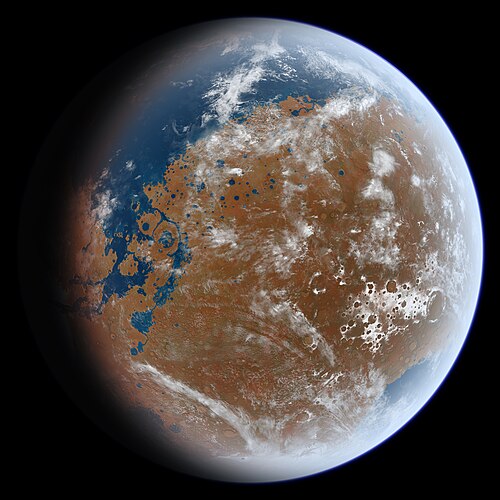
The Mars ocean theory suggests that nearly a third of the surface of Mars was once covered by water, though the water on Mars is no longer oceanic.
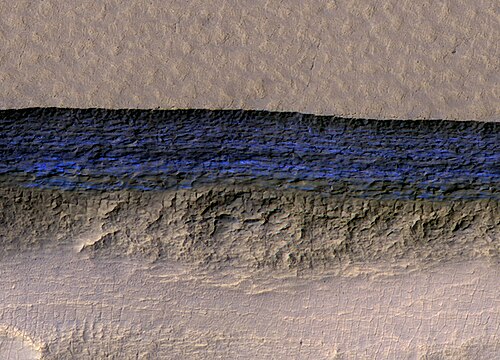
Water on Mars exists today almost exclusively as ice and underground, with a small amount present in the atmosphere as vapor. Some liquid water may occur transiently on the Martian surface today but only under certain conditions.[12] No large standing bodies of liquid water exist because the atmospheric pressure at the surface averages just 600 pascals (0.087 psi)—about 0.6% of Earth's mean sea level pressure—and because the global average temperature is far too low (210 K (−63 °C)), leading to either rapid evaporation or freezing. Features called recurring slope lineae are thought to be caused by flows of brine—hydrated salts.[13][14][15]
في يوليو/تموز 2018، أعلن علماء من وكالة الفضاء الإيطالية عن اكتشاف بحيرة تحت جليدية على سطح المريخ، تقع على عمق 1.5 كيلومتر (0.93 ميل) أسفل الغطاء الجليدي القطبي الجنوبي ، وتمتد أفقيًا لمسافة 20 كيلومترًا (12 ميلًا) ، وهو أول دليل على وجود مسطح مائي مستقر على الكوكب. [ 16 ] [ 17 ] ونظرًا لأن درجة الحرارة عند قاعدة الغطاء القطبي تُقدّر بنحو 205 كلفن (-68 درجة مئوية؛ -91 درجة فهرنهايت) ، يفترض العلماء أن الماء قد يبقى سائلًا بفضل تأثير بيركلورات المغنيسيوم والكالسيوم المضاد للتجمد . [ 16 ] [ 18 ] تتكون طبقة الجليد التي تغطي البحيرة، والتي يبلغ سمكها 1.5 كيلومتر (0.93 ميل) ، من جليد مائي مختلط بنسبة 10 إلى 20% من الغبار، وتُغطى موسميًا بطبقة من جليد ثاني أكسيد الكربون يبلغ سمكها مترًا واحدًا (3 أقدام و3 بوصات) . [ 16 ]
أوروبا
يتفق العلماء على وجود طبقة من الماء السائل تحت سطح أوروبا ، أحد أقمار كوكب المشتري، وأن الحرارة الناتجة عن حركة المد والجزر تُبقي هذا المحيط تحت السطح سائلاً. [ 19 ] ويُقدّر سمك القشرة الخارجية من الجليد الصلب بحوالي 10-30 كيلومترًا (6.2-18.6 ميلًا) ، بما في ذلك طبقة من "الجليد الدافئ" المرن، مما قد يعني أن عمق المحيط السائل تحته قد يصل إلى حوالي 100 كيلومتر (62 ميلًا) . [ 20 ] ويؤدي هذا إلى حجم محيطات أوروبا يبلغ 3 × 10¹⁸ متر مكعب ( 3 مليارات كيلومتر مكعب ) ، أي ما يزيد قليلاً عن ضعف حجم محيطات الأرض.
إنسيلادوس
أظهر قمر إنسيلادوس ، التابع لكوكب زحل، وجود ينابيع مائية حارة، أكدتها مركبة كاسيني الفضائية عام 2005، وخضعت لتحليل أعمق عام 2008. وأكدت بيانات قياس الجاذبية في الفترة 2010-2011 وجود محيط جوفي. وبينما كان يُعتقد سابقًا أنه محيط محلي، على الأرجح في جزء من نصف الكرة الجنوبي، تشير الأدلة التي كُشفت عام 2015 إلى أن هذا المحيط الجوفي ذو طبيعة عالمية. [ 21 ]
إضافةً إلى الماء، احتوت هذه الينابيع الحارة المتدفقة من فتحات بالقرب من القطب الجنوبي على كميات ضئيلة من الملح والنيتروجين وثاني أكسيد الكربون والهيدروكربونات المتطايرة. ويبدو أن ذوبان مياه المحيط والينابيع الحارة ناتج عن تدفق المد والجزر من كوكب زحل.
ميماس
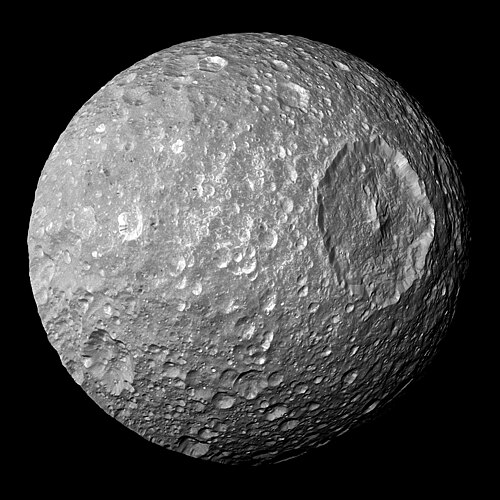
Mimas, another moon of Saturn similar in size and orbit to Enceladus, was found by Cassini to have a "rocking" motion whose amplitude could only be explained by a large subsurface ocean.[22]
Ganymede
A subsurface saline ocean is theorized to exist on Ganymede, a moon of Jupiter, following observation by the Hubble Space Telescope in 2015. Patterns in auroral belts and rocking of the magnetic field suggest the presence of an ocean. It is estimated to be 100 km deep with the surface lying below a crust of 150 km of ice.[23] As of 2015, the precise quantity of liquid water on Ganymede is highly uncertain (1–33 times as much as Earth).[10]
Ceres
Ceres appears to be differentiated into a rockycore and icy mantle, and may have a remnant internal ocean of liquid water under the layer of ice.[24][25][26] The surface is probably a mixture of water ice and various hydrated minerals such as carbonates and clay. In January 2014, emissions of water vapor were detected from several regions of Ceres.[27] This was unexpected, because large bodies in the asteroid belt do not typically emit vapor, a hallmark of comets. Ceres also features a mountain called Ahuna Mons that is thought to be a cryovolcanic dome that facilitates the movement of high viscosity cryovolcanic magma consisting of water ice softened by its content of salts.[28][29]
Ice giants
The ice giant planets Uranus and Neptune are thought to have a supercritical water ocean beneath their clouds, which accounts for about two-thirds of their total mass,[30][31] most likely surrounding small rocky cores, although a 2006 study by Wiktorowicz and Ingersall ruled out the possibility of such a water "ocean" existing on Neptune.[32] This kind of planet is thought to be common in extrasolar planetary systems.
Pluto
في يونيو 2020، أفاد علماء الفلك بوجود أدلة تشير إلى أن بلوتو ربما كان يحتوي على محيط تحت سطحه ، وبالتالي ربما كان صالحاً للسكن ، عند تشكله لأول مرة. [ 33 ] [ 34 ]
المؤشرات، وطرق الكشف والتأكيد
يبدو أن معظم الأنظمة الكوكبية الخارجية المعروفة لها تركيبات مختلفة تمامًا عن النظام الشمسي ، على الرغم من أنه من المحتمل وجود تحيز في العينة ناتج عن طرق الكشف .
التحليل الطيفي


يتميز الماء السائل ببصمة طيفية امتصاصية فريدة مقارنةً بحالات الماء الأخرى، وذلك بسبب طبيعة روابطه الهيدروجينية. ورغم تأكيد وجود بخار الماء والجليد خارج كوكب الأرض، إلا أن البصمة الطيفية للماء السائل لم تُؤكد بعد خارج كوكب الأرض. وقد يصعب رصد بصمات المياه السطحية على الكواكب الأرضية عبر الأغلفة الجوية الكثيفة في الفضاء الشاسع باستخدام التقنيات الحالية.
على الرغم من أن التدفقات الموسمية على المنحدرات المريخية الدافئة تشير بقوة إلى وجود مياه سائلة مالحة، إلا أنها لم تُظهر ذلك بعد في التحليل الطيفي.
تم تأكيد وجود بخار الماء في العديد من الأجرام السماوية عبر التحليل الطيفي، مع أن ذلك لا يُثبت وجود الماء السائل بحد ذاته. ومع ذلك، عند دمجه مع ملاحظات أخرى، يُمكن استنتاج هذه الإمكانية. على سبيل المثال، تشير كثافة GJ 1214 b إلى أن جزءًا كبيرًا من كتلته عبارة عن ماء، كما أن رصد تلسكوب هابل لبخار الماء يُشير بقوة إلى احتمال وجود مواد غريبة مثل "الجليد الساخن" أو "الماء فائق الميوعة". [ 35 ] [ 36 ]
المجالات المغناطيسية
بالنسبة لقمري المشتري غانيميد وأوروبا، يُستدل على وجود محيط تحت الجليد من قياسات المجال المغناطيسي للمشتري. [ 37 ] [ 38 ] وبما أن الموصلات المتحركة عبر مجال مغناطيسي تُنتج مجالًا كهربائيًا معاكسًا، فقد استُنتج وجود الماء تحت السطح من التغير في المجال المغناطيسي عندما مر القمر من نصف الكرة المغناطيسي الشمالي إلى نصف الكرة المغناطيسي الجنوبي للمشتري.
المؤشر الجيولوجي
وقد طرح توماس غولد فرضية مفادها أن العديد من أجرام النظام الشمسي قد تحتوي على مياه جوفية تحت سطحها. [ 39 ]
It is thought that liquid water may exist in the Martian subsurface. Research suggests that in the past there was liquid water flowing on the surface,[40] creating large areas similar to Earth's oceans. However, the question remains as to where the water has gone.[41] There are a number[42] of direct and indirect proofs of water's presence either on or under the surface, e.g. stream beds, polar caps, spectroscopic measurement, eroded craters or minerals directly connected to the existence of liquid water (such as Goethite). In an article in the Journal of Geophysical Research, scientists studied Lake Vostok in Antarctica and discovered that it may have implications for liquid water still being on Mars. Through their research, scientists came to the conclusion that if Lake Vostok existed before the perennial glaciation began, that it is likely that the lake did not freeze all the way to the bottom. Due to this hypothesis, scientists say that if water had existed before the polar ice caps on Mars, it is likely that there is still liquid water below the ice caps that may even contain evidence of life.[43]
"Chaos terrain", a common feature on Europa's surface, is interpreted by researchers studying images of Europa taken by NASA's Galileo spacecraft as regions where the subsurface ocean has melted through the icy crust.[12]
Volcanic observation
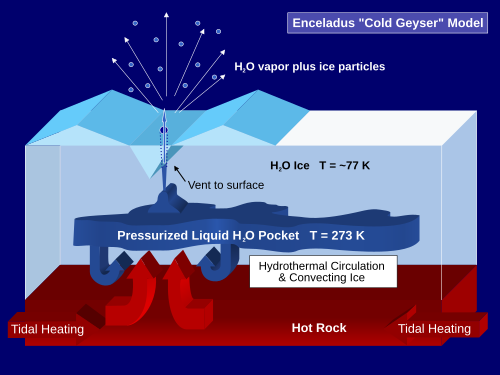
تم اكتشاف ينابيع حارة على إنسيلادوس ، أحد أقمار زحل ، وأوروبا ، أحد أقمار المشتري . [ 44 ] تحتوي هذه الينابيع على بخار الماء، وقد تكون مؤشراً على وجود ماء سائل في أعماق أكبر. [ 45 ] وقد يكون الماء مجرد جليد. [ 46 ] في يونيو 2009، وباستخدام بيانات جمعتها مركبة كاسيني الفضائية التابعة لناسا، لاحظ الباحثون أن إنسيلادوس يتذبذب بطريقة معينة أثناء دورانه حول زحل. وأشار هذا التذبذب إلى أن القشرة الجليدية للقمر لا تمتد إلى نواته، بل تستقر على محيط عالمي، كما استنتج الباحثون. [ 47 ] وفي 3 أبريل 2014، أعلنت ناسا أن مركبة كاسيني الفضائية عثرت على أدلة على وجود محيط جوفي كبير من الماء السائل على إنسيلادوس . بحسب العلماء، تشير الأدلة على وجود محيط جوفي إلى أن إنسيلادوس أحد أكثر الأماكن ترجيحًا في النظام الشمسي لاستضافة حياة ميكروبية . [ 48 ] [ 49 ] وقالت ليندا سبيكر، عالمة مشروع كاسيني في مختبر الدفع النفاث: "تحتوي المواد المنبعثة من تيارات القطب الجنوبي لإنسيلادوس على مياه مالحة وجزيئات عضوية، وهي المكونات الكيميائية الأساسية للحياة. وقد وسّع هذا الاكتشاف نظرتنا إلى "المنطقة الصالحة للسكن" داخل نظامنا الشمسي وفي الأنظمة الكوكبية لنجوم أخرى. [ 2 ] كما تم رصد انبعاثات بخار الماء من عدة مناطق على الكوكب القزم سيريس، [ 50 ] بالإضافة إلى أدلة على نشاط بركاني جليدي مستمر. [ 51 ]
الأدلة الجاذبية
يتفق العلماء على وجود طبقة من الماء السائل تحت سطح أوروبا، وأن الطاقة الحرارية الناتجة عن حركة المد والجزر تسمح لهذا المحيط الجوفي بالبقاء سائلاً. [ 52 ] [ 53 ] وقد ظهرت أولى الدلائل على وجود محيط جوفي من خلال اعتبارات نظرية حول التسخين الناتج عن المد والجزر (نتيجة لمدار أوروبا غير المنتظم قليلاً ورنينه المداري مع أقمار غاليليو الأخرى).
استخدم العلماء قياسات الجاذبية من مركبة كاسيني الفضائية لتأكيد وجود محيط مائي تحت قشرة إنسيلادوس . [ 48 ] [ 49 ] وقد استُخدمت نماذج المد والجزر هذه كنظريات لطبقات المياه في أقمار أخرى من المجموعة الشمسية. ووفقًا لدراسة جاذبية واحدة على الأقل استنادًا إلى بيانات كاسيني، فإن ديون يمتلك محيطًا على عمق 100 كيلومتر تحت سطحه. [ 54 ]
أدت شذوذات في التذبذب المداري لقمر زحل ميمس، بالإضافة إلى نماذج ميكانيكا المد والجزر، إلى اقتراح العلماء في عام 2022 أنه يحوي محيطًا داخليًا. وقد فاجأ هذا الاكتشاف الكثيرين ممن اعتقدوا أنه من المستحيل وجود محيط داخلي على أصغر جسم كروي في النظام الشمسي، والذي كان يُعتقد سابقًا أنه متجمد تمامًا، وأدى إلى تصنيف نوع جديد من "عوالم المحيطات الخفية". [ 55 ] [ 56 ] [ 57 ]
راديو اختراق الأرض

تمكن العلماء من رصد وجود الماء السائل باستخدام الإشارات الراديوية. فقد استُخدم جهاز الرادار ( RADAR ) التابع لمسبار كاسيني للكشف عن وجود طبقة من الماء السائل والأمونيا تحت سطح قمر تيتان التابع لكوكب زحل ، وهو ما يتوافق مع حسابات كثافة القمر. [ 58 ] [ 59 ] وتشير بيانات الرادار المخترق للأرض وبيانات السماحية الكهربائية من جهاز MARSIS على متن مركبة مارس إكسبريس إلى وجود كتلة مستقرة من الماء السائل المالح بعرض 20 كيلومترًا في منطقة بلانوم أوسترال على كوكب المريخ. [ 60 ]
حساب الكثافة

يستطيع علماء الكواكب استخدام حسابات الكثافة لتحديد تكوين الكواكب وإمكانية امتلاكها للماء السائل، على الرغم من أن هذه الطريقة ليست دقيقة للغاية لأن مزيج العديد من المركبات والحالات يمكن أن ينتج عنه كثافات متشابهة.
تشير نماذج كثافة قمر تيتان التابع لكوكب زحل إلى وجود طبقة محيطية تحت سطحه. [ 59 ] وتُعدّ تقديرات الكثافة المماثلة مؤشرات قوية على وجود محيط تحت سطح إنسيلادوس. [ 48 ] [ 49 ]
أشارت التحليلات الأولية لكثافة نيزك 55 Cancri e المنخفضة إلى أنه يتكون من 30% من سائل فوق حرج ، والذي اقترحت ديانا فالنسيا من معهد ماساتشوستس للتكنولوجيا أنه قد يكون على شكل ماء فوق حرج مالح ، [ 61 ] على الرغم من أن التحليل اللاحق لانتقاله فشل في الكشف عن آثار للماء أو الهيدروجين. [ 62 ]
كان الكوكب GJ 1214 b ثاني كوكب خارج المجموعة الشمسية (بعد CoRoT-7b) ذي كتلة ونصف قطر أقل من كواكب المجموعة الشمسية العملاقة. فهو أكبر من الأرض بثلاثة أضعاف، وكتلته أكبر منها بنحو 6.5 مرة. تشير كثافته المنخفضة إلى أنه على الأرجح مزيج من الصخور والماء، [ 63 ] ويبدو أن عمليات الرصد اللاحقة باستخدام تلسكوب هابل تؤكد أن جزءًا كبيرًا من كتلته ماء، مما يجعله عالمًا مائيًا ضخمًا. من شأن درجات الحرارة والضغوط العالية أن تُشكّل مواد غريبة مثل "الجليد الساخن" أو "الماء فائق الميوعة". [ 35 ] [ 36 ]
نماذج الاضمحلال الإشعاعي
تشير نماذج احتفاظ الأجرام الجليدية الصغيرة في النظام الشمسي بالحرارة وتسخينها عبر التحلل الإشعاعي إلى أن ريا ، وتيتانيا ، وأوبرون ، وتريتون ، وبلوتو ، وإيريس ، وسيدنا ، وأوركوس قد تحتوي على محيطات تحت قشور جليدية صلبة يبلغ سمكها حوالي 100 كيلومتر. [ 64 ] ومن الأمور ذات الأهمية الخاصة في هذه الحالات أن النماذج تشير إلى أن الطبقات السائلة على اتصال مباشر بالنواة الصخرية، مما يسمح بخلط المعادن والأملاح بكفاءة في الماء. وهذا على النقيض من المحيطات التي قد توجد داخل الأقمار الجليدية الأكبر حجمًا مثل غانيميد، وكاليستو، وتيتان، حيث يُعتقد أن طبقات من أطوار الجليد عالية الضغط تقع أسفل طبقة الماء السائل. [ 64 ]
تشير نماذج التحلل الإشعاعي إلى أن الكوكب الصغير MOA-2007-BLG-192Lb ، الذي يدور حول نجم صغير، قد يكون دافئًا مثل الأرض ومغطى بالكامل بمحيط عميق جدًا. [ 65 ]
نماذج التمايز الداخلي

تشير نماذج أجرام النظام الشمسي إلى وجود الماء السائل في تمايزها الداخلي.
Some models of the dwarf planetCeres, largest object in the asteroid belt indicate the possibility of a wet interior layer. Water vapor detected to be emitted by the dwarf planet[66][67] may be an indicator, through sublimation of surface ice.
A global layer of liquid water thick enough to decouple the crust from the mantle is thought to be present on Titan, Europa and, with less certainty, Callisto, Ganymede[64] and Triton.[68][69] Other icy moons may also have internal oceans, or have once had internal oceans that have now frozen.[64]
Habitable zone
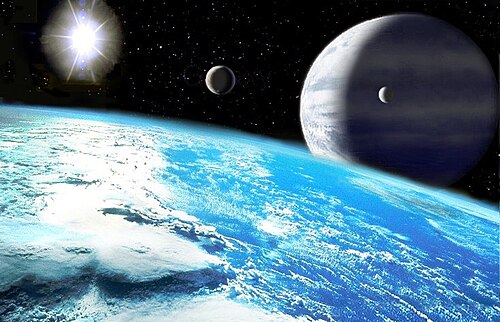
A planet's orbit in the circumstellar habitable zone is a popular method used to predict its potential for surface water at its surface. Habitable zone theory has put forward several extrasolar candidates for liquid water, though they are highly speculative as a planet's orbit around a star alone does not guarantee that it has liquid water. In addition to its orbit, a planetary mass object must have the potential for sufficient atmospheric pressure to support liquid water and a sufficient supply of hydrogen and oxygen at or near its surface.
The Gliese 581 planetary system contains multiple planets that may be candidates for surface water, including Gliese 581c,[70]Gliese 581d, might be warm enough for oceans if a greenhouse effect was operating,[71] and Gliese 581e.[72]
Gliese 667 C has three of them are in the habitable zone[73] including Gliese 667 Cc is estimated to have surface temperatures similar to Earth and a strong chance of liquid water.[74]
Kepler-22b one of the first 54 candidates found by the Kepler telescope and reported is 2.4 times the size of the Earth, with an estimated temperature of 22 °C. It is described as having the potential for surface water, though its composition is currently unknown.[75]
Among the 1,235 possible extrasolar planet candidates detected by NASA's planet-hunting Kepler space telescope during its first four months of operation, 54 are orbiting in the parent star's habitable 'Goldilocks' zone where liquid water could exist.[76] Five of these are near Earth-size.[77]
On 6 January 2015, NASA announced further observations conducted from May 2009 to April 2013 which included eight candidates between one and two times the size of Earth, orbiting in a habitable zone. Of these eight, six orbit stars that are similar to the Sun in size and temperature. Three of the newly confirmed exoplanets were found to orbit within habitable zones of stars similar to the Sun: two of the three, Kepler-438b and Kepler-442b, are near-Earth-size and likely rocky; the third, Kepler-440b, is a super-Earth.[78]
Water rich circumstellar disks
Long before the discovery of water on asteroids, on comets, and on dwarf planets beyond Neptune, the Solar System's circumstellar disks, beyond the snow line, including the asteroid belt and the Kuiper belt were thought to contain large amounts of water and these were believed to be the Origin of water on Earth. Given that many types of stars are thought to blow volatiles from the system through the photoevaporation effect, water content in circumstellar disks and rocky material in other planetary systems are very good indicators of a planetary system's potential for liquid water and a potential for organic chemistry, especially if detected within the planet forming regions or the habitable zone. Techniques such as interferometry can be used for this.
In 2007, such a disk was found in the habitable zone of MWC 480.[79] In 2008, such a disk was found around the star AA Tauri.[80] In 2009, a similar disk was discovered around the young star HD 142527.[81]
In 2013, a water-rich debris disk around GD 61 accompanied by a confirmed rocky object consisting of magnesium, silicon, iron, and oxygen.[82][83] The same year, another water rich disk was spotted around HD 100546 has ices close to the star.[84]
There is no guarantee that the other conditions will be found that allow liquid water to be present on a planetary surface. Should planetary mass objects be present, a single, gas giant, with or without planetary mass moons, orbiting close to the circumstellar habitable zone, could prevent the necessary conditions from occurring in the system. However, it would mean that planetary mass objects, such as the icy bodies of the solar system, could have abundant quantities of liquid within them.
History
Lunar maria are vast basaltic plains on the Moon that were thought to be bodies of water by early astronomers, who referred to them as "seas". Galileo expressed some doubt about the lunar 'seas' in his Dialogue Concerning the Two Chief World Systems.[a]
Before space probes were landed, the idea of oceans on Venus was credible science, but the planet was discovered to be much too hot.
Telescopic observations from the time of Galileo onward have shown that Mars has no features resembling watery oceans. Mars' dryness was long recognized, and gave credibility to the spurious Martian canals.
Ancient water on Venus
NASA's Goddard Institute for Space Studies and others have postulated that Venus may have had a shallow ocean in the past for up to 2 billion years,[85][86][87][88][89] with as much water as Earth.[90] Depending on the parameters used in their theoretical model, the last liquid water could have evaporated as recently as 715 million years ago.[87] Currently, the only known water on Venus is in the form of a tiny amount of atmospheric vapor (20 ppm).[91][92]Hydrogen, a component of water, is still being lost to space as detected by ESA's Venus Express spacecraft.[90]
Evidence of past surface water
بافتراض صحة فرضية الاصطدام العملاق ، لم تكن هناك بحار أو محيطات حقيقية على سطح القمر، ربما فقط القليل من الرطوبة (سائلة أو جليدية) في بعض الأماكن، عندما كان للقمر غلاف جوي رقيق ناتج عن انبعاث الغازات من البراكين أو اصطدام الأجسام الجليدية.
عثر مسبار الفضاء داون على أدلة محتملة على تدفق المياه في الماضي على الكويكب فيستا ، [ 93 ] مما أدى إلى التكهن بوجود خزانات جوفية من جليد الماء. [ 94 ]
يتكهن علماء الفلك بأن كوكب الزهرة كان يحتوي على ماء سائل، وربما محيطات، في بدايات تاريخه. [ 95 ] ونظرًا لأن سطح الزهرة قد أُعيد تشكيله بالكامل بفعل نشاطه الجيولوجي، فإن فكرة وجود محيط بدائي يصعب اختبارها. وقد تُقدم عينات الصخور الإجابة يومًا ما. [ 96 ]
كان يُعتقد سابقًا أن المريخ ربما يكون قد جفّ بعد أن كان أشبه بالأرض. وقد جعل الاكتشاف الأولي لسطح مليء بالفوهات هذا الاحتمال مستبعدًا، لكن أدلة أخرى غيّرت هذا الرأي. فقد يكون الماء السائل قد وُجد على سطح المريخ في الماضي البعيد، واقتُرحت عدة أحواض على سطحه كقيعان بحرية جافة. [ 3 ] أكبرها هو فاستيتاس بوراليس ؛ ومن الأحواض الأخرى هيلاس بلانيتيا وأرغيري بلانيتيا .
يدور جدل واسع حاليًا حول ما إذا كان المريخ قد احتوى في نصفه الشمالي على محيط مائي، وما حدث له إن كان كذلك. تشير نتائج مهمة مركبة استكشاف المريخ الجوالة إلى وجود بعض المياه الراكدة على المدى الطويل في موقع واحد على الأقل، لكن مداها غير معروف. وقد التقطت مركبة "أوبورتيونيتي" الجوالة صورًا لعروق معدنية لامعة، مما أدى إلى تأكيد قاطع لترسب المياه السائلة. [ 97 ]
في 9 ديسمبر 2013، أفادت وكالة ناسا أن كوكب المريخ كان يحتوي على بحيرة كبيرة من المياه العذبة (والتي ربما كانت بيئة مواتية للحياة الميكروبية ) استنادًا إلى أدلة من مركبة كيوريوسيتي الجوالة التي درست إيوليس بالوس بالقرب من جبل شارب في فوهة غيل . [ 98 ] [ 99 ]
الماء السائل على المذنبات والكويكبات
Comets contain large proportions of water ice, but are generally thought to be completely frozen due to their small size and large distance from the Sun. However, studies on dust collected from comet Wild-2 show evidence for liquid water inside the comet at some point in the past.[100] It is yet unclear what source of heat may have caused melting of some of the comet's water ice.
Nevertheless, on 10 December 2014, scientists reported that the composition of water vapor from comet Churyumov–Gerasimenko, as determined by the Rosetta spacecraft, is substantially different from that found on Earth. That is, the ratio of deuterium to hydrogen in the water from the comet was determined to be three times that found for terrestrial water. This makes it very unlikely that water found on Earth came from comets such as comet Churyumov–Gerasimenko according to the scientists.[101][102]
The asteroid 24 Themis was the first found to have water, including liquid pressurised by non-atmospheric means, dissolved into mineral through ionising radiation. Water has also been found to flow on the large asteroid 4 Vesta heated through periodic impacts.[103]
Extrasolar habitable zone candidates for water

Most known extrasolar planetary systems appear to have very different compositions compared to that of the Solar System, though there may be sample bias arising from the detection methods.
The goal of current searches is to find Earth-sized planets in the habitable zone of their planetary systems (also sometimes called the "Goldilocks zone").[105] Planets with oceans could include Earth-sized moons of giant planets, though it remains speculative whether such 'moons' really exist. There is speculation that rocky planets hosting water may be commonplace throughout the Milky Way.[106]
In July 2022, water vapor was detected in the atmosphere of the exoplanet WASP-96b based on spectrum studies with the James Webb Space Telescope.[107] In August 2022, the exoplanet TOI-1452 b was found to have a density consistent with a water-rich composition based on studies with data from the Transiting Exoplanet Survey Satellite (TESS).[108][109]

See also
- Planetary oceanography
- Earth analog
- Water vapor § Extraterrestrial
- List of nearest terrestrial exoplanet candidates
- List of largest lakes and seas in the Solar System
- Ocean world
- Pale Blue Dot
- Planetary habitability
- Super-Earth
- Terrestrial planet
- Water on terrestrial planets of the Solar System
- APM 08279+5255, quasar with a vast amount of water
Bibliography
- Aguilera Mochon, Juan Antonio (2017). El agua en el cosmos[Water in the cosmos] (in Spanish). Spain: RBA. ISBN 978-84-473-9082-3.
References
Explanatory notes
- ↑ 'Salviati', who normally gives Galileo's own opinions, says:
I say then that if there were in nature only one way for two surfaces to be illuminated by the sun so that one appears lighter than the other, and that this were by having one made of land and the other of water, it would be necessary to say that the moon's surface was partly terrene and partly aqueous. But because there are more ways known to us that could produce the same effect, and perhaps others that we do not know of, I shall not make bold to affirm one rather than another to exist on the moon... What is clearly seen in the moon is that the darker parts are all plains, with few rocks and ridges in them, though there are some. The brighter remainder is all fill of rocks, mountains, round ridges, and other shapes, and in particular there are great ranges of mountains around the spots... I think that the material of the lunar globe is not land and water, and this alone is enough to prevent generations and alterations similar to ours.
Citations
- 123Dyches, Preston; Chou, Felcia (7 April 2015). "The Solar System and Beyond is Awash in Water". NASA. Archived from the original on 10 April 2015. Retrieved 8 April 2015.
- 12"Earth". Nineplanets.org. 6 December 2019.
- 12"Mars Probably Once Had A Huge Ocean". Sciencedaily.com. 13 June 2007. Retrieved 22 January 2012.
- ↑Owen, James (28 November 2007). "Venus Craft Reveals Lightning, Supports Watery Past". National Geographic News. Archived from the original on 30 November 2007. Retrieved 7 September 2016.
- ↑NASA (18 June 2020). "Are planets with oceans common in the galaxy? It's likely, NASA scientists find". EurekAlert!. Archived from the original on 21 June 2020. Retrieved 20 June 2020.
- ↑Shekhtman, Lonnie; et al. (18 June 2020). "Are Planets with Oceans Common in the Galaxy? It's Likely, NASA Scientists Find". NASA. Retrieved 20 June 2020.
- ↑Aguilera Mochon, p. 8
- ↑Aguilera Mochon, p. 12
- ↑Aguilera Mochon, p. 18
- 12Hall, Shannon (2015). "Our Solar System Is Overflowing with Liquid Water [Graphic]". Scientific American. 314 (6): 14–15. doi:10.1038/scientificamerican0116-14. PMID 27196829.
- ↑Steep Slopes on Mars Reveal Structure of Buried Ice. NASA Press Release. 11 January 2018.
- 12"NASA Mars Spacecraft Reveals a More Dynamic Red Planet". NASA JPL. 10 December 2013. Archived from the original on 14 December 2013. Retrieved 12 December 2014.
- ↑Sample, Ian (28 September 2015). "Nasa scientists find evidence of flowing water on Mars". The Guardian. Retrieved 28 September 2015.
- ↑Wall, Mike (28 September 2015). "Salty Water Flows on Mars Today, Boosting Odds for Life". Space.com. Retrieved 28 September 2015.
- ↑Ojha, Lujendra; Wilhelm, Mary Beth; Murchie, Scott L.; McEwen, Alfred S.; et al. (28 September 2015). "Spectral evidence for hydrated salts in recurring slope lineae on Mars". Nature Geoscience. 8 (11): 829–832. Bibcode:2015NatGe...8..829O. doi:10.1038/ngeo2546.
- 123Orosei, R.; et al. (25 July 2018). "Radar evidence of subglacial liquid water on Mars". Science. 361 (6401): 490–493. arXiv:2004.04587. Bibcode:2018Sci...361..490O. doi:10.1126/science.aar7268. PMID 30045881.
- ↑Chang, Kenneth; Overbye, Dennis (25 July 2018). "A Watery Lake Is Detected on Mars, Raising the Potential for Alien Life". The New York Times. Retrieved 25 July 2018.
- ↑Halton, Mary (25 July 2018). "Liquid water 'lake' revealed on Mars". BBC News.
- ↑"Tidal Heating". Archived from the original on 29 March 2006.
- ↑Adamu, Zaina (1 October 2012). "Water near surface of a Jupiter moon only temporary". Light Years blog. CNN. Archived from the original on 3 December 2014. Retrieved 12 December 2014.
- ↑Wagstaff, Keith (15 September 2015). "Saturn's Moon Enceladus Is Home to a Global Ocean". NBC News. Retrieved 3 October 2015.
- ↑Lainey, V.; Rambaux, N.; Tobie, G.; Cooper, N.; Zhang, Q.; Noyelles, B.; Baillié, K. (7 February 2024). "A recently formed ocean inside Saturn's moon Mimas". Nature. 626 (7998). Springer Science and Business Media LLC: 280–282. Bibcode:2024Natur.626..280L. doi:10.1038/s41586-023-06975-9. ISSN 0028-0836. PMID 38326592.
- ↑"NASA's Hubble Observations Suggest Underground Ocean on Jupiter's Largest Moon". NASA. 12 March 2015.
- ↑McCord, T. B.; Sotin, C. (21 May 2005). "Ceres: Evolution and current state". Journal of Geophysical Research: Planets. 110 (E5): E05009. Bibcode:2005JGRE..110.5009M. doi:10.1029/2004JE002244.
- ↑Redd, Nola Taylor. "Water Ice on Ceres Boosts Hopes for Buried Ocean [Video]". Scientific American. Retrieved 7 April 2016.
- ↑Carey, Bjorn (7 September 2005). "Largest Asteroid Might Contain More Fresh Water than Earth". Space.com. Archived from the original on 18 December 2010. Retrieved 16 August 2006.
- ↑"Water Detected on Dwarf Planet Ceres". NASA Science News. 22 January 2014.
- ↑Skibba, Ramin (1 September 2016). "Giant ice volcano spotted on dwarf planet Ceres". Nature. doi:10.1038/nature.2016.20526. ISSN 0028-0836. S2CID 131884543.
- ↑Ruesch, O.; Platz, T.; Schenk, P.; et al. (2 September 2016). "Cryovolcanism on Ceres". Science. 353 (6303) aaf4286. Bibcode:2016Sci...353.4286R. doi:10.1126/science.aaf4286. PMID 27701087.
- ↑NASA Completes Study of Future 'Ice Giant' Mission ConceptsArchived 6 August 2020 at the Wayback Machine. NASA TV. 20 June 2017.
- ↑NASA, On to the Ice Giants. (PDF) Pre-Decadal study summary, presented at the European Geophysical Union, 24 April 2017.
- ↑Wiktorowicz, Sloane J.; Ingersoll, Andrew P. (2007). "Liquid water oceans in ice giants". Icarus. 186 (2): 436–447. arXiv:astro-ph/0609723. Bibcode:2007Icar..186..436W. doi:10.1016/j.icarus.2006.09.003. ISSN 0019-1035. S2CID 7829260.
- ↑Rabie, Passant (22 June 2020). "New Evidence Suggests Something Strange and Surprising About Pluto". Inverse. Retrieved 23 June 2020.
- ↑Bierson, Carver; et al. (22 June 2020). "Evidence for a hot start and early ocean formation on Pluto". Nature Geoscience. 769 (7): 468–472. Bibcode:2020NatGe..13..468B. doi:10.1038/s41561-020-0595-0. S2CID 219976751. Retrieved 23 June 2020.
- 12"Distant 'water-world' confirmed". BBC News. 21 February 2012. Retrieved 3 October 2015.
- 12European Space Agency (ESA) (21 February 2012). "Hubble Reveals a New Class of Extrasolar Planet". ScienceDaily. Retrieved 3 October 2015.
- ↑Fitzpatrick, Garret (12 February 2013). "How Jupiter Moon Europa's Underground Ocean Was Discovered". Space.com.
- ↑"Europa: In Depth". NASA Science.
- ↑Gold, T. (1992). "The deep, hot biosphere". Proceedings of the National Academy of Sciences. 89 (13): 6045–6049. Bibcode:1992PNAS...89.6045G. doi:10.1073/pnas.89.13.6045. ISSN 0027-8424. PMC 49434. PMID 1631089.
- ↑"The Case of the Missing Mars Water". Science@NASA. 5 January 2001. Archived from the original on 27 March 2009. Retrieved 7 March 2009.
- ↑"Water on Mars: Where is it All?". Adler Planetarium. Archived from the original on 10 August 2006. Retrieved 7 March 2009.
- ↑"Water at Martian south pole". ESA. 17 March 2004. Retrieved 29 September 2009.
- ↑ دوكسبوري، ن. س.؛ زوتيكوف، إ. أ.؛ نيلسون، ك. هـ.؛ رومانوفسكي، ف. إ.؛ كارسي، ف. د. (2001). "نموذج عددي لأصل بديل لبحيرة فوستوك وآثاره البيولوجية الفلكية على المريخ" . مجلة البحوث الجيوفيزيائية . 106 (E1): 1453. Bibcode : 2001JGR...106.1453D . doi : 10.1029/2000JE001254 .
- ↑ كوك، جيا-روي سي؛ غوترو، روب؛ براون، دواين؛ هارينغتون، جيه دي؛ فون، جو (12 ديسمبر 2013). "هابل يرصد أدلة على وجود بخار الماء على قمر المشتري" . ناسا . تم الاطلاع عليه بتاريخ 12 ديسمبر 2013 .
- ↑ «صور كاسيني لإنسيلادوس تشير إلى ثوران ينابيع حارة من الماء السائل عند القطب الجنوبي للقمر» . مختبر كاسيني المركزي للتصوير (CICLOPS) . 9 مارس 2006. مؤرشف من الأصل في 13 مارس 2012. تم الاطلاع عليه في 22 يناير 2012 .
- ↑ جامعة إلينوي في أوربانا-شامبين (17 أغسطس 2007). "من غير المرجح أن يؤوي قمر زحل إنسيلادوس حياة" . ساينس ديلي . تم الاطلاع عليه بتاريخ 22 يناير 2012 .
- ↑ بالدوين، إميلي (25 يونيو 2009). "محيط مالح محتمل مخفي في أعماق قمر زحل" . أسترونومي ناو . مؤرشف من الأصل في 19 ديسمبر 2009. تم الاطلاع عليه في 22 يناير 2012 .
- 1 2 3 بلات، جين؛ بيل، برايان (3 أبريل 2014). "أصول ناسا الفضائية تكتشف محيطًا داخل قمر زحل" . ناسا . تم الاسترجاع في 3 أبريل 2014 .
- 1 2 3 إيس، إل؛ ستيفنسون، دي جي؛ باريسي، م.؛ همنغواي، د.؛ جاكوبسون، را؛ لونين، جوناثان الأول. نيمو، ف. ارمسترونج، جي دبليو. أسمر، جنوب غرب؛ دوتشي، م.؛ تورتورا، ب. (4 أبريل 2014). “مجال الجاذبية والبنية الداخلية لإنسيلادوس” (PDF) . علوم . 344 (6179): 78– 80. بيب كود : 2014Sci...344...78I . دوى : 10.1126/science.1250551 . بميد 24700854 . S2CID 28990283 .
- ↑ أخبار ناسا العلمية: اكتشاف الماء على الكوكب القزم سيريس ، بقلم محرر الإنتاج: توني فيليبس | حقوق الصورة: Science@NASA. ٢٢ يناير ٢٠١٤
- ↑ سوري، مايكل م.؛ بيرن، شين؛ بلاند، مايكل ت.؛ برامسون، علي م.؛ إرماكوف، أنطون إ.؛ هاميلتون، كريستوفر و.؛ أوتو، كاتارينا أ.؛ رويش، أوتافيانو؛ راسل، كريستوفر ت. (2017). "البراكين الجليدية المتلاشية لسيريس" (ملف PDF) . رسائل البحوث الجيوفيزيائية . 44 (3): 1243-1250 . Bibcode : 2017GeoRL..44.1243S . doi : 10.1002/2016GL072319 . hdl : 10150/623032 . ISSN 0094-8276 . S2CID 52832191 .
- ↑ "التسخين المدّي" . geology.asu.edu . مؤرشف من الأصل في 29 مارس 2006.
- ↑ غرينبيرغ، ريتشارد (2005). أوروبا: قمر المحيط: البحث عن محيط حيوي غريب . سبرينغر + براكسيس بوكس. ISBN 978-3-540-27053-9.
- ↑ بيوث، ميكائيل؛ ريفولديني، أتيليو؛ ترينه، أنتوني (2016). "الأغلفة الجليدية العائمة لإنسيلادوس وديون مدعومة بتوازن الإجهاد الأدنى". رسائل البحوث الجيوفيزيائية . 43 (19): 10088-10096 . arXiv : 1610.00548 . Bibcode : 2016GeoRL..4310088B . doi : 10.1002/2016GL070650 . ISSN 0094-8276 . S2CID 119236092 .
- ↑ رودن، أليسا روز؛ ووكر، ماثيو إي. (2022). "حالة وجود محيط في ميماس من خلال تحليل التسخين المدّي" . إيكاروس . 376 114872. إلسيفير بي في. رمز Bibcode : 2022Icar..37614872R . doi : 10.1016/j.icarus.2021.114872 . ISSN 0019-1035 . S2CID 245718864 .
- ↑ «عالم من معهد ساوث ويست للأبحاث يكشف أدلة على وجود محيط داخلي في قمر صغير تابع لكوكب زحل» . معهد ساوث ويست للأبحاث (بيان صحفي). ١٩ يناير ٢٠٢٢. تاريخ الاطلاع: ٢٠ يناير ٢٠٢٢ .
- ↑ تشانغ، كينيث (21 يناير 2022). "قد يكمن محيط داخل قمر ميماس الجليدي التابع لكوكب زحل - بحث جديد يُقنع بعض المتشككين بأن هذا القمر الجليدي الصغير قد يكون مليئًا بالسوائل" . صحيفة نيويورك تايمز . تاريخ الاطلاع: 22 يناير 2022 .
- ↑Shiga, David (11 June 2007). "Mysterious signal hints at subsurface ocean on Titan". New Scientist. Retrieved 22 January 2012.
- 12Briggs, Helen (20 March 2008). "Saturn moon may have hidden ocean". BBC News. Retrieved 22 January 2012.
- ↑Orosei, R.; Lauro, S. E.; Pettinelli, E.; et al. (2018). "Radar evidence of subglacial liquid water on Mars". Science. 361 (6401): 490–493. arXiv:2004.04587. Bibcode:2018Sci...361..490O. doi:10.1126/science.aar7268. ISSN 0036-8075. PMID 30045881.
- ↑Grossman, Lisa (18 November 2011). "Astrophile: Supercritical water world does somersaults". New Scientist. Retrieved 22 January 2012.
- ↑Ehrenreich, David; Bourrier, Vincent; Bonfils, Xavier; Lecavelier des Étangs, Alain; Hébrard, Guillaume; Sing, David K.; Wheatley, Peter J.; Vidal-Madjar, Alfred; Delfosse, Xavier; Udry, Stéphane; Forveille, Thierry (1 November 2012). "Hint of a transiting extended atmosphere on 55 Cancri b". Astronomy & Astrophysics. 547: A18. arXiv:1210.0531. Bibcode:2012A&A...547A..18E. doi:10.1051/0004-6361/201219981. ISSN 0004-6361.
- ↑Cooper, Keith (17 December 2009). "The small planet with a thick coat". Astronomy Now. Retrieved 22 January 2012.
- 1234Hussmann, Hauke; Sohl, Frank; Spohn, Tilman (November 2006). "Subsurface oceans and deep interiors of medium-sized outer planet satellites and large trans-neptunian objects". Icarus. 185 (1): 258–273. Bibcode:2006Icar..185..258H. doi:10.1016/j.icarus.2006.06.005.
- ↑University of Notre Dame (3 June 2008). "Small Planet Discovered Orbiting Small Star". ScienceDaily. Retrieved 22 January 2012.
- ↑Küppers, Michael; O'Rourke, Laurence; Bockelée-Morvan, Dominique; Zakharov, Vladimir; Lee, Seungwon; von Allmen, Paul; Carry, Benoît; Teyssier, David; Marston, Anthony; Müller, Thomas; Crovisier, Jacques; Barucci, M. Antonietta; Moreno, Raphael (2014). "Localized sources of water vapour on the dwarf planet (1) Ceres". Nature. 505 (7484): 525–527. Bibcode:2014Natur.505..525K. doi:10.1038/nature12918. ISSN 0028-0836. PMID 24451541. S2CID 4448395.
- ↑Harrington, J.D. (22 January 2014). "Herschel Telescope Detects Water on Dwarf Planet - Release 14-021". NASA. Retrieved 22 January 2014.
- ↑McKinnon, William B.; Kirk, Randolph L. (2007). "Triton". In Lucy Ann Adams McFadden; Lucy-Ann Adams; Paul Robert Weissman; Torrence V. Johnson (eds.). Encyclopedia of the Solar System (2nd ed.). Amsterdam; Boston: Academic Press. pp. 483–502. ISBN 978-0-12-088589-3.
- ↑Javier Ruiz (December 2003). "Heat flow and depth to a possible internal ocean on Triton"(PDF). Icarus. 166 (2): 436–439. Bibcode:2003Icar..166..436R. doi:10.1016/j.icarus.2003.09.009. Archived from the original(PDF) on 12 December 2019. Retrieved 5 January 2019.
- ↑Than, Ker (24 April 2007). "New Planet Could Harbor Water and Life". Space.com. Retrieved 22 January 2012.
- ↑Than, Ker (18 June 2007). "Scientists might have picked right star, wrong world for hosting life". NBC News. Retrieved 22 January 2012.
- ↑"Exoplanet near Gliese 581 star 'could host life'". BBC News. 17 May 2011. Retrieved 22 January 2012.
- ↑European Southern Observatory (ESO) (25 June 2013). "Three Planets in Habitable Zone of Nearby Star: Gliese 667c Reexamined". ScienceDaily. Retrieved 3 October 2015.
- ↑Baldwin, Emily (2 February 2012). "Super-Earth orbits in habitable zone of cool star". Astronomy Now. Retrieved 3 October 2015.
- ↑"Kepler 22-b: Earth-like planet confirmed". BBC News. 5 December 2011. Retrieved 22 January 2012.
- ↑Harwood, William (2 February 2011). "Kepler detects more than 1,200 possible planets". Spaceflight Now. Retrieved 22 January 2012.
- ↑Lissauer, Jack J.; Fabrycky, Daniel C.; Ford, Eric B.; et al. (2 February 2011). "NASA Finds Earth-Size Planet Candidates in Habitable Zone, Six Planet System". Nature. 470 (7332): 53–8. arXiv:1102.0291. Bibcode:2011Natur.470...53L. doi:10.1038/nature09760. PMID 21293371. S2CID 4388001. Retrieved 22 January 2012.
- ↑Clavin, Whitney; Chou, Felicia; Johnson, Michele (6 January 2015). "NASA's Kepler Marks 1,000th Exoplanet Discovery, Uncovers More Small Worlds in Habitable Zones". NASA. Retrieved 6 January 2015.
- ↑Eisner, J. A. (2007). "Water vapour and hydrogen in the terrestrial-planet-forming region of a protoplanetary disk". Nature. 447 (7144): 562–564. arXiv:0706.1239. Bibcode:2007Natur.447..562E. doi:10.1038/nature05867. ISSN 0028-0836. PMID 17538613. S2CID 4362195.
- ↑ كار، جيه إس؛ ناجيتا، جيه آر (2008). "الجزيئات العضوية والماء في منطقة تكوين الكواكب في الأقراص النجمية الشابة". مجلة ساينس . 319 (5869): 1504-1506 . رمز Bibcode : 2008Sci...319.1504C . doi : 10.1126/science.1153807 . ISSN 0036-8075 . PMID 18339932. S2CID 1125520 .
- ↑ هوندا، م.؛ إينوي، أ.ك.؛ فوكاغاوا، م.؛ وآخرون (2009). "الكشف عن حبيبات جليد الماء على سطح القرص المحيط بالنجم Hd 142527" . المجلة الفيزيائية الفلكية . 690 (2): L110– L113. Bibcode : 2009ApJ...690L.110H . doi : 10.1088/0004-637X/690/2/L110 . ISSN 0004-637X .
- ↑ جامعة كامبريدج (10 أكتوبر 2013). "اكتشاف كويكب مائي في نجم يحتضر يشير إلى وجود كواكب خارجية صالحة للسكن" . Phys.org . تاريخ الاطلاع: 12 أكتوبر 2013 .
- ↑ ماك، إريك (17 أكتوبر 2011). "كويكبات رطبة مكتشفة حديثًا تشير إلى وجود كواكب شبيهة بالأرض بعيدة المدى | كريف - سي نت" . News.cnet.com . تم الاطلاع عليه بتاريخ 12 أكتوبر 2013 .
- ↑ هوندا، م.؛ كودو، ت.؛ تاكاتسوكي، س.؛ وآخرون (2016). "جليد الماء على سطح قرص Hd 100546" . المجلة الفيزيائية الفلكية . 821 (1): 2. arXiv : 1603.09512 . Bibcode : 2016ApJ...821....2H . doi : 10.3847/0004-637X/821/1/2 . ISSN 1538-4357 . S2CID 119275458 .
- ↑ هاشيموتو، جي إل؛ روس-سيروت، إم؛ سوجيتا، إس؛ وآخرون (2008). "قشرة مرتفعة فلسية على كوكب الزهرة كما تشير بيانات مطياف رسم الخرائط بالأشعة تحت الحمراء القريبة لمركبة غاليليو" . مجلة البحوث الجيوفيزيائية: الكواكب . 113 (E9): E00B24. رمز Bibcode : 2008JGRE..113.0B24H . doi : 10.1029/2008JE003134 .
- ↑ شيغا، ديفيد (10 أكتوبر 2007). "هل احتضنت محيطات الزهرة القديمة الحياة؟" . مجلة نيو ساينتست .
- 1 2 واي، مايكل جيه؛ وآخرون . (26 أغسطس 2016). "هل كان كوكب الزهرة أول عالم صالح للسكن في نظامنا الشمسي؟" . رسائل البحوث الجيوفيزيائية . 43 (16): 8376-8383 . arXiv : 1608.00706 . Bibcode : 2016GeoRL..43.8376W . doi : 10.1002/2016GL069790 . PMC 5385710. PMID 28408771 .
- ↑ كابيج، مايكل؛ مكارثي، ليزلي (11 أغسطس 2016). "تشير نماذج ناسا المناخية إلى أن كوكب الزهرة ربما كان صالحًا للسكن" . ناسا . تم الاطلاع عليه في 19 نوفمبر 2016 .
- ↑ هول، شانون (10 أغسطس 2016). "ربما كان كوكب الزهرة الجهنمي صالحًا للسكن لمليارات السنين" . مجلة ساينتفك أمريكان . تم الاطلاع عليه بتاريخ 19 نوفمبر 2016 .
- 1 2 "أين ذهب ماء كوكب الزهرة؟" . وكالة الفضاء الأوروبية . 18 ديسمبر 2008. تم الاطلاع عليه في 19 نوفمبر 2016 .
- ↑ باسيلفسكي، ألكسندر ت.؛ هيد، جيمس و. (2003). "سطح الزهرة". تقرير التقدم في الفيزياء 66 ( 10): 1699-1734 . Bibcode : 2003RPPh...66.1699B . doi : 10.1088/0034-4885/66/10/R04 . S2CID 250815558 .
- ↑ بيرتو، جان لوب؛ فانديل، آن كارين؛ كورابليف، أوليغ؛ وآخرون (2007). "طبقة دافئة في الغلاف الجليدي لكوكب الزهرة وقياسات عالية الارتفاع لـ HF وHCl وH2O وHDO" (ملف PDF) . مجلة نيتشر . 450 (7170): 646-649 . Bibcode : 2007Natur.450..646B . doi : 10.1038/ nature05974 . hdl : 2268/29200 . PMID 18046397. S2CID 4421875 .
- ↑ آموس، جوناثان (6 ديسمبر 2012). "مسبار داون يرصد أخاديد محتملة ناتجة عن قطع المياه على فيستا" . بي بي سي نيوز . تم الاطلاع عليه في 3 أكتوبر 2015 .
- ↑ "قد يكون الكويكب الضخم فيستا مليئًا بالجليد المائي" . Space.com . 26 يناير 2012. تم الاطلاع عليه في 3 أكتوبر 2015 .
- ↑ أوين، جيمس (28 نوفمبر 2007). "مركبة فينوس تكشف عن البرق، وتدعم ماضيها المائي" . أخبار ناشيونال جيوغرافيك . مؤرشف من الأصل في 30 نوفمبر 2007.
- ↑ "هل احتضنت محيطات كوكب الزهرة حياة؟". مجلة نيو ساينتست . 196 (2626): 22. 2007. doi : 10.1016/S0262-4079(07)62635-9 . ISSN 0262-4079 .
- ↑ ويبستر، جاي (7 ديسمبر 2011). "مركبة ناسا الجوالة على سطح المريخ تعثر على عرق معدني ترسب بفعل الماء" . مختبر الدفع النفاث التابع لناسا. مؤرشف من الأصل في 20 أكتوبر 2020. تم الاطلاع عليه في 22 يناير 2012 .
- ↑ تشانغ، كينيث (9 ديسمبر 2013). "على المريخ، بحيرة قديمة وربما حياة" . صحيفة نيويورك تايمز . تم الاطلاع عليه في 9 ديسمبر 2013 .
- ↑ "كيوريوسيتي المريخ" . ساينس (نتائج البحث). 9 ديسمبر 2013. تم الاطلاع عليه في 9 ديسمبر 2013 .
- ↑ بيرغر، إيف ل.؛ زيغا، توماس ج.؛ كيلر، ليندسي ب.؛ لوريتا، دانتي س. (5 أبريل 2011). "الماضي المائي لمذنب متجمد: اكتشاف يتحدى النموذج السائد للمذنبات باعتبارها "كرات ثلجية قذرة" متجمدة في الزمن" . مجلة جيوكيميكا إت كوزموكيميكا أكتا . 75 (12): 3501. رمز Bibcode : 2011GeCoA..75.3501B . doi : 10.1016/j.gca.2011.03.026 . تاريخ الاسترجاع: 22 يناير 2012 .
- ^ آجل ، دي سي. باور، ماركوس (10 ديسمبر 2014). "أداة روزيتا تُشعل الجدل حول محيطات الأرض" . ناسا . تم الاسترجاع 10 ديسمبر 2014 .
- ↑ تشانغ، كينيث (10 ديسمبر 2014). "بيانات المذنب تُنهي الجدل حول مياه الأرض" . صحيفة نيويورك تايمز . تاريخ الاسترجاع: 10 ديسمبر 2014 .
- ↑ دي سانكتيس، إم سي؛ كومب، جيه-فيه؛ أمانيتو، إي؛ وآخرون (2012). "الكشف عن مواد مائية واسعة الانتشار على فيستا بواسطة مطياف التصوير بالأشعة تحت الحمراء المرئية على متن مهمة دون " . المجلة الفيزيائية الفلكية . 758 (2): L36. Bibcode : 2012ApJ...758L..36D . doi : 10.1088/2041-8205/758/2/L36 . ISSN 2041-8205 .
- ↑ «العوالم المائية شائعة: قد تحتوي الكواكب الخارجية على كميات هائلة من الماء» . Phys.org . ١٧ أغسطس ٢٠١٨. تم الاطلاع عليه بتاريخ ١٧ أغسطس ٢٠١٨ .
- ↑ غارليك، مارك أ. (3 يناير 2003). "قد تكون الكواكب الصالحة للسكن شائعة" . مجلة نيو ساينتست . تم الاطلاع عليه بتاريخ 22 يناير 2012 .
- ↑ بالدوين، إميلي (13 أبريل 2011). "الماء، الماء في كل مكان" . علم الفلك الآن . مؤرشف من الأصل في 22 يوليو 2011. تم الاسترجاع في 22 يناير 2012 .
- 1 2 سيزاري، ثاديوس (11 يوليو 2022). "ناسا تنشر قائمة الأهداف الكونية لأولى صور تلسكوب جيمس ويب" . ناسا . مؤرشف من الأصل في 12 يوليو 2022. تم الاطلاع عليه في 19 سبتمبر 2022 .
- ^ ديبريس ، سال (24 أغسطس 2022). "عالم خارج المجموعة الشمسية مغطى بالمياه؟" . جامعة مونتريال . تم الاسترجاع في 19 سبتمبر 2022 .
- ↑ برينان، بات (24 أغسطس 2022). "تنبيه اكتشاف: قد يحظى كوكب "الأرض العملاقة" الجديد والمثير للاهتمام بنظرة أقرب" . ناسا . تم الاسترجاع في 19 سبتمبر 2022 .
روابط خارجية
- موسوعة الكواكب الخارجية
- علم الفلك والفيزياء الفلكية (14 ديسمبر 2007). "غليس 581: كوكب خارج المجموعة الشمسية قد يكون صالحًا للسكن بالفعل" . ساينس ديلي .
- جامعة تكساس في أوستن (14 ديسمبر 2007). "قمر أوروبا التابع لكوكب المشتري: ماذا يمكن أن يكون تحت الجليد؟" . ساينس ديلي .
- جامعة فلوريدا (24 ديسمبر 2007). "بالنسبة للكائنات الفضائية الفضولية، ستبرز الأرض ككوكب حي" . ساينس ديلي .
- جامعة ولاية أوهايو (16 ديسمبر 2008). "كواكب تحتوي على محيطات: البحث عن حياة خارج كوكب الأرض في جميع الأماكن المناسبة" . ساينس ديلي .
- مياه خارج الأرض
- ماء
- قابلية الكواكب للسكن