
Gwanak District
Gwanak District (Korean: 관악구;RR: Gwanak-gu) is one of the 25 districts (gu) of Seoul, South Korea. It lies on the southern skirt of Seoul, bordering Anyang, Gyeonggi Province. The southern border of Gwanak District, bordering Anyang, consists of the craggy ridgeline of Gwanaksan (Mt. Gwanak), which dominates the local geography.
Originally a part of Siheung, Gyeonggi Province, it was transferred to Seoul with the rapid expansion of the National Capital Area and its population growth in 1960s. Partitioned from Yeongdeungpo District and established as a district in 1973, it now neighbours the Seocho, Dongjak, Guro, and Geumcheon Districts, and exercises jurisdiction over 21 neighborhoods (dong), with a population of 500,000.
Overview
Gwanak District is densely populated with over 500,000 people. While it was once a rural area dominated by the presence of Gwanaksan (Mt. Gwanak), population booms in the late 1950s and early 1960s, accompanied by rapid industrialization of the capital area, quickly changed the town into a mosaic of dense residential and industrial areas. Large slum quarters were formed by migrant populations from all over Korea who sought jobs in industrialized Seoul. A series of redevelopment projects starting in the 1970s, and the relocation of Seoul National University to the district, led to a reduction of slum quarters and indigent textile industries and transformed the town into a residential uptown neighborhood of Seoul. The area is also heavily populated by university students from surrounding provinces.
Commercial zones
Central commercial zones include the Seorim and Daehak area and the Cheongnyong area near Seoul National University. These areas also form a large zone of private dormitories and small houses, which primarily target university students and national examination takers (gosi-saeng) looking for an environment that is favorable for studying. Restaurants, supermarkets, bars and pubs in the area are centered in Nokdu Street (Nokdu-geori) in the Daehak area and near Seoul National University Station. Other commercial zones for residents are located along the Nambu Beltway and two main roads.
The main shopping district, the Bongcheon Central Market (Bongcheon-jungang-sijang), is positioned in Jungang neighborhood, north from Seoul National University Station.
Transportation
Nambu Beltway, which circles Seoul, passes through the very center of the district. The beltway and two main avenues, Gwanak Road (Gwanak-ro) and Sillim Road (Sillim-ro), make the main route of the automobile traffic. Nambu Beltway is connected to multiple expressways.
Public transportation
Green Line (Line 2) and Blue Line (Line 4) of Seoul Metro links Gwanak District and other areas. Many trunk (painted in blue) buses such as 501, 506, 651 and 750 lines, and branch (in green) buses in 5XXX or X5XX line passes Gwanak area.[2]
Metro stations
- Seoul Metro (Seoul Metropolitan Rapid Transit Corporation)
- Seoul Subway Line 2 (Green Line)
- (Dongjak) ← Nakseongdae — Bongcheon — Sillim → (Dongjak)
- Seoul Subway Line 4 (Blue Line)
- Seoul Subway Line 2 (Green Line)
Administrative divisions

There are three statutory subdivisions: Sillim, Bongcheon and Namhyeon neighborhood. Those are further divided into multiple administrative neighborhoods (dong) to balance excessive populations and for administrative expedience. As of September 2008, there are 21 administrative neighborhoods in Gwanak District.[3]
| Statutory neighborhood | Administrative neighborhood | Hangul | Hanja |
|---|---|---|---|
| Sillim | Seowon | 서원 | 書院 |
| Sinwon | 신원 | 新源 | |
| Seorim | 서림 | 西林 | |
| Nangok | 난곡 | 蘭谷 | |
| Sinsa | 신사 | 新士 | |
| Sillim | 신림 | 新林 | |
| Samseong | 삼성 | 三聖 | |
| Nanhyang | 난향 | 蘭香 | |
| Jowon | 조원 | 棗園 | |
| Daehak | 대학 | 大學 | |
| Miseong | 미성 | 美星 | |
| Bongcheon | Euncheon | 은천 | 殷川 |
| Seonghyeon | 성현 | 成賢 | |
| Cheongnyong | 청룡 | 靑龍 | |
| Boramae | 보라매 | No hanja notation | |
| Cheongnim | 청림 | 靑林 | |
| Haengun | 행운 | 幸運 | |
| Nakseongdae | 낙성대 | 落星垈 | |
| Jungang | 중앙 | 中央 | |
| Inheon | 인헌 | 仁憲 | |
| Namhyeon | Namhyeon | 남현 | 南峴 |
Points of interest
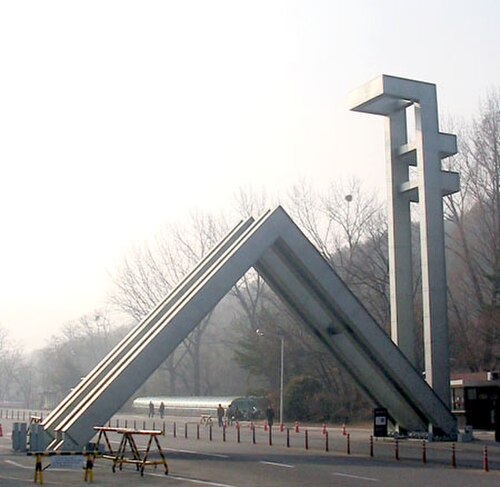
- Seoul National University
- Seoul Museum of Art, South Branch (SeMA Nam-Seoul)
- Former Belgian Consulate Building
- Horim Museum
- Nokdu Street
- Nakseongdae
- Anguk Shrine
- Gwanaksan (Mt. Gwanak)
- Gwaneumsa (in Gwanaksan Park)
Sister cities
 Daxing, Beijing, China
- Tiexi, Shenyang, China
 Royal Kingston, London, United Kingdom
 Montgomery County, Pennsylvania, United States of America
شخصيات بارزة من مقاطعة غواناك
- كانغ كام تشان ، مسؤول حكومي كوري في العصور الوسطى وقائد عسكري خلال الأيام الأولى من عهد مملكة غوريو
- يانغ جونغوون ( 정원 )، مغني وراقص ومعبود كيبوب ، قائد وعضو في فرقة فتيان الكيبوب إنهيبن .
- سولجي (اسمها الحقيقي: هيو سولجي ، 허솔지 )، مغنية وراقصة وعارضة أزياء ونجمة موسيقى البوب الكورية ، وقائدة وعضوة في فرقة الفتيات الكورية EXID وعضوة سابقة في فرقة الأغاني الرومانسية 2NB
- تايونغ (اسمه الحقيقي: لي تايونغ ، 이태용 )، مغني وكاتب أغاني، ومغني راب، وراقص، ونجم موسيقى البوب الكورية ، وقائد وعضو في فرقة فتيان البوب الكورية NCT ، وفرقتيها الفرعيتين NCT U و NCT 127 ، وعضو في فرقة الفتيان الكورية Super M
- هيجو (اسمها الحقيقي: سون هيجو ، 손혜주)، مغنية وراقصة ونجمة موسيقى البوب الكورية ، وعضوة في فرقة الفتيات لونا ، ووحداتها الفرعية لونا واي واي إكس واي ، ولوسيمبل
- ليم نا يونغ ( 임나영 )، مغنية، مغنية راب، راقصة، وممثلة، قائدة سابقة وعضوة في فرقتي الفتيات الكوريتين I.OI و Pristin
- هونغ إيون تشاي ( 홍은채 )، مغنية وراقصة ونجمة موسيقى البوب الكورية ، وعضوة في فرقة الفتيات Le Sserafim التابعة لشركة Source Music ، والمضيفة الحالية لبرنامج KBS Music Bank [ 4 ].
انظر أيضاً
مراجع
- ↑ "خدمة المعلومات الإحصائية الكورية (باللغة الكورية) : السكان والأسر : نتائج التعداد (2010) : السكان حسب المنطقة الإدارية والجنس والعمر / الأجانب حسب المنطقة الإدارية والجنس" . Kosis.kr . تم الاطلاع عليه في 2 يونيو 2010 .
- ↑ "حكومة مدينة سيول الكبرى – "مدينة نظيفة وجذابة وعالمية، سيول!"تمت أرشفة هذا النص من المصدر الأصلي في 23 أغسطس 2008. تم الاطلاع عليه في 23 أغسطس 2008 .
- ↑[ 서울신문 ] "مرحبًا بك في منزلك"صحيفة سيول شينمون . 5 أغسطس 2008. تم الاطلاع عليه بتاريخ 17 يونيو 2017 .
- ↑20 مليون دولار أمريكي 27 مليون دولار أمريكي، 13 أكتوبر 2022 ، تم الاطلاع عليه في 11 سبتمبر 2023
روابط خارجية
- مقاطعة غواناك
- منشآت عام 1973 في كوريا الجنوبية
- أحياء سيول