
قنبوس
القَنبوس ( بالعربية : قنبوس ) هو عود قصير العنق نشأ في اليمن [ 1 ] وانتشر في جميع أنحاء شبه الجزيرة العربية . ويرى ساكس أنه مشتق من الكلمة التركية "كوموز" ، ولكنه أقرب إلى العود . [ 2 ] وترتبط هذه الآلة بالبرباط ، وهو عود ذو غطاء جلدي (ربما) من آسيا الوسطى ، أو ربما تكون من نسله . [ 3 ] يحتوي القَنبوس على 6 أو 7 أوتار من النايلون تُعزف بريشة لإصدار الصوت. وعلى عكس العديد من آلات عائلة العود الأخرى، لا يحتوي القَنبوس على دساتين . تراجعت شعبيته في اليمن خلال أوائل القرن العشرين في عهد الإمام يحيى ؛ وبحلول بداية القرن الحادي والعشرين، حلّ العود محل القَنبوس كآلة مفضلة لعازفي العود في الشرق الأوسط.
مع هجرة اليمن ، انتشرت هذه الآلة الموسيقية إلى مناطق مختلفة من المحيط الهندي . في جنوب شرق آسيا الإسلامية (وخاصة إندونيسيا وماليزيا وبروناي )، حيث عُرفت باسم "غامبوس" ، نشأت منها موسيقى خاصة بها. تُعزف اليوم في رقصة " زابين" التقليدية ، وفي أنواع موسيقية أخرى، مثل الغزل الماليزي ، وفي فرقة موسيقية تُعرف باسم " كومبولان غامبوس " (مجموعة غامبوس). في جزر القمر، تُعرف باسم " غابوسي " ، وفي زنجبار باسم "غابوس " .
في اليمن وسلطنة عمان

القنابس آلة موسيقية تقليدية من اليمن ، تُنحت من قطعة خشب واحدة. تُعزف أيضاً في عُمان، حيث تُسمى جبوس . يُغطى النصف السفلي من سطحها بالجلد، بينما يحتوي النصف العلوي على لوحة صوتية خشبية، غالباً ما تكون بها فتحات صوتية صغيرة. ولها جسر عائم، وصندوق أوتاد على شكل هلال، وعادةً ما تحتوي على 7 أوتار من النايلون أو الأمعاء موزعة على 4 مجموعات، مع كون المجموعة السفلية منفردة. توجد أيضاً نسخ بثلاث مجموعات، بستة أو خمسة أوتار، إلا أنها أقل شيوعاً. [ 5 ]
The Yemeni lute has 7 strings in four courses, tuned low note to high C DD GG CC. The first C string is a single string; strings D G and C are all pairs.[6]
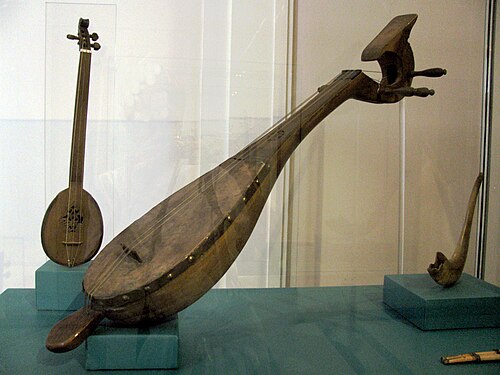 A qanbūs lute in the Kunsthistorisches Museum in Vienna, with 6 strings organized into 3 pairs.
In East Africa
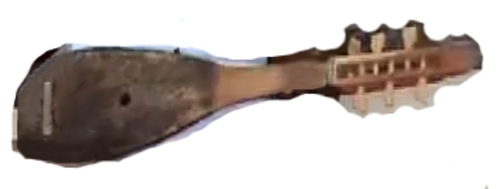
In Kenya and Tanzania, a related instrument was called the Kibangala. It used to be built and strung in the same way as the Qanbus. In the Comoros islands, a related instrument called the Gambusi is played, which is built in the same way but often has a flat-shaped pegbox, rather than the sickle-shape, and sometimes has a differently shaped soundbox. Both usually have 4 courses of strings, which can be double or single.[7][8][9] Several structural nuances exist between the original design (Anjouan, Mwali) and the later avatars in Mayotte.[9] The corrupted pronunciations Gaboussi, Gabusi, or Gaboussa are also found in Mayotte, and obviously preaches for a joined etymology with the Kabosy chordophone in N-W Madagascar.
In Southeast Asia

The word gambus (Jawi: ݢمبوس) covers a variety of instruments, some with skin soundboards, some with wooden soundboards, some that are shaped like the Yemeniquanbūs, and some that are shaped like the Arabian oud. The instruments may have 3, 4 or 5 courses of strings, plus a single base string. To avoid confusion, various descriptors are used in the names by academic researchers.
يوجد في العالم الملاوي نوعان من آلات الغامبوس : غامبوس ملايو وغامبوس حضرموت . ويمكن استخدام مصطلح " غامبوس " للإشارة إلى أيٍّ من هذين النوعين من الآلات، إلا أن هذه الآلات تختلف عن آلات العود البحرية (هاسابي) . وقد نُقلت هذه الآلات من العالم الإسلامي إلى العالم الملاوي في فترة تاريخية غير محددة. وتعود الروابط مع الشرق الأوسط إلى القرنين الخامس والسادس الميلاديين، مع وجود شبكات تجارية واحتلال في القرن الخامس عشر. وقد حدد الخبراء مبدئيًا تاريخ وصول هذه الآلات بين القرنين التاسع والخامس عشر الميلاديين. وفي سياق البحث عن أصولها، لاحظ علماء الموسيقى أيضًا بعض أوجه التشابه مع آلة البيبا الصينية . [ 10 ] [ 11 ]
من المرجح أن نوعي الغامبوس قد وصلا في أوقات مختلفة؛ فالغامبوس الملايوي وصل على الأرجح باسم القوانبوس أو البربات وتطور على مر القرون. أما الغامبوس الحضرموتي فقد تطور على الأرجح في القرن التاسع عشر بعد وصول العود . [ 11 ]
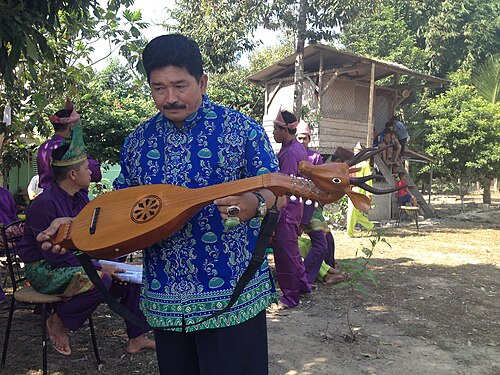
Some modern luthiers in Indonesia and other countries have begun to make hybrid instruments, combining the gambus or dambus (?) with other instruments, such as the ud (Sabah), the Hawaiian ukulele (Flores) or the bluegrass mandoline (Lombok)[9][12][13] The pronunciation dambus is met in Bangka Belitung Islands[14] and also in a limited area from Sukamara Regency and Pangkalan Bun (Central Kalimantan).[15] Elsewhere in Indonesia, some other well known corruptions are Gambusu and Gambusi, respectively observed in Sulawesi and Gorontalo[16]..In Lombok, the mandoline-shaped gambus - actually a vague, fretless copy of Gibson's A-type bluegrass mandoline - is also locally named Manolin [17] which used to accompany Kemidi Rudat plays or Kecimol entertainment.
Gambus Melayu or gambus Hijaz
The gambus Melayu –also known as gambus Hijaz ("Hijazi gambus"), panting, gita nangka, gambus seludang ("palm spathe gambus"), gambus perahu ("perahu gambus"), and gambus biawak – retains a shape similar to the original qanbūs, but equipped with a skin soundboard.[18] The sounds of this gambus accommodate to native Malay music more than its more conservative Hadhramaut counterpart.[10]
Tuning:
- Riau Islands: G3 D4D4 G4G4 C5C5 for wire strings or A3 D4D4 G4G4 C5C5 for nylon strings[10]
- Eastern Sumatra: G AA B DD AA EE (double courses tuned in unison)[19]
- elsewhere in Indonesia and Malay Peninsula: A3 D4D4 G4G4 C5C5[10]
- Brunei: E3E3 A3A3 D4D4[10] or DD GG CC[19]
Gambus Hadhramaut
The gambus Hadhramaut is a gambus that resembles an oud. The name Hadhramaut refers to Eastern Yemen, and this form of the instrument may have arrived in Indonesia (and a wider extent to another Malay world countries) with immigrants from there in the 19th century, joining Muslim communities already established centuries earlier. The bowl is made of light woods, the neck of a hardwood. It has a wooden soundboard.[18] It is a fretless instrument with 11 strings in 6 courses, tuned low note to high:
Gambus Seludang
The Gambus Seludang was another name for the gambus Hijaz with a specific reference to its monoxyle (like boat constructed from a single piece of timber) structure. The name came with the revival in Brunei, Riau and Sabah. In Sabah, this is similar in shape and size to the gambus Hijaz, but features a wooden resonator.[21]
 c. 1871, an ancient gambus originated from Indonesia.
 2014. Gambus Hadhramaut.
 2010, Malaysia. Musician playing gambus Hadhramaut.
 Myanmar. (top row from left): Gambus (or Indonesian: saludang bunta), gambus Melayu, gambus Hadhramaut and gambus Hadhramaut (bottom).[22]
 c. 1939 in Lombok, Indonesia. Penting. "Panting" is another word for the gambus Melayu in South Kalimantan, Indonesia.[10]
 c. 1936 in Halmahera, Indonesia. Gambus originated from Indonesia as the Tropenmuseum collection, Netherlands.
Similar instruments
- Gittern – a medieval European instrument built in the same way, but with a completely wooden soundboard.
See also
Sources
- ↑Urkevich, Lisa (2014). Music and Traditions of the Arabian Peninsula: Saudi Arabia, Kuwait, Bahrain, and Qatar. Routledge. p. 341. ISBN 9781135628161.
- ↑The gambus (lutes) of the Malay world: its origins and significance in zapin Music, Larry Hilarian, Nanyang Technological University, Singapore, 06 Jul 2004
- ↑Hilarian, Larry Francis (2003). "Documentación y rastreo histórico del laúd malayo (gambus)"[Documentation and historical tracking of the Malay lute (gambus)]. Desacatos (in Spanish) (12): 78–92.
El gambus melayu que ahí llegó podría ser, o bien un descendiente directo del barbat persa, o del qanbus yemenita, que a su vez evolucionó del barbat.[translation: The malay gambus that arrived there could be either a direct descendant of the Persian barbat, or the Yemenite qanbus, which in turn evolved from the barbat.]
- ↑Simon Broughton; Mark Ellingham; Richard Trillo (1999). World Music: Africa, Europe and the Middle East. Rough Guides. pp. 505–. ISBN 978-1-85828-635-8. Retrieved 18 September 2012.
- ↑"ATLAS of Plucked Instruments - Middle East". Atlasofpluckedinstruments.com. Retrieved 21 April 2021.
- ↑ سمير مقراني؛ بيير دي هيروفيل. "لاحظ استخدام De La Conservation Du Musee Horniman, La Souche Et Le Luth, Entretien Avec Un Luthier De San'a Par Samir Mokrani & Pierre D' Herouville, Indice : Draft4 Mars 2006" (PDF) . الصفحات 7، 28.
3 خيوط من الحبال المزدوجة + قطعة بسيطة من أجل القنبوس...do-ré-sol-do pour le qanbûs...جان لامبرت دقيق في أن الحبال متناغمة مع الكرواسون: دو، ميتال - ري، بوياو (chœur de 2 في انسجام) – Sol, boyau (chœur de 2 à l'unisson) – Do, boyau (chœur de 2 à l'unisson).
[
الترجمة:
3 أزواج من الأوتار المزدوجة + وتر واحد بسيط للقنابس... دو-ري-صول-دو للقنابس... حدد جان لامبرت في كتابه أن الأوتار يتم ضبطها على النحو التالي، في اتجاه متزايد: دو، معدني - ري، أمعاء (جوقة من 2 في انسجام) - صول، أمعاء (جوقة من 2 في انسجام) - دو، أمعاء (جوقة من 2 في انسجام).]
- ↑ "أطلس الآلات الوترية - أفريقيا" . Atlasofpluckedinstruments.com . تم الاطلاع عليه بتاريخ 21 أبريل 2021 .
- ↑ "قاعدة بيانات الآلات الوترية: JK" . Stringedinstrumentdatabase.aornis.com . تم الاطلاع عليه بتاريخ 21 أبريل 2021 .
- 1 2 3 دي هيروفيل، بيير. "مشروع «غامبوس»" .
- 1 2 3 4 5 6 7 هيلاريان، لاري فرانسيس (مايو 2005). "بنية وتطور آلة الغامبوس (العود الماليزي)" . مجلة جمعية غالپين . 58 : 66-216 . JSTOR 25163827 .
- 1 2 هيلاريان، إل إف (2003). "الغامبوس (العود) في العالم الملاوي". في جيه إس بوينكونسيخو (محرر). بحث في آسيا عن نظرية جديدة للموسيقى: ندوة نظمها مركز الفلبين للإثنوموسيقى كمؤتمر دولي سابع لجمعية آسيا والمحيط الهادئ للإثنوموسيقى (APSE) . مدينة كويزون، الفلبين: مركز جامعة الفلبين للإثنوموسيقى. ص 455-480 .
ربما تطور الغامبوس على مر القرون في العالم الملاوي، ومع ذلك، فإن التشابه اللافت مع القنبوس أو البربات يدعم نظرية أنه كان آلة "مستوردة" وليست أصلية في العالم الملاوي، وإن كانت معدلة ومتكيفة الآن... وصل غامبوس حضرموت إلى العالم الملاوي في وقت لاحق، حيث لم يصل العود إلى
اليمن
إلا في القرن التاسع عشر.
- ↑ "أطلس الآلات الوترية - جنوب شرق آسيا" . Atlasofpluckedinstruments.com . تم الاطلاع عليه بتاريخ 21 أبريل 2021 .
- ↑ "قاعدة بيانات الآلات الوترية: G" . Stringedinstrumentdatabase.aornis.com . تم الاطلاع عليه بتاريخ 21 أبريل 2021 .
- ^ بيير دي هيروفيل. "Le Luth Arabe dans Le Coral Malais" (PDF) . Inthegapbetween.free.fr .
- ^ بيير دي هيروفيل. "الصور الرمزية du luth Gambus à Bornéo" (PDF) . Inthegapbetween.free.fr .
- ^ بيير دي هيروفيل. "Périgrinations du Gambus aux Célèbes et aux Moluques" (PDF) . Inthegapbetween.free.fr .
- ↑ ديفيد هارنيش (2021). التغيير والهوية في الثقافات الموسيقية في لومبوك، إندونيسيا . بريل. ISBN 978-90-04-47260-0.
- 1 2 فضيلة جونيدين. "غامبوس حضرموت للإنشاءات" (PDF) . Inthegapbetween.free.fr .
- 1 2 لاري فرانسيس هيلاريان. “العود الشعبي (الغامبوس) وتعبيره الرمزي في الثقافة الإسلامية الماليزية”. Studia Instrumentorum Musicae Popularis XVI Tarptautinės tradicinės muzikos tarybos Liaudies muzikos Instrumentų tyrimų groupės XVI tarptautinės conferencijos straipsniai / ICTM مجموعة دراسة الآلات الموسيقية الشعبية وقائع الاجتماع الدولي السادس عشر . جامعة نانيانغ التكنولوجية / المعهد الوطني للتعليم، سنغافورة. ص. 56.
- 1 2 3 4 جوزيف م. كينزر (2017). أجساد الصوت، عوامل الهوية الماليزية الإسلامية: سياسات الهوية الماليزية والبيئة الرمزية لآلة العود غامبوس (أطروحة). جامعة واشنطن.
- ↑ بيير ديروفيل. "إنشاءات غامبوس سيلودانغ، الإصدار 12-13" (ملف PDF) .
غامبوس سيلودانغ، آلة موسيقية بروناوية أحادية الأسطوانة، هي عائلة تصميم محلية مشتركة بين بروناي وصباح. يُذكر أن اسم "سيلودانغ" كان لقبًا محليًا قديمًا لغامبوس حجاز، لكن تقنيات الصنع والتركيب الموسيقي في بروناي - السمة المميزة الواضحة هي لوحة الصوت الخشبية بالكامل...
- ↑ دي هيروفيل، بيير. "إنشاءات غامبوس سيلودانغ" (ملف PDF) . مشروع «العملية» . ص 4.
مراجع
- بوش، كريستيان. "قنبوس". غروف ميوزيك أونلاين (يتطلب اشتراكًا). تحرير ل. ماسي. تم الاطلاع عليه بتاريخ 15 أغسطس 2007.
- جامبوس - الآلات الموسيقية الماليزية
- تشارلز كابويل، المظاهر المعاصرة للأغنية والرقص المشتقين من اليمن في إندونيسيا ، حولية الموسيقى التقليدية ، المجلد 27، (1995)، الصفحات 76-89
- Kinzer, Joe. "The Agency of a Lute: Post-Field Reflections on the Materials of Music." Blog post. Ethnomusicology Review: Notes from the Field. UCLA,2016.
External links
Further reading
- Qanbus, Kigangala, & Gabusi: A Portfolio. Monoxyle Lutes/Index v.21 March 2016
- Music of Southeast Asia
- Arabic musical instruments
- Bruneian musical instruments
- Comorian musical instruments
- Indonesian musical instruments
- Malaysian musical instruments
- Yemeni musical instruments
- Arab inventions
- Necked bowl lutes