
Parallel and cross cousins
In discussing consanguinealkinship in anthropology, a parallel cousin or ortho-cousin is a cousin from a parent's same-sex sibling, while a cross-cousin is from a parent's opposite-sex sibling. Thus, a parallel cousin is the child of the father's brother (paternal uncle's child) or of the mother's sister (maternal aunt's child), while a cross-cousin is the child of the mother's brother (maternal uncle's child) or of the father's sister (paternal aunt's child). Where there are unilineal descent groups in a society (i.e. matrilineal and/or patrilineal), one's parallel cousins on one or both sides will belong to one's own descent group, while cross-cousins will not (assuming descent group exogamy).
Role
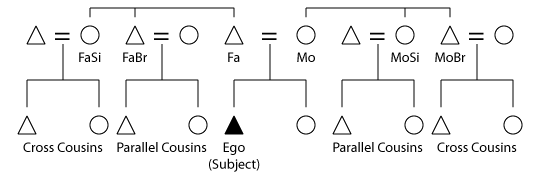
The role of cross-cousins is especially important in some cultures. For example, marriage is promoted between them in the Iroquois system. Parallel cousins are occasionally the subject of promoted marriage, such as the preferential marriage of a male to his father's brother's daughter, common among some pastoral peoples. Such a marriage helps keep property within a lineage. On the other hand, parallel cousin unions in some cultures would fall under an incesttaboo, since parallel cousins are part of the subject's unilineage whereas cross-cousins are not.
Kinship terminologies
In many "classificatory" systems of kinship terminology, relatives far beyond genealogical first cousins are referred to using the terms for parallel and cross-cousins. And in many societies, parallel cousins (but not cross-cousins) are also referred to by the same terms that are used for siblings. For instance, it is characteristic of the "Iroquois" system of kinship terminology, its variants the "Crow" and "Omaha", and most Australian Aboriginal systems, that a male parallel cousin is referred to as "brother", and a female parallel cousin is "sister". In an Iroquois type of terminology, if the terms used to refer to cross-cousins are assimilated to those for other relatives, it is generally in-laws (since marriage with cross-cousins is often preferentially favored), so that the terms for "male cross-cousin" and "brother-in-law" are the same, as are the terms for "female cross-cousin" and "sister-in-law".
أما الأنواع المتبقية من مصطلحات القرابة ( الهاوائية والإسكيمو والسودانية ) فلا تجمع أبناء العمومة المتوازيين معًا في مقابل أبناء العمومة غير المتوازيين.
المحرمات
يشير جون ماينارد سميث ، في كتابه "تطور الجنس" (1978)، [ 1 ] إلى أن ريتشارد د. ألكسندر قد اقترح أن عدم اليقين بشأن الأبوة قد يفسر تحريم الزواج بين أبناء العمومة من الدرجة الأولى، وليس أبناء العمومة من الدرجة الثانية. فالآباء الذين هم إخوة قد يمارسون الجنس، علنًا أو سرًا، مع زوجة أحدهما، مما يثير احتمال أن يكون أبناء العمومة الظاهرين من الدرجة الأولى في الواقع إخوة غير أشقاء من نفس الأب. وبالمثل، قد تمارس الأمهات اللواتي هن أخوات الجنس، علنًا أو سرًا، مع زوج إحداهن، مما يثير احتمال أن يكون أبناء العمومة الظاهرين من الدرجة الأولى في الواقع إخوة غير أشقاء من نفس الأب. تجدر الإشارة إلى أنه لا يوجد احتمال لأن يشترك أي من أبناء العمومة المصنفين في نفس الأم. ولأن هوية الأم لا تكون موضع شك (تقريبًا)، فسيتم تصنيفهم تلقائيًا على أنهم إخوة. ولا يؤدي إلى مثل هذه الأخطاء إلا خطأ في تحديد الأبوة.
هذا الاحتمال أقل ترجيحًا بكثير بالنسبة لأبناء العمومة من جهة الأب، لأنه في غياب زواج الأخوة ، من غير المرجح أن يشترك أبناء العمومة من جهة الأب في أب واحد من خلال علاقات جنسية ظاهرة أو خفية. ولا يكون ذلك ممكنًا إلا إذا كان لأم الشخص أخٌ حملت زوجته من والد الشخص، مما يسمح لأبناء العمومة الظاهرين بأن يكونوا إخوة غير أشقاء في الخفاء، يشتركون في الأب نفسه.
زواج الأقارب المتوازي في الشرق الأوسط
زعم أندريه كوروتيف أن أسلمة المجتمع كانت مؤشراً قوياً وهاماً على زواج الأقارب من أبناء العم (ابنة عم الأب). وقد بيّن أنه على الرغم من وجود صلة وظيفية واضحة بين الإسلام وزواج الأقارب من أبناء العم، إلا أن اشتراط الزواج من ابنة عم الأب لا يبدو كافياً لإقناع الناس بهذا الزواج، حتى وإن كان يحمل معه مزايا اقتصادية. ووفقاً لكوروتيف، فقد حدث قبول منهجي لزواج الأقارب من أبناء العم عندما تزامنت أسلمة المجتمع مع تعريبه . [ 2 ]
انظر أيضاً
ملحوظات
- ↑ ماينارد سميث، ج. (1978) تطور الجنس . مطبعة جامعة كامبريدج. ص 142. ISBN 0-521-29302-2.
- ↑ كوروتيف، أ.ف. ، " زواج أبناء العمومة المتوازيين (FBD)، والأسلمة، والتعريب "، علم الأعراق 39/4 (2000): 395-407.
روابط خارجية
- أنظمة تسمية الأقارب الجزء الأول والجزء الثاني في كلية بالومار .
- القرابة الأمومية والأبوية في جامعة مانيتوبا .
- صلة القرابة