
Michael Damaskinos
Michael Damaskenos or Michail Damaskenos (also Damaskinos) (Greek: Μιχαήλ Δαμασκηνός, 1530/35–1592/93) was a leading post-Byzantine Cretanpainter. He is a major representative of the Cretan School of painting that flourished in the 16th and 17th centuries. Painters Georgios Klontzas and Damaskenos were major contributors to the Cretan School during the same period. Damaskinos traveled all over the Venetian Empire painting. He remained loyal to his Greek roots stylistically but incorporated some Italian elements in his work. He was strongly influenced by the Venetian school. He painted parts of the Cathedral of San Giorgio dei Greci. Damaskenos has 100 known works. He influenced the works of Theodore Poulakis.[1][2][3]
Life and work

Damaskinos was born in Candia (Herakleion), his father was George Damaskinos. According to legend, Damaskinos spent some time living and working in Vrontisi Monastery, where six of his icons were kept until 1800. Damaskinos moved to Venice in the 1560s; while he was there he learned miniature painting.[4]
He traveled extensively throughout Italy.[5] From contracts we know he briefly stayed in Sicily from 1569 to 1571. Afterward, he traveled back to Venice. He was a member of the Greek Brotherhood of Venice from 1577 to 1582. He painted icons for the Greek Orthodox Cathedral of San Giorgio dei Greci in Venice. He tried to become a member of the council of the confraternity, but was unsuccessful. During the same period, he worked for both Catholic institutions and executed private commissions.[6]
He became friends with sculptor Alessandro Vittoria, and sold a collection of drawings to him which he amassed from other Italian artists (namely the Mannerist Parmigianino). He was also familiar with Palma Giovane and may have had some contact with the workshop of Tintoretto. Some of his works are clearly influenced by Paolo Veronese, Tintoretto, and Titian, which was not unusual: many Greek painters were influenced by the Venetian school. He returned to Candia around 1583.[7]
His only daughter Antonia married painter Ioannis Mavrikas-Mandouphos (or Yannas Mantoufos). Damaskinos stayed in Greece and worked mainly in Crete and the Ionian Islands. He was invited to return to Venice by the Greek Orthodox Confraternity, who wanted to commission him to paint the dome of San Giorgio dei Greci. He declined the invitations for personal reasons.[8] Extensive work was later completed at the church San Giorgio dei Greci by another famous painter, Emmanuel Tzane-Bounialis, who was himself influenced by Damaskinos.[9]
Damaskinos's works were characteristic of the traditional Byzantine style. His own paintings are characterized by the use of a particular rose color; further, his figures' dimensions were defined by only a few brush strokes.[10] He drew on wood, but never the marble thrones which were typical in the Cretan School.[11] Damaskinos was also the first artist to introduce paler flesh tones to post-Byzantine painting, one of the stylistic features of his work which proved highly influential from the second half of the sixteenth century and onwards.[12]
Damaskinos signed his works: ΧΕΙΡ ΜΙΧΑΗΛ ΤΟΥ ΔΑΜΑΣΚΗΝΟΥ or ΧΕΙΡ ΜΙΧΑΗΛ ΔΑΜΑΣΚΗΝΟΥ, ΔΑΜΑΣΚΗΝΟΥ ΜΙΧΑΗΛ ΧΕΙΡ or even ΠΟΙΗΜΑ ΜΙΧΑΗΛ ΤΟΥ ΔΑΜΑΣΚΗΝΟΥ (creation of Michael Damaskinos).[13] Damaskinos worked extensively on the Ionian Islands. He contributed to the fusion of the Cretan and the Heptanese School of painting. He influenced the works of Theodore Poulakis. The famous Greek Painter and theorist Panagiotis Doxaras, in his book The Art of Painting (published in 1720), considered Damaskinos to be one of the most important painters.[14]
San Giorgio dei Greci

توجد خمس وعشرون لوحة من أهم لوحاته في البندقية. أنجز داماسكينوس أعمالاً لكنيسة سان جورجيو دي غريتشي بين عامي 1560 و1583. عشرون من أعماله جزء من كنيسة سان جورجيو دي غريتشي، وثماني عشرة لوحة منها جزء من حامل الأيقونات. يظهر رئيس الملائكة ميخائيل في إحدى الأيقونات. كما تظهر الأعياد الكبرى، المعروفة أيضاً باسم "دوديكاورتو" في الكنيسة الأرثوذكسية الشرقية، في تسع من لوحاته. توجد لوحتان له خلف حامل الأيقونات داخل الحرم المقدس. يضم المعهد الهيليني في البندقية أربعاً من لوحاته، ويرتبط هذا المرفق البحثي والمتحف بكنيسة سان جورجيو دي غريتشي . إحدى لوحاته، " عرس قانا" ، جزء من مجموعة متحف كورير في البندقية. [ 15 ]
معرض
تقليدي
 أربعة قديسين عسكريين
 يوحنا ملاك الصحراء
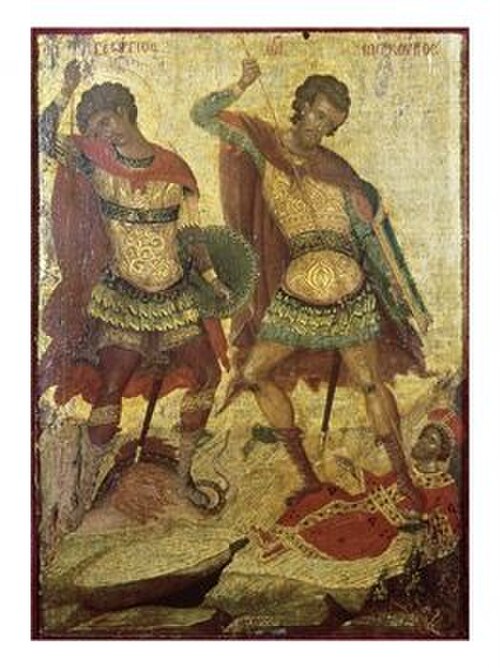 القديس جورج والقديس ديمتريوس
 القديس أثناسيوس
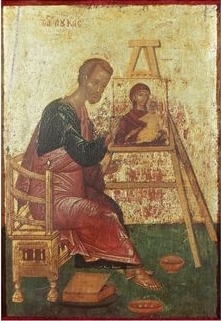 القديس لوقا والعذراء مريم
 القداس الإلهي
 مجمع نيقية الأول
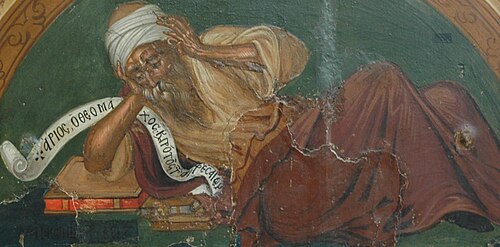 آريوس - تفصيل من أيقونة بيزنطية تصور مجمع نيقية الأول
مدرسة البندقية الكريتية
 عرس قانا
 قطع رأس القديس يوحنا المعمدان
 العشاء الأخير
 القديسون سرجيوس وباخوس وجوستينا
أعمال بارزة
انظر أيضاً
مراجع
- ↑ باتريك كومرفورد (27 يونيو 2009). "مدرسة كريت للأيقونات ومساهمتها في الفن الغربي" . مجلة إلكترونية حول الأنجليكانية واللاهوت والروحانية . تاريخ الاطلاع: 25 مايو 2021 .
- ↑ سبيك، غراهام (2021).مايكل داماسكينوس، موسوعة اليونان والتقاليد الهيلينية . لندن ونيويورك: مجموعة روتليدج تايلور وفرانسيس. ص 443-444.
- ↑ يوجينيا دراكوبولو (18 يونيو 2021). "داماسكينوس ميخائيل" . معهد البحوث اليونانية الحديثة . تم الاطلاع عليه في 18 يونيو 2021 .
- ↑ سبيك، 2021 ، ص 443-444
- ↑ رسم الأيقونات اليونانية (1927) ج. ستيوارت هاي، ليونارد باور، مجلة برلنغتون للخبراء، 51، (292)؛ الصفحات: 8-9 و12-14
- ↑ سبيك، 2021 ، ص 443-444
- ↑ سبيك، 2021 ، ص 443
- ↑ سبيك، 2021 ، ص 443-444
- ↑ سبيك، 2021 ، ص 443-444
- ↑ سبيك، 2021 ، ص 443-444
- ^ 2000_ΑΥΓΟΥΣΤΟΣ-ΜΙΧΑΗΛ ΔΑΜΑΣΚΗΝΟΣ أرشفة 2007-09-28 في آلة Wayback.
- ↑ أيقونة القديس يوحنا المعمدان المجنحة في المتحف البريطاني (2003) أنجليكي ليمبيروبولو أبولو
- ↑"Cretan portable icons". Archived from the original on 2007-09-28. Retrieved 2007-07-31.
- ↑Speake, 2021, p. 443-444
- ↑Drakopoulou 2010, p. 238.
Bibliography
- Drakopoulou, Evgenia (2010). Έλληνες Ζωγράφοι μετά την Άλωση (1450–1830). Τόμος 3: Αβέρκιος - Ιωσήφ[Greek Painters after the Fall of Constantinople (1450–1830). Volume 3: Averkios - Joseph]. Athens, Greece: Center for Modern Greek Studies, National Research Foundation. ISBN 978-960-7916-94-5.
- Tselenti-Papadopoulou, Niki G. (2002). Οι Εικονες της Ελληνικης Αδελφοτητας της Βενετιας απο το 16ο εως το Πρωτο Μισο του 20ου Αιωνα: Αρχειακη Τεκμηριωση[The Icons of the Greek Brotherhood of Venice from 1600 to First Half of the 20th Century]. Athens: Ministry of Culture Publication of the Archaeological Bulletin No. 81. ISBN 960-214-221-9.
External links
- Biography of Works in Greek
- Michael Damaskinos a Contribution to the Study of his Painting (Dissertation) in Greek
- Cretan Icon Painting up to the Fall of Candia
- The work of Michael Damaskinos by S. Peponakis-in Greek
- Collection of Agia Aikaterini of Sinai
- Byzantium: faith and power (1261-1557), an exhibition catalog from The Metropolitan Museum of Art (fully available online as PDF), which contains material on Damaskinos (see index)
- 1530s births
- 1590s deaths
- Artists from Heraklion
- Cretan Renaissance painters
- 16th-century Greek painters
- Greek icon painters
- Michael Damaskinos