
Algebraic element
In mathematics, if A is an associative algebra over K, then an element a of A is an algebraic element over K, or just algebraic overK, if there exists some non-zero polynomial with coefficients in K such that g(a) = 0.[1] Elements of A that are not algebraic over K are transcendental overK. A special case of an associative algebra over is an extension field of . If all elements of are algebraic over , then is called an algebraic extension.
![{\displaystyle g(x)\in K[x]}](https://wikimedia.org/api/rest_v1/media/math/render/svg/05c5e57806f21a7f66ee6161ed5a3be4cad749a5)


These notions generalize the algebraic numbers and the transcendental numbers (where the field extension is C/Q, with C being the field of complex numbers and Q being the field of rational numbers).
Examples
- The square root of 2 is algebraic over Q, since it is the root of the polynomial g(x) = x2 − 2 whose coefficients are rational.
- Pi is transcendental over Q but algebraic over the field of real numbersR: it is the root of g(x) = x − π, whose coefficients (1 and −π) are both real, but not of any polynomial with only rational coefficients. (The definition of the term transcendental number uses C/Q, not C/R.)
- An indeterminatex in a field K(x) of rational functions or K((x)) of formal Laurent series is defined to be transcendental over K.
- Algebraic functions are the algebraic elements over a field of rational functions K(x1, ..., xm).
Properties
The following conditions are equivalent for an element of an extension field of :

- is algebraic over ,
- the field extension هو جبري، أي كل عنصر منهو جبري على(هنايشير إلى أصغر حقل فرعي منيحتوي علىو)
- توسيع الحقلله درجة محدودة، أي بُعدكـ- الفضاء المتجهي محدود،
- ، أينهي مجموعة جميع عناصريمكن كتابة ذلك بالشكل التاليباستخدام متعدد الحدودالتي تقع معاملاتها في.


![{\displaystyle K[a]=K(a)}](https://wikimedia.org/api/rest_v1/media/math/render/svg/78c72d8375e2bcd607fcc749228a76d51ef46cb6)
![{\displaystyle K[a]}](https://wikimedia.org/api/rest_v1/media/math/render/svg/6518b3c3d07b52fb4cb2ce1cf8474fc22db0be73)


ولتوضيح ذلك بشكل أكبر، انظر إلى تقييم كثير الحدودهذا تماثل ، ونواته هي. لوإذا كان هذا المثالي جبريًا، فإنه يحتوي على كثيرات حدود غير صفرية، ولكن بما أنهو مجال إقليدي ، ويحتوي على متعدد حدود فريدبدرجة دنيا ومعامل رئيسي، والذي بدوره يُولّد المثالي ويجب أن يكون غير قابل للاختزال . متعددة الحدوديُطلق عليه اسم متعددة الحدود الدنيا لـوهي تتضمن العديد من الخصائص المهمة لـومن ثمّ تماثل الحلقةإن النتيجة التي تم الحصول عليها من خلال نظرية التشاكل هي تماثل بين الحقول، حيث يمكننا حينها ملاحظة أن. خلاف ذلك،هي دالة أحادية، وبالتالي نحصل على تماثل حقلي، أينهو مجال كسورأي حقل الدوال الكسرية على، وذلك بفضل الخاصية العامة لحقل الكسور. يمكننا أن نستنتج أنه في أي حال، نجد تماثلاً.أويؤدي التحقيق في هذا البناء إلى النتائج المرجوة.
![{\displaystyle \varepsilon _{a}:K[X]\rightarrow K(a),\,P\mapsto P(a)}](https://wikimedia.org/api/rest_v1/media/math/render/svg/e0438385c45747829ddc1c2fc60ae9f68bbbe1f2)
![{\displaystyle \{P\in K[X]\mid P(a)=0\}}](https://wikimedia.org/api/rest_v1/media/math/render/svg/54e7f27e904ec8de5d0cfbcdd7ac935c58fa7f51)
![{\displaystyle K[X]}](https://wikimedia.org/api/rest_v1/media/math/render/svg/5bb4d802ca5718a14dc961af8692f35cdfad169b)


![{\displaystyle K[X]/(p)\rightarrow \mathrm {im} (\varepsilon _{a})}](https://wikimedia.org/api/rest_v1/media/math/render/svg/6624069bba7d1ae9831bd3ca5e942fb29f3a87c3)




![{\displaystyle K(a)\cong K[X]/(p)}](https://wikimedia.org/api/rest_v1/media/math/render/svg/8f9296fb9a5b86dca618bb66327872730904f117)
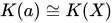
يمكن استخدام هذا التوصيف لإظهار أن مجموع وفرق وضرب وقسمة العناصر الجبرية علىوهي جبرية مرة أخرى على. لأنه إذاوكلاهما جبري، إذنهي محدودة. لأنها تحتوي على التوليفات المذكورة سابقًا منو، مجاورًا أحدها لـكما ينتج عنه امتداد محدود، وبالتالي فإن هذه العناصر جبرية أيضًا. وهكذا، فإن مجموعة جميع عناصرالتي هي جبرية علىهو مجال يقع بينو.


تُسمى الحقول التي لا تسمح بوجود أي عناصر جبرية عليها (باستثناء عناصرها الخاصة) بالحقول المغلقة جبريًا . حقل الأعداد المركبة مثال على ذلك.إذا كانت المجموعة مغلقة جبريًا، فإن حقل العناصر الجبرية لـزيادةهي مجموعة مغلقة جبريًا، ويمكن إثبات ذلك مباشرةً باستخدام خصائص الامتدادات الجبرية البسيطة المذكورة أعلاه. ومن الأمثلة على ذلك حقل الأعداد الجبرية .
انظر أيضاً
مراجع
للمزيد من القراءة
- لانغ، سيرج (2002)، الجبر ، نصوص الدراسات العليا في الرياضيات ، المجلد 211 (الطبعة الثالثة المنقحة )، نيويورك: سبرينغر-فيرلاغ، ISBN 978-0-387-95385-4، MR 1878556 ، Zbl 0984.00001
- الخصائص الجبرية للعناصر
- نظرية المجال